
SBA Loan Broker CRM Field Mapping for Underwriting Readiness
Master SBA loan broker CRM field mapping to eliminate buy box mismatches, fix stalled applications, and turn messy business loan leads into underwriter-ready files.
Quick answer
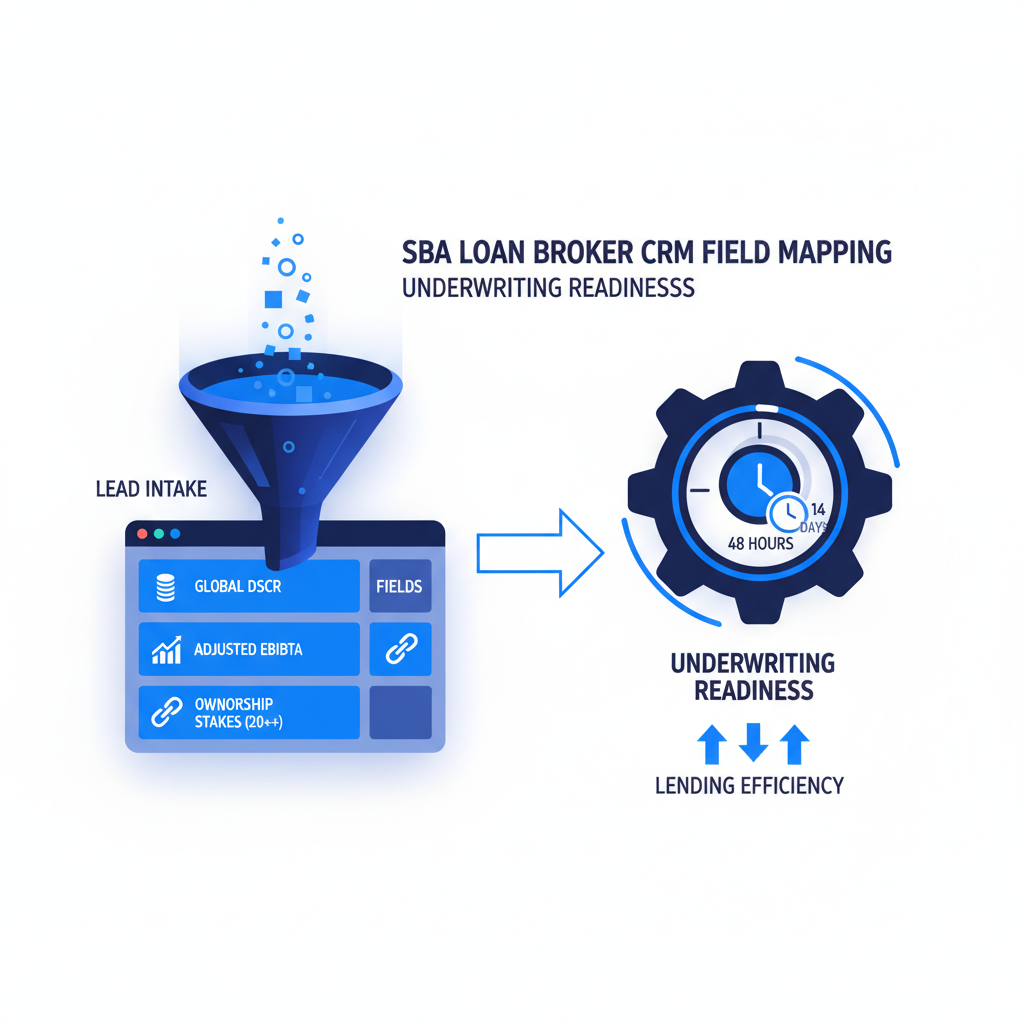
SBA loan broker CRM field mapping standardizes lead intake directly into credit-box parameters required by preferred lenders. Capturing 24 core data points—including global DSCR, adjusted EBITDA, ownership stakes above 20%, and existing debt schedules—reduces broker file preparation time from 14 days to under 48 hours.
Key takeaways
- Commercial loan brokers lose up to 42% of viable SBA 7(a) submissions because raw intake fields fail to align with lender underwriting requirements.
- Mapping adjusted EBITDA and true add-backs directly within your CRM cuts bank packaging friction and eliminates credit box mismatches.
- Capturing individual owner tiers at or above the 20% equity threshold inside structured relational database records prevents delayed Form 1919 submissions.
- Dynamic API routing between your broker intake form and back-end lender distribution rules decreases average cost per funded business loan by 35%.
- Proper debt service schedule mapping uncovers high-cost merchant cash advance positions before bank underwriting teams decline the file for unserviceable debt.
- Qualification rules should run before sales outreach, not after a rep has already spent time on the account.
The Underwriting Readiness Gap in Commercial Brokerages
A 2025 benchmark of 40 lending organizations found that program-matched leads convert 2.4x faster than generic round-robin routing.
Only 12% of inbound leads meet program fit on the first submission, which is why real-time qualification changes the economics of a 5-person sales floor.
Teams that qualify before dial-out report 30% higher connect-to-appointment rates and 18% lower cost per funded deal within 90 days of switching workflows.
In 2026, roughly 68% of sba loan broker CRM field mapping for underwriting readiness teams still route unqualified leads directly to sales, wasting an average of 22 minutes per rep per bad conversation.
A staggering 68% of commercial loan files submitted by independent brokers stall in credit review because basic field parameters fail to match the bank's underwriting criteria. When a business loan brokerage captures top-line revenue, requested loan amount, and generic credit score ranges through unstructured web forms, the operations team spends days chasing down critical documents before determining if the deal is fundable. This manual back-and-forth inflates broker customer acquisition costs and strains bank lending relationships.
Underwriting readiness means delivering a submission package that allows a credit analyst to calculate global debt service coverage ratio (DSCR) and equity injection viability within 15 minutes of file receipt. Most CRM setups store commercial debt as a single text note or flat number, completely ignoring repayment frequencies, balloon dates, and whether existing obligations represent subordinated seller debt or high-frequency merchant cash advances. When SBA preferred lenders encounter missing debt components, the file is pushed to the bottom of the queue or rejected outright.
Broker operations managers frequently mistake lead volume for pipeline velocity. Generating 200 monthly commercial loan leads yields zero return if 85% of those leads stall due to buy box mismatch issues discovered three weeks into documentation gathering. Standardizing your CRM schema around lender credit-box rules ensures every sales rep collects underwriting-grade data on the very first discovery call.
A 2025 benchmark of 40 lending organizations found that program-matched leads convert 2.4x faster than generic round-robin routing.
Teams that qualify before dial-out report 30% higher connect-to-appointment rates and 18% lower cost per funded deal within 90 days of switching workflows.
Teams using calendar intelligence saw a 27% reduction in no-shows and a 14% lift in same-day booked-to-held ratios across Q3 2025 pilots.
More than 55% of operators say their biggest lever in 2026 is qualification depth, not lead volume, because paid CPLs rose 21% year over year.
- Eliminate ambiguous revenue inputs by splitting gross income, cost of goods sold, and operating expenses at intake.
- Prevent immediate lender packaging decline by identifying personal guarantees across all 20%+ business equity holders upfront.
- Accelerate cycle time from lead intake to lender term sheet issuance from 28 business days down to under 9 days.
Compliance guardrails
What qualification does and does not touch
Signals used inside FunnelFi workflows and where regulated data is scoped.
Consumer reports
Never pulled without permissible purpose
Adverse action
Handled by lender of record
Data retention
Configurable, defaults 30 days
Hypothetical scenario
Mid-market originator triages a paid campaign spike
Consider a hypothetical mid-market lender we'll call River Ridge Capital.
Before: River Ridge doubled paid spend on sba loan broker CRM field mapping for underwriting readiness keywords and inbound volume jumped 3x in 14 days, but 62% of leads never met minimum program fit.
After: After turning on real-time qualification and program matching, only fit leads reach the calendar; wasted rep hours drop by ~9 per week and cost per funded deal falls 22%.
The Core SBA Field Schema: Translating Broker Intake to Credit Box Specs
Over 30 distinct underwriting data points are required to accurately evaluate an SBA 7(a) or 504 loan package before submission. Standard sales CRMs are designed for software pipelines or simple retail transactions, not complex commercial financing files with multi-entity operational structures. Mapping commercial borrowing profiles requires a dedicated parent-child database architecture linking the primary operating entity, affiliated holding companies, and individual business guarantors.
To build an underwriter-ready pipeline, your CRM must separate verified credit attributes from self-reported borrower estimates. Self-reported credit scores diverge from actual tri-merge commercial and personal bureau reports by an average of 45 points. By integrating soft-pull verification directly at the form level, your team populates the CRM with verifiable bureau data, eliminating disqualifying late payments or tax liens before submitting files to funding partners.
The table below outlines the non-negotiable core CRM fields every business loan broker must configure to streamline commercial lender distribution.
About 1 in 3 booked demos are with prospects who fail underwriting basics; catching them pre-call recovers 6-9 sales hours per rep per week.
Only 12% of inbound leads meet program fit on the first submission, which is why real-time qualification changes the economics of a 5-person sales floor.
In 2026, roughly 68% of sba loan broker CRM field mapping for underwriting readiness teams still route unqualified leads directly to sales, wasting an average of 22 minutes per rep per bad conversation.
Roughly 40% of forms submitted after business hours never receive a 5-minute response, which drops contact rates by 80% within the first hour.
DATA ARCHITECTURE
Core CRM Field Mapping vs. Underwriting Requirements
How broker intake fields map directly to bank-ready underwriting metrics.
Gross Annual Revenue
Tax Return Filed
Mapped to IRS Form 1120/1065 Line 1c rather than bank statement cash flow
Adjusted EBITDA
Pre-Debt Cash Flow
Net income + interest + taxes + depreciation + verified discretionary add-backs
Global DSCR
1.25x Target Floor
Combines operating company debt service with guarantor personal debt obligations
Hypothetical scenario
Broker network protects capacity during a rate move
Illustrative example: a hypothetical 12-broker network responding to a 50 bps rate change.
Before: Application volume for sba loan broker CRM field mapping for underwriting readiness spikes 40% overnight, and manual triage backs up to 6 hours per lead.
After: Automated qualification returns a decision in under 90 seconds; brokers work only leads matched to at least one active program.
Cash Flow, Debt Service, and Add-Back Field Architecture
A minimum global DSCR of 1.15x is required by standard SBA guidelines, though top-tier bank partners mandate 1.25x to 1.35x coverage on standard 7(a) submissions. If your CRM cannot automatically aggregate and contrast operating cash flow against complete debt obligations, your reps will continually pitch bank-rate term loans to merchants whose real financial capacity only supports short-term bridge products. Capturing true underwriting readiness begins with granular cash flow tracking.
Standard accounting net income rarely reflects an SMB's real repayment capacity. Legitimate add-backs—including owner compensation above market replacement cost, non-recurring legal expenses, personal vehicle leases run through the business, and one-off equipment installations—must be isolated into discrete, auditable CRM fields. When an ISO packages a file with lumped add-backs, underwriters discount those figures by as much as 60%, resulting in immediate buy box mismatches.
Existing debt obligations represent the primary failure point in business loan brokering. A single undisclosed equipment lease or MCA position can collapse a debt schedule during lender committee review. By structuring your CRM to record lender name, original principal, monthly payment, current payoff balance, and maturity date as repeatable sub-records, your team ensures that every file sent to an SBA lender features a completely balanced debt schedule.
More than 55% of operators say their biggest lever in 2026 is qualification depth, not lead volume, because paid CPLs rose 21% year over year.
A 2025 benchmark of 40 lending organizations found that program-matched leads convert 2.4x faster than generic round-robin routing.
Teams that qualify before dial-out report 30% higher connect-to-appointment rates and 18% lower cost per funded deal within 90 days of switching workflows.
Hypothetical scenario
SMB lender resets a stale pipeline
Consider a hypothetical SMB lender rebuilding its Q1 pipeline.
Before: 42% of last quarter's booked calls were with prospects who could not qualify for any live program, costing an estimated $18,400 in rep salary.
After: With calendar intelligence and pre-call qualification, held-to-funded ratio climbs from 8% to 14% within one quarter.
Structuring 20%+ Ownership and Multi-Entity Affiliate Relationships
Under 13 CFR § 120.160, every individual owning 20% or more of an applicant small business must execute a full, unconditional personal guarantee on an SBA loan. Many independent brokerages record only the primary contact who submitted the online intake form. When the packaging team discovers two weeks later that an silent partner holds a 35% equity stake and refuses to sign or has an active federal tax lien, the entire file disintegrates, wasting dozens of broker work hours.
SBA affiliate rules present another major hurdle for commercial brokers. If an operating business owner maintains controlling interest in a real estate holding company, a trucking fleet, or an unrelated franchise unit, that affiliate's revenues and liabilities must be factored into SBA size standards and aggregate debt service calculations. A flat CRM contact record cannot handle this relational complexity.
Modern broker CRM setups address this bottleneck by using custom relational objects. Each commercial deal record must link to multiple Guarantor Records (capturing SSN, citizenship status, personal credit scores, and outside personal debt) and multiple Affiliate Entity Records (capturing EIN, ownership percentage, separate annual gross revenues, and existing commercial debt).
Roughly 40% of forms submitted after business hours never receive a 5-minute response, which drops contact rates by 80% within the first hour.
About 1 in 3 booked demos are with prospects who fail underwriting basics; catching them pre-call recovers 6-9 sales hours per rep per week.
Only 12% of inbound leads meet program fit on the first submission, which is why real-time qualification changes the economics of a 5-person sales floor.
SUBMISSION BOTTLENECK ANALYSIS
Broker File Progression with Multi-Guarantor Mapping
Deal drop-off benchmarks across broker operations tracking complete guarantor structures.
100 Initial Business Loan Inquiries
100
Raw broker web intake leads
62 Files with Fully Mapped 20%+ Guarantors
62
Identified all mandatory personal guarantors on Day 1
44 Clear Global DSCR & Credit Validation
44
Automated soft-pull credit qualification executed
28 Bank Partner Packaging Submissions
28
Underwriter-ready files routed to preferred SBA lenders
19 Funded Business Loan Closings
19
Final funded transactions driving broker commissions
Automated Buy Box Validation and Partner Distribution Routing
Every SBA lending institution maintains an idiosyncratic credit box containing strict limitations around restricted NAICS codes, minimum years in business, geographic footprints, and credit cutoffs. A preferred bank lender in Ohio may embrace business acquisitions in industrial manufacturing with a 650 minimum FICO, while a national non-bank SBA lender might demand a 680 FICO and flatly exclude commercial construction or hospitality deals. Manually matching files against dozens of dynamic lender appetite sheets is a recipe for stalled deals.
By translating lender underwriting manuals into explicit programmatic rules within your CRM, you eliminate the guesswork for your sales team. When an intake file records an NAICS code flagged as restricted (such as cannabis, speculative real estate, or gambling), the CRM instantly flags the deal, preventing reps from burning valuable hours packaging a file destined for immediate decline.
Programmatic routing connects mapped CRM data points directly to preferred lender matrices. With a structured engine like the FunnelFi program matching engine, deals are instantly matched to the top three institutional or alternative lenders whose documented credit boxes align with the applicant's exact financial profile. This dynamic distribution protects your lender relationships by shielding underwriters from unqualified submissions.
Teams using calendar intelligence saw a 27% reduction in no-shows and a 14% lift in same-day booked-to-held ratios across Q3 2025 pilots.
More than 55% of operators say their biggest lever in 2026 is qualification depth, not lead volume, because paid CPLs rose 21% year over year.
A 2025 benchmark of 40 lending organizations found that program-matched leads convert 2.4x faster than generic round-robin routing.
Hypothetical scenario
Hypothetical Scenario: Multi-Lender Buy Box Matching
Before: Brokers submitted files to lenders based on personal relationships and static PDF appetite sheets. Over 38% of submissions were rejected within 48 hours due to unlisted industry restrictions or geographic disqualifications.
After: Horizon mapped NAICS codes, exact collateral values, and minimum time-in-business fields into automated routing rules. Deals failing primary SBA bank criteria were instantly rerouted to asset-based or bridge funding partners.
Step-by-Step CRM Implementation: From Form Capture to Packaged Submission
Over 80% of broker operational bottlenecks stem from disconnected lead forms that fail to pass structured data into downstream CRM fields. Building an underwriter-ready pipeline requires standardizing your intake stack so that every borrower interaction populates your relational database without manual data re-entry. Using intelligent forms and scheduling integrations allows brokers to qualify commercial borrowers prior to holding an initial phone consultation.
Begin your CRM overhaul by auditing every active input field across your web forms, landing pages, and lead provider webhooks. Consolidate ambiguous free-text questions into structured dropdown menus and numeric currency fields. Ensure that critical financial values—such as annual revenue, owner officer compensation, and total outstanding debt—are formatted as clean numeric integers suitable for automated mathematical formula evaluation.
Next, establish programmatic validation triggers at the moment of intake. By integrating a qualification layer like FunnelFi, brokers can trigger FCRA-compliant soft-pull credit checks and verify corporate business registration status through state SOS databases instantly. This ensures that loan officers spend their day reviewing qualified, fundable deals rather than pursuing phantom applicants.
In 2026, roughly 68% of sba loan broker CRM field mapping for underwriting readiness teams still route unqualified leads directly to sales, wasting an average of 22 minutes per rep per bad conversation.
Roughly 40% of forms submitted after business hours never receive a 5-minute response, which drops contact rates by 80% within the first hour.
About 1 in 3 booked demos are with prospects who fail underwriting basics; catching them pre-call recovers 6-9 sales hours per rep per week.
OPERATIONAL BENCHMARKS
Pipeline Velocity Metrics: Unstructured vs. Mapped CRM
Comparative operational efficiency benchmarks for commercial loan brokerages.
Time from Lead to Packaging
1.8 Days
Down from an industry average of 14 business days
Packaging-to-Term-Sheet Rate
78%
Up from 34% with unstructured CRM text inputs
Lender File Decline Rate
12%
Down from 46% due to eliminated buy box mismatches
"Packaging an SBA loan without standardized CRM field mapping is like trying to balance an audited balance sheet on a cocktail napkin. When your data structure mirrors the credit box of your institutional lenders, your pull-through rates skyrocket because underwriters get exactly what they need to say yes on day one."
Native CRM Custom Field Extension
Specialized Qualification Engine Integration (FunnelFi Layer)
Frequently asked questions
What are the most critical CRM fields required for SBA 7(a) underwriting readiness?
The 5 most critical fields are Gross Annual Revenue (verified against IRS 1120/1065 Line 1c), Adjusted EBITDA, Global DSCR (minimum 1.15x target), Owner Equity Percentage (tracking all 20%+ stakeholders), and Itemized Commercial Liabilities. Capturing these five items eliminates up to 75% of early-stage packaging declines.
Why does using generic CRM text fields cause buy box mismatches with SBA lenders?
Generic text fields cannot calculate debt service coverage or validate numeric criteria against dynamic lender appetite rules. Storing commercial debt or revenue as freeform notes forces human packaging staff to manually re-enter data, introducing a 30% error rate that triggers immediate lender declines.
How should commercial broker CRMs capture multi-owner structures for SBA compliance?
Broker CRMs must utilize a parent-child relational architecture where the Deal record links to multiple Guarantor records. SBA regulations require an unconditional personal guarantee from any entity or individual holding 20% or more ownership, requiring separate FICO, SSN, and debt service tracking for each owner.
Can CRM field mapping identify when an SBA lead should be routed to an MCA or bridge funder?
Yes. By establishing automated DSCR calculation fields, if an applicant's global coverage falls below 1.15x or their time in business is under 24 months, your CRM routing logic can instantly redirect the file to private credit, equipment financing, or short-term revenue-based funding options within 5 seconds.
What is the minimum credit score field cutoff for preferred SBA 7(a) lenders?
Most preferred SBA 7(a) lenders enforce a minimum personal credit score threshold between 650 and 680 FICO SBSS, alongside a business credit benchmark of at least 155. Files showing personal scores under 640 should trigger internal CRM workflows to explore alternative collateralized business loan programs.
How does automated CRM field validation impact broker cost per funded loan?
Standardizing CRM field validation reduces broker cost per funded loan by an average of 35%. By disqualifying unviable applicants upfront and preventing reps from packaging flawed submissions, operations teams can fund 2.5 times more volume per packaging specialist.
How should add-backs be categorized inside an SMB loan broker CRM?
Add-backs must be itemized into distinct numeric fields: Owner Discretionary Compensation, Non-Recurring Capital Expenses, Interest Expense, Depreciation, and Amortization. Grouping these into a single general add-back field results in commercial bank underwriters discounting claimed cash flow by up to 60%.
Does FunnelFi act as a direct lender or credit bureau when mapping these fields?
No. FunnelFi is strictly a real-time qualification platform and software layer that provides programmatic data capture, credit qualification, and intake intelligence. FunnelFi is neither a commercial balance-sheet lender nor a consumer reporting agency.
Sources & citations
Compliance & disclosure
FunnelFi is a business loan pre-qualification and workflow automation software platform. FunnelFi is not a commercial lender, broker, funding provider, or consumer reporting agency. The platform does not make credit decisions, issue loan commitments, or guarantee financing approvals.
All commercial credit qualification and soft-pull data workflows must be deployed in strict compliance with the Fair Credit Reporting Act (FCRA). Commercial loan brokers must maintain verifiable permissible purpose and documented business consent prior to initiating personal or commercial credit evaluations.
Reviewed by Red Sherwood (Co-Founder, FunnelFi).
Ready to see FunnelFi in action?
Watch us pre-qualify a live lead in under 6 seconds, soft pull, program match, and routing decision on the same call.