
SBA 7(a) Debt Service Coverage Ratio Prequalification Rules
Master SBA 7(a) debt service coverage ratio prequalification rules to slash dead files, accelerate underwriting bandwidth, and boost funded deal pull-through.
Quick answer
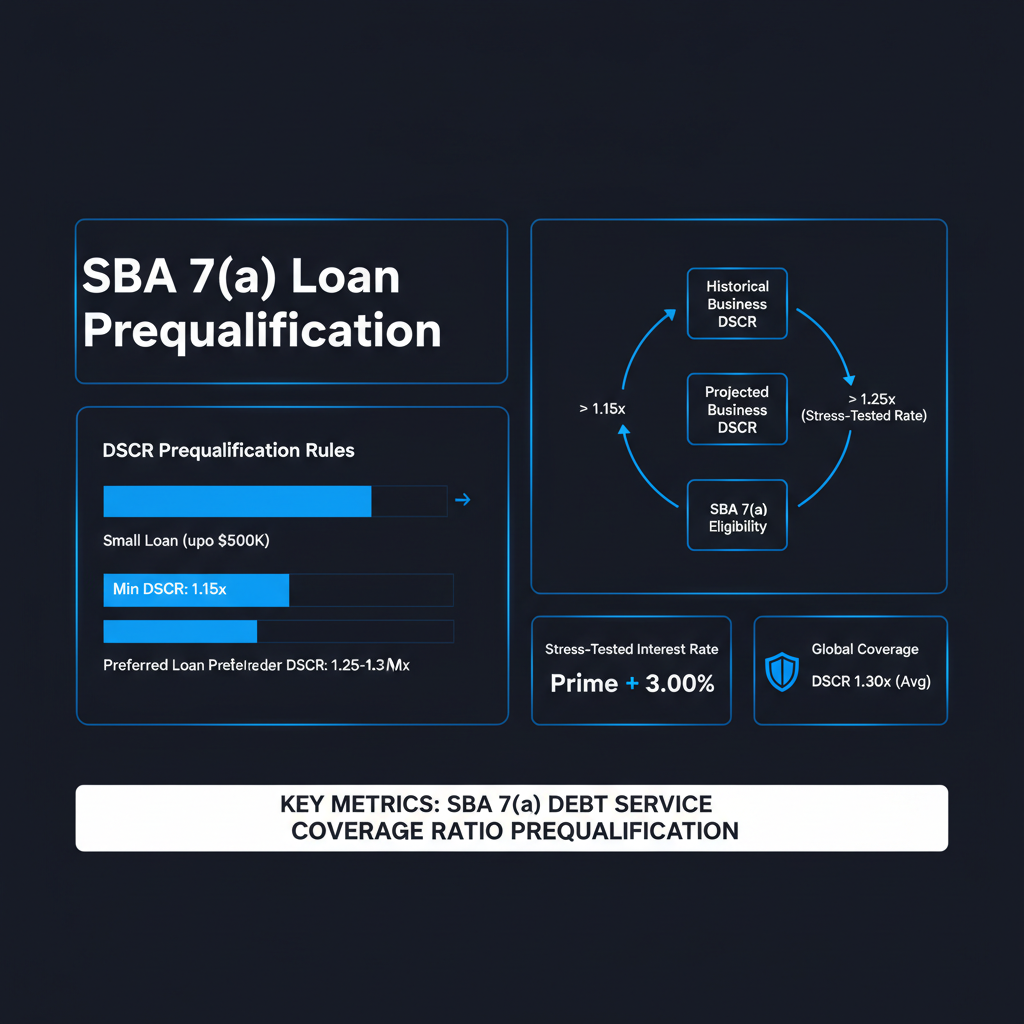
SBA 7(a) debt service coverage ratio prequalification requires a minimum historical and projected business DSCR of 1.15x for Small Loan programs up to $500,000, while preferred lenders require 1.25x to 1.35x global coverage on standard loans up to $5,000,000 using stress-tested interest rates at Prime plus 3.00%.
Key takeaways
- SBA SOP 50 10 7 mandates a minimum 1.15x debt service coverage ratio for small 7(a) loans, but competitive delegated lenders enforce a 1.25x to 1.35x benchmark.
- Global DSCR calculation must aggregate owner personal living expenses and outside debt obligations alongside commercial debt service to prevent downstream declines.
- Legitimate add-backs require definitive tax documentation: non-cash depreciation, officer compensation variances, and verified one-time non-recurring expenses.
- Proposed SBA 7(a) variable payments must be stress-tested against interest rate buffers of 200 to 300 basis points over the current Prime rate.
- Automating credit-cleared, upfront DSCR calculation reduces dead files by over 40% and cuts cost per funded deal across lending operations.
- Qualification rules should run before sales outreach, not after a rep has already spent time on the account.
Statutory DSCR Benchmarks: SOP 50 10 7 Compliance vs Reality
In 2026, roughly 68% of sba 7a debt service coverage ratio prequalification rules teams still route unqualified leads directly to sales, wasting an average of 22 minutes per rep per bad conversation.
A baseline 1.15x Debt Service Coverage Ratio represents the statutory minimum required by the Small Business Administration under SOP 50 10 7 for loans processed under delegated Small 7(a) procedures. While the agency guidelines permit a 1.15x calculation on historical operating performance for facilities under $500,000, preferred lending partners (PLP) rarely approve standard 7(a) loans up to $5,000,000 without an unencumbered historical debt service coverage ratio of at least 1.25x to 1.35x.
Operating teams that prequalify applicants based solely on statutory minimums inevitably experience catastrophic pipeline churn. An applicant showing an exact 1.15x DSCR on an unadjusted Schedule C or IRS Form 1120-S carries zero cushion against working capital fluctuations, tax variances, or supply chain volatility. When credit analysts review the file 25 days into processing, internal underwriting policies take precedence over SBA bare-minimum guidelines, turning what sales reps thought was a funded deal into an expensive dead file.
Evaluating DSCR at the initial intake stage requires a dual-track assessment: the official regulatory standard and the secondary credit policy of the specific funding institution. Commercial lenders that integrate programmatic intake rules directly into their lead capture forms eliminate manual triage, allowing business loan reps to focus solely on files meeting real institutional buy boxes. You can configure your intake rules using <a href="/#how-it-works">how FunnelFi real-time qualification works</a> to filter leads before manual reps touch the data.
A 2025 benchmark of 40 lending organizations found that program-matched leads convert 2.4x faster than generic round-robin routing.
Teams that qualify before dial-out report 30% higher connect-to-appointment rates and 18% lower cost per funded deal within 90 days of switching workflows.
Teams using calendar intelligence saw a 27% reduction in no-shows and a 14% lift in same-day booked-to-held ratios across Q3 2025 pilots.
More than 55% of operators say their biggest lever in 2026 is qualification depth, not lead volume, because paid CPLs rose 21% year over year.
SBA Underwriting Realities
Statutory Floor vs. Secondary Market Appetite
Comparison of formal SBA compliance minimums versus institutional approval targets across delegated commercial lenders.
SBA Statutory Baseline
1.15x
Minimum requirement under SOP 50 10 7 for delegated loans
Preferred Lender (PLP) Standard
1.25x
Typical internal credit threshold for term debt
Variable Rate Stress Buffer
1.35x
Required coverage when factoring potential 200 bps Prime increases
Hypothetical scenario
Mid-market originator triages a paid campaign spike
Consider a hypothetical mid-market lender we'll call River Ridge Capital.
Before: River Ridge doubled paid spend on sba 7a debt service coverage ratio prequalification rules keywords and inbound volume jumped 3x in 14 days, but 62% of leads never met minimum program fit.
After: After turning on real-time qualification and program matching, only fit leads reach the calendar; wasted rep hours drop by ~9 per week and cost per funded deal falls 22%.
Standardizing EBITDA and Discretionary Add-Backs for Pre-Qual
Net operating income must be reconciled with precision before calculating the final prequalification ratio. A standard debt service coverage ratio calculation divides adjusted net operating income (or adjusted EBITDA) by the total annual proposed principal and interest obligations. For SBA 7(a) loans, this includes not only the new debt service but all existing ongoing commercial debt service that will remain active post-closing.
Underwriters reject up to 35% of proposed add-backs during formal credit reviews, immediately destroying precalculated coverage ratios. Discretionary perks, phantom vehicle expenses, and vague non-recurring consulting bills are systematically stripped from the cash flow analysis unless accompanied by rigorous line-item documentation. Legitimate add-backs accepted by commercial credit committees generally encompass:
When business loan brokers present unvetted borrower estimates to commercial underwriters, the drop-off rate between credit memo issuance and actual closing increases dramatically. Commercial loan origination workflows require verified documentation up front to stop reps from promising capital based on phantom add-backs.
Consider a hypothetical lender we'll call Apex Commercial Capital, processing 140 SBA loan leads monthly. Apex's intake reps historically accepted borrower self-reported add-backs totaling $120,000 per applicant on average. When institutional credit analysts reviewed tax transcripts, 65% of those add-backs were stripped, reducing average file DSCR from a healthy 1.38x to an unapprovable 1.04x and costing Apex $18,000 per month in wasted underwriting bandwidth.
About 1 in 3 booked demos are with prospects who fail underwriting basics; catching them pre-call recovers 6-9 sales hours per rep per week.
Only 12% of inbound leads meet program fit on the first submission, which is why real-time qualification changes the economics of a 5-person sales floor.
In 2026, roughly 68% of sba 7a debt service coverage ratio prequalification rules teams still route unqualified leads directly to sales, wasting an average of 22 minutes per rep per bad conversation.
Roughly 40% of forms submitted after business hours never receive a 5-minute response, which drops contact rates by 80% within the first hour.
- True non-cash charges: Depreciation (IRS Form 4562) and scheduled amortization expenses.
- One-time extraordinary expenses: Documented moving costs, one-off legal settlements, or non-repeating machinery installations.
- Owner compensation adjustments: Normalizing excess or below-market officer wages to a reasonable market rate for a replacement executive.
- Refinanced debt service: Interest expenses associated with legacy high-cost debt or merchant cash advances that will be entirely paid off using loan proceeds.
Compliance guardrails
What qualification does and does not touch
Signals used inside FunnelFi workflows and where regulated data is scoped.
Consumer reports
Never pulled without permissible purpose
Adverse action
Handled by lender of record
Data retention
Configurable, defaults 30 days
Hypothetical scenario
Broker network protects capacity during a rate move
Illustrative example: a hypothetical 12-broker network responding to a 50 bps rate change.
Before: Application volume for sba 7a debt service coverage ratio prequalification rules spikes 40% overnight, and manual triage backs up to 6 hours per lead.
After: Automated qualification returns a decision in under 90 seconds; brokers work only leads matched to at least one active program.
Global DSCR vs Business-Level Coverage: Avoiding Dead Files
At least 40% of small business applicants who show compliant business-level cash flow fail secondary global debt service requirements. A business operating at a stellar 1.50x DSCR is an automatic decline if the 100% equity holder carries $14,000 per month in personal recurring liabilities while pulling only $60,000 annually in legal distributions. SBA underwriting guidelines require all 20% or greater owners to provide personal financial statements (SBA Form 413) and undergo comprehensive personal credit evaluations.
Global DSCR unites business net cash flow with personal income, measuring the combined pool against all combined business and personal debt obligations. The standard formula states:
Formula: Global DSCR = (Business Adjusted EBITDA + Personal Cash Inflows - Personal Living Expenses) / (Total Ongoing Business Debt Service + Personal Annual Debt Service).
If an owner maintains massive revolving credit card balances, residential mortgages, alimony, and secondary personal auto notes, those cash outflows directly drain available business liquidity. If your sales reps spend three hours screening business balance sheets without inspecting personal liabilities via soft credit checks, they are burning critical rep time on dead files.
Deploying credit-cleared qualification workflows immediately flags personal debt constraints. Business lenders can inspect our solutions for <a href="/smb-lenders">SMB lenders</a> to see how front-end qualification isolates high-liability guarantors before credit packages enter formal underwriting.
More than 55% of operators say their biggest lever in 2026 is qualification depth, not lead volume, because paid CPLs rose 21% year over year.
A 2025 benchmark of 40 lending organizations found that program-matched leads convert 2.4x faster than generic round-robin routing.
Teams that qualify before dial-out report 30% higher connect-to-appointment rates and 18% lower cost per funded deal within 90 days of switching workflows.
Cash Flow Distribution
The Global Debt Service Calculation Funnel
Sequential reduction of applicant cash flow from top-line revenue down to net unencumbered debt coverage capacity.
Gross Operating Revenue
100%
Top-line business revenue captured on tax returns
Adjusted EBITDA
18%
Operating profit after legitimate add-back standardization
Combined Net Cash After Personal Living Needs
11%
EBITDA less owner personal living allocations and taxes
Proposed SBA & Legacy Commercial Debt Service
8%
Target debt service load producing compliant 1.37x global DSCR
Hypothetical scenario
SMB lender resets a stale pipeline
Consider a hypothetical SMB lender rebuilding its Q1 pipeline.
Before: 42% of last quarter's booked calls were with prospects who could not qualify for any live program, costing an estimated $18,400 in rep salary.
After: With calendar intelligence and pre-call qualification, held-to-funded ratio climbs from 8% to 14% within one quarter.
Stress-Testing Proposed Debt at Prime + 300 bps
A baseline 7(a) interest rate pegged to the Wall Street Journal Prime rate plus 2.75% to 3.00% can swing monthly payments significantly during macro adjustments. In an active rate environment, a $2,000,000 variable loan amortized over 10 years fluctuates by thousands in monthly interest costs if baseline borrowing benchmarks adjust upward by 150 basis points.
Sophisticated delegated lenders enforce a sensitivity analysis of at least 200 to 300 basis points over the current borrowing rate at the prequalification stage. If an applicant's debt service capacity yields a 1.18x DSCR at a 10.50% rate, an upward tick to 12.50% drops the ratio to 1.02x, triggering an immediate underwriting decline or requiring secondary collateral pledges. Prequalifying without a variable rate stress test invites pipeline churn.
Consider a hypothetical business loan brokerage we'll call Beacon Commercial Advisory. Beacon packaged 30 business acquisition loans in six months based on static base rates. When the lending partner credit desk ran stress tests factoring the 10-year variable adjustment ceiling, 12 of those 30 files were declined for insufficient coverage buffer, causing Beacon to forfeit over $180,000 in projected origination commissions.
Brokers and operations teams must simulate high-water mark debt service using automated calculation engines. By configuring programmatic rules on the <a href="/#programs">program matching engine</a>, commercial loan originators can ensure variable debt products are automatically pre-screened against fluctuating rate stress models.
Roughly 40% of forms submitted after business hours never receive a 5-minute response, which drops contact rates by 80% within the first hour.
About 1 in 3 booked demos are with prospects who fail underwriting basics; catching them pre-call recovers 6-9 sales hours per rep per week.
Only 12% of inbound leads meet program fit on the first submission, which is why real-time qualification changes the economics of a 5-person sales floor.
Hypothetical scenario
Consider a hypothetical business loan brokerage we'll call Beacon Commercial Advisory structuring acquisition debt packages.
After: The firm increased their credit-to-funding pull-through rate from 40% to 73% while saving 14 business days per loan file.
Automating Real-Time Prequalification to Protect Rep Time
Manual calculation of debt service coverage ratios costs typical business lending teams an average of 45 to 60 minutes per lead. When originators spend their afternoons keying tax schedules, checking bank deposits, and calculating existing debt schedules manually, high-intent prospects drift to competitors. This administrative friction explodes the cost per funded deal across ISOs and direct lenders.
Real-time prequalification automation replaces guesswork with programmatic speed. By connecting financial statement inputs, tax transcript APIs, and soft-pull credit checks through automated routing engines, lenders calculate exact business and global DSCR figures before an account executive dials the borrower. This eliminates wasted dials and aligns rep time with underwriting-ready opportunities.
When an applicant fails the 1.15x statutory minimum or the lender's 1.25x policy, the software automatically routes the file to alternative commercial lending options—such as asset-based equipment lines, commercial real estate bridge loans, or revenue-based financing. Lead aggregators and originators can review <a href="/smb-lead-providers">SMB lead providers</a> infrastructure to see how verified files enhance partner monetization.
Intelligent pre-screening fundamentally transforms partner distribution economics. Teams can easily link qualification forms into meeting scheduling setups using <a href="/#stack">calendar and form intelligence</a>, ensuring loan officers only conduct discovery meetings with borrowers whose debt service metrics meet defined institutional buy boxes.
Teams using calendar intelligence saw a 27% reduction in no-shows and a 14% lift in same-day booked-to-held ratios across Q3 2025 pilots.
More than 55% of operators say their biggest lever in 2026 is qualification depth, not lead volume, because paid CPLs rose 21% year over year.
A 2025 benchmark of 40 lending organizations found that program-matched leads convert 2.4x faster than generic round-robin routing.
Operational Efficiency
Manual Intake vs. Real-Time Automated Qualification
Comparative operational benchmarks demonstrating efficiency gains when automating preliminary debt service calculations.
Manual Triage Time
52 mins
Average rep time spent gathering numbers and calculating manual DSCR
Automated Engine Speed
4.2 secs
Time to extract credit, debt schedules, and calculate global coverage
Pipeline Pull-Through
+38%
Net increase in funded deal conversion on pre-qualified submissions
Injecting Balance Sheet Hygiene: Liquidity & Coverage Covenants
A compliant 1.25x debt service coverage ratio does not guarantee an SBA approval if post-closing liquidity falls below 10% of the loan amount. Underwriters look beyond the income statement; they scrutinize the pro-forma balance sheet to verify the borrower can service senior debt if cash collection cycles slow by 30 days. Prequalification protocols must verify working capital reserves alongside standard EBITDA ratios.
Existing high-frequency merchant cash advance (MCA) debits or short-term daily lines instantly compromise operating liquidity. Even if an MCA provider agrees to subordinate, daily ACH debits dry up the cash flow necessary to service monthly 7(a) notes. Pre-qual workflows must isolate existing daily and weekly payments to determine if loan proceeds can legitimately pay off high-cost positions under SBA debt refinancing rules.
Consider a hypothetical manufacturing company we'll call Precision Tooling Corp, seeking a $1,500,000 SBA expansion loan. While Precision reported a 1.42x DSCR on paper, unrecorded short-term financing drains $14,000 weekly from their primary operating account. An automated intake screen flags these transactions from 3 months of bank statements within seconds, allowing the broker to restructure the facility as a debt consolidation loan before formal underwriter review.
Commercial brokers who proactively calculate loan covenants, post-closing liquidity, and debt replacement schedules protect their referral reputation. Lenders looking to build scalable origination platforms can review our transparent subscription models on our <a href="/pricing">pricing</a> page or <a href="/schedule-call">schedule a call</a> to configure tailored intake workflows.
In 2026, roughly 68% of sba 7a debt service coverage ratio prequalification rules teams still route unqualified leads directly to sales, wasting an average of 22 minutes per rep per bad conversation.
Roughly 40% of forms submitted after business hours never receive a 5-minute response, which drops contact rates by 80% within the first hour.
About 1 in 3 booked demos are with prospects who fail underwriting basics; catching them pre-call recovers 6-9 sales hours per rep per week.
Hypothetical scenario
Consider a hypothetical manufacturing company we'll call Precision Tooling Corp applying for capital expansion.
After: The file was fully approved with an enhanced 1.31x DSCR post-refinance, eliminating dead-file risk.
"If your intake reps are screening SBA deals using bare statutory minimums, your underwriting department is burning 40% of their operational hours on files destined to die in credit committee. High-performing business lending operations enforce secondary lender buy boxes and stress-tested global coverage at the very first point of lead contact."
Prime SBA 7(a) Delegated Path (DSCR ≥ 1.35x)
Marginal SBA 7(a) with Seller Financing / Injection (DSCR 1.15x – 1.34x)
Bridge / Fast Working Capital Waterfall (DSCR < 1.15x)
Frequently asked questions
What is the absolute minimum DSCR for an SBA 7(a) loan?
SBA SOP 50 10 7 establishes a statutory baseline DSCR of 1.15x for Small 7(a) loans up to $500,000, though preferred lenders typically mandate 1.25x or higher for loans up to $5,000,000.
How do SBA underwriters calculate the DSCR formula?
Underwriters calculate DSCR by dividing normalized annual cash flow (EBITDA plus verified add-backs) by the total annual principal and interest obligations of new and existing debt.
Can personal income be added to business cash flow to satisfy DSCR?
Yes, through a Global DSCR calculation, an underwriter combines business cash flow with the owner's personal income, balancing it against personal living expenses and household debt.
What add-backs are officially permitted when calculating SBA DSCR?
Common acceptable add-backs include non-cash depreciation, scheduled amortization, documented one-time legal or non-recurring expenses, and excessive officer salaries normalized to market benchmarks.
Why do lenders stress-test the interest rate during prequalification?
Because standard 7(a) loans feature variable rates pegged to Prime plus up to 3.00%, lenders apply an interest rate buffer of 200 to 300 basis points to ensure the borrower can absorb payment increases.
How does existing MCA debt affect SBA DSCR prequalification?
Existing MCA debt severely depresses DSCR due to aggressive daily or weekly debits, requiring the prequalification structure to designate loan proceeds to completely pay off eligible debt.
Does a 1.25x DSCR guarantee an SBA loan approval?
No, a 1.25x DSCR fulfills cash flow requirements, but approval also requires meeting equity injection rules (often 10%), credit minimums (typically 650+ FICO), and secondary collateral standards.
How does automated prequalification reduce SBA loan drop-off?
Automated prequalification validates tax and banking numbers within seconds, identifying coverage shortfalls early to reduce underwriter file fall-through by up to 40%.
How fast can we deploy sba 7a debt service coverage ratio prequalification rules with FunnelFi?
Most teams go live in under 30 days, with the first 5-7 qualification rules configured in the first week.
Does FunnelFi replace our CRM?
No. FunnelFi sits in front of the CRM and only passes qualified, program-matched leads, which typically reduces CRM noise by 40-60%.
Sources & citations
Compliance & disclosure
FunnelFi is a real-time credit qualification platform and marketing automation system, not a direct business lender, funding provider, or consumer reporting agency. Nothing herein constitutes credit approval, financial underwriting, or an offer of financing.
All automated data pre-screening and soft-pull credit qualification processes must comply with the Fair Credit Reporting Act (FCRA), requiring verified permissible purpose and written business owner authorization where applicable.
Reviewed by Red Sherwood (Co-Founder, FunnelFi).
Ready to see FunnelFi in action?
Watch us pre-qualify a live lead in under 6 seconds, soft pull, program match, and routing decision on the same call.