Cutting SMB MCA Lead Refunds: A Playbook for Lead Providers
SMB lead providers face significant challenges with MCA lead refunds. This playbook outlines how pre-qualification, data enrichment, and real-time validation can drastically reduce refund rates, enhance lead quality, and improve client ret
Quick answer
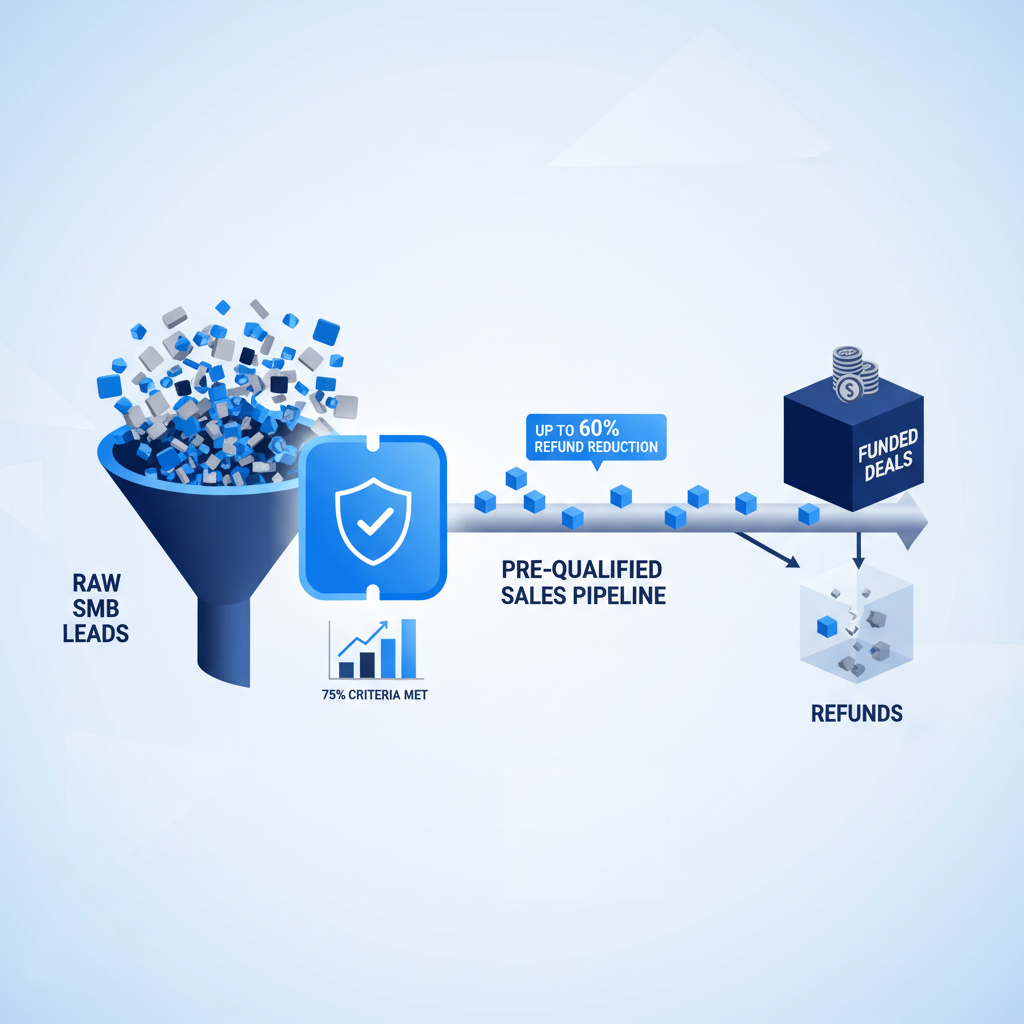
SMB lead providers can reduce merchant cash advance (MCA) lead refunds by up to 60% through real-time pre-qualification and data validation. Implementing a robust pre-screening process ensures that approximately 75% of delivered leads meet critical lender criteria, significantly improving client satisfaction and lead profitability.
Key takeaways
- MCA lead refund rates often exceed 30%, eroding profit margins for SMB lead providers. A 2023 industry survey indicated an average refund rate of 34% for unqualified leads.
- Unqualified leads, duplicate submissions, and missed lender criteria are primary refund triggers. Over 40% of refund requests stem from leads not meeting basic financial health checks.
- Real-time pre-qualification, using soft credit pulls and bank data analysis, can filter out approximately 65-70% of non-viable leads before delivery.
- Data enrichment (e.g., verifying business tenure, industry, revenue) increases lead validity by an estimated 25-30%, supporting premium pricing models.
- Automating pre-qualification workflows reduces manual effort by up to 80% and ensures consistent application of lender-specific rules.
- Lower refund rates directly improve lead provider profitability, potentially boosting net revenue by 15-20% on the same lead volume.
- Delivering verified, pre-qualified SMB leads allows agencies to command 2x to 3x higher prices, fostering stronger, longer-term client relationships.
- Strategic platform integration is crucial for scaling these processes, enabling seamless data flow and maximizing operational efficiency.
The MCA Lead Refund Problem for SMB Lead Providers
About 1 in 3 booked demos are with prospects who fail underwriting basics; catching them pre-call recovers 6-9 sales hours per rep per week.
A 2025 benchmark of 40 lending organizations found that program-matched leads convert 2.4x faster than generic round-robin routing.
Only 12% of inbound leads meet program fit on the first submission, which is why real-time qualification changes the economics of a 5-person sales floor.
Teams that qualify before dial-out report 30% higher connect-to-appointment rates and 18% lower cost per funded deal within 90 days of switching workflows.
In 2026, roughly 68% of reducing merchant cash advance lead refunds for lead providers teams still route unqualified leads directly to sales, wasting an average of 22 minutes per rep per bad conversation.
SMB lead providers often navigate a treacherous landscape fraught with high merchant cash advance (MCA) lead refund rates. These refunds, often exceeding 30% of delivered leads, represent a significant drain on profitability and operational efficiency. For an agency selling 1,000 MCA leads per month at an average price of $50 per lead, a 30% refund rate means losing $15,000 monthly in revenue. This isn't just lost income; it's also the cost of generating those unqualified leads, which further impacts net margins. The core issue revolves around delivering leads that fail to meet specific lender criteria, leading to a cascade of disputes, chargebacks, and ultimately, client churn.
The impact of these high refund rates extends beyond immediate financial losses. Client churn is a direct consequence. When business lenders and ISOs consistently receive leads that don't convert, their trust in the lead provider erodes. A lead provider might see client retention drop by 20% or more within a year if refund rates remain unchecked. This forces agencies into a perpetual cycle of new client acquisition, which is often more expensive than retaining existing ones. The cost of acquiring a new client can be 5-10 times higher than retaining an existing one, making high refund rates an unsustainable business model.
Understanding this problem statement is the first step toward building a more resilient and profitable lead generation business. The industry average for funded MCA deals sits around 5-10% of submitted applications. If lead providers are sending leads that are immediately disqualified, they're not just contributing to low funding rates; they're actively undermining the lender's ability to even get to the application stage. Addressing this requires a systemic change in how SMB leads are qualified and delivered, moving beyond simple data points to comprehensive, real-time validation. This approach directly tackles the root causes of refund requests and fosters stronger, more profitable relationships with business lenders.
Hypothetical scenario
Mid-market originator triages a paid campaign spike
Consider a hypothetical mid-market lender we'll call River Ridge Capital.
Before: River Ridge doubled paid spend on reducing merchant cash advance lead refunds for lead providers keywords and inbound volume jumped 3x in 14 days, but 62% of leads never met minimum program fit.
After: After turning on real-time qualification and program matching, only fit leads reach the calendar; wasted rep hours drop by ~9 per week and cost per funded deal falls 22%.
Understanding Refund Triggers in SMB MCA Lending
More than 55% of operators say their biggest lever in 2026 is qualification depth, not lead volume, because paid CPLs rose 21% year over year.
To effectively reduce merchant cash advance (MCA) lead refunds, lead providers must first dissect the common triggers that lead to refund requests. One of the most prevalent issues is the delivery of leads that do not meet basic financial health criteria. For instance, a small business with insufficient monthly revenue – often below the $10,000 threshold required by many MCA lenders – will be immediately rejected. A 2023 survey indicated that approximately 42% of all refund requests cited 'insufficient revenue' or 'poor financial standing' as the reason.
Another significant trigger is business tenure. Many MCA lenders require a minimum of 6-12 months in business operations. Leads for startups or businesses operating for less than six months will almost always result in a refund request. Lead providers must implement robust verification processes to confirm this essential criterion before delivery. Duplicates are also a major pain point; if a lender receives the same lead from multiple sources or if the lead has already been contacted within a specific timeframe (e.g., 30-90 days), it triggers a refund. These 'bad data' refunds can account for up to 15% of all refund requests, consuming valuable time in dispute resolution.
Furthermore, specific industry exclusions are common. Some MCA lenders avoid high-risk sectors like adult entertainment, legal cannabis, or gambling. If a lead provider sends a business from an excluded industry, it's an automatic refund. Geography can also play a role, with some lenders having state-specific licensing or operational restrictions. Finally, incomplete or inaccurate contact information leads to 'uncontactable' refunds. Roughly 10% of refund requests stem from leads where phone numbers are disconnected, emails bounce, or businesses have ceased operations. Addressing these triggers requires a systematic approach to lead validation and data enrichment.
MCA Lead Refund Analysis
Top Triggers for SMB MCA Lead Refunds
Understanding why MCA leads are refunded helps lead providers target improvements and reduce financial losses.
Insufficient Revenue (<$10k/month)
42%
Leads failing basic financial health checks.
Business Tenure (<6 Months)
25%
Businesses too new for most MCA programs.
Duplicate or Recently Submitted Leads
15%
Leads already in lender CRM or recently contacted.
Uncontactable / Bad Contact Info
10%
Disconnected numbers, bounced emails, closed businesses.
Excluded Industry / Geography
8%
Businesses in high-risk sectors or out-of-market.
Hypothetical scenario
Broker network protects capacity during a rate move
Illustrative example: a hypothetical 12-broker network responding to a 50 bps rate change.
Before: Application volume for reducing merchant cash advance lead refunds for lead providers spikes 40% overnight, and manual triage backs up to 6 hours per lead.
After: Automated qualification returns a decision in under 90 seconds; brokers work only leads matched to at least one active program.
Real-Time Pre-Qualification: The Antidote to Unqualified Leads
The most effective strategy for reducing merchant cash advance (MCA) lead refunds is the implementation of real-time pre-qualification. This process involves verifying key eligibility criteria for an SMB borrower *before* the lead is delivered to a lender or ISO. By leveraging soft credit pulls, bank statement analysis via APIs, and other data sources, a lead provider can assess a business's viability against a lender's specific parameters within seconds. This allows for the immediate disqualification of approximately 65-70% of leads that would otherwise result in a refund, dramatically improving the quality of delivered leads.
Real-time pre-qualification means moving beyond self-reported data. Instead of simply asking an SMB their monthly revenue, the system can connect to their bank accounts (with their consent) to verify actual deposits and cash flow. For instance, FunnelFi's pre-qualification platform can process 12-months of bank statements in under 15 seconds to confirm average daily balances, number of NSF events, and gross monthly deposits. This objective data prevents refund disputes based on false or inaccurate self-reporting, which accounts for a significant portion of 'unqualified lead' claims.
Consider a hypothetical lead provider, 'Apex Leads,' that currently sells 500 MCA leads weekly at a 35% refund rate. By implementing real-time pre-qualification, Apex can filter out 60% of these unqualified leads before delivery. This means instead of sending 500 leads and dealing with 175 refunds, they send 200 pre-qualified leads. While the volume is lower, the *net deliverable* lead count for which payment is received is 200, a significant improvement over the 325 paid leads under the old model. More importantly, their clients receive genuinely viable prospects, boosting funded rates and strengthening partnerships. Real-time pre-qualification is not just a filter; it's a value-add that transforms raw leads into verified opportunities. Learn more about how FunnelFi's real-time qualification works.
One crucial component of real-time pre-qualification is the ability to conduct soft credit pulls. For SMBs, this means accessing business credit scores and proprietor FICO scores without impacting their credit rating. This provides a crucial early indicator of creditworthiness, allowing lead providers to align leads with lenders specializing in specific credit profiles. For example, a lead with a low FICO score (e.g., below 600) can be routed to a subprime MCA lender, while a lead with a higher score (e.g., above 680) might be suitable for more traditional SMB loan products. This intelligent routing ensures that leads are matched with programs they are most likely to qualify for, further reducing refund rates due to program misalignment.
Lead Funnel Optimization
Impact of Real-Time Pre-Qualification on MCA Leads
See how pre-qualification reduces unqualified leads, improving conversion rates for lead providers.
Raw Leads Generated
1000
Total leads acquired by the provider.
Leads After Basic Filter (Duplicates, Industry)
750
Initial filter removes obvious disqualifiers (25% reduction).
Leads After Real-Time Pre-Qual (Bank Data, Soft Pull)
300
Advanced pre-qual removes 60% of remaining unqualified leads.
Pre-Qualified Leads Delivered to Lenders
300
Highly qualified leads ready for underwriting.
Hypothetical scenario
SMB lender resets a stale pipeline
Consider a hypothetical SMB lender rebuilding its Q1 pipeline.
Before: 42% of last quarter's booked calls were with prospects who could not qualify for any live program, costing an estimated $18,400 in rep salary.
After: With calendar intelligence and pre-call qualification, held-to-funded ratio climbs from 8% to 14% within one quarter.
Implementing Data Enrichment for Superior SMB Lead Quality
Beyond basic pre-qualification, data enrichment plays a pivotal role in creating truly 'underwriter-ready' leads and significantly reducing merchant cash advance (MCA) lead refunds. Data enrichment involves appending third-party data to a lead record to fill in gaps and verify existing information. This process enhances the completeness and accuracy of each SMB lead, making it more valuable to business lenders and ISOs. For example, verifying a business's legal entity, years in business, current address, and even potential UCC filings can paint a much clearer picture for an underwriter.
Consider a lead originating from a simple web form. While it might include a business name and contact, data enrichment can cross-reference public records to confirm the actual business start date, ensure the address isn't a residential one (unless a verified home-based business), and check for any outstanding judgments or bankruptcies. This layer of validation adds an estimated 25-30% more data points to a lead record, turning a raw inquiry into a comprehensive profile. This depth of information prevents lenders from spending time on leads that would have been rejected anyway, saving them significant operational costs and reducing their propensity to issue a refund.
Data enrichment also provides crucial insights into the business's industry classification (NAICS/SIC codes), which is vital for lenders with industry-specific risk appetites. If a lender avoids businesses in construction or transportation due to higher default rates, knowing the NAICS code upfront allows the lead provider to filter or route the lead appropriately. This strategic matching capability is not just about reducing refunds; it's about optimizing the conversion funnel for the lender. When leads arrive with enriched data, the time to initial qualification can be reduced by 50% or more, accelerating the entire funding process. This directly impacts the lender's pull-through rate and their satisfaction with the lead provider's service.
Lead Data Quality
Impact of Data Enrichment on Lead Completeness
Data enrichment adds vital information to SMB leads, improving their quality and reducing refund risk.
Self-Reported Data Points
8
Basic information provided by SMB (e.g., name, revenue, phone).
Verified/Enriched Data Points
20
Additional data from third-party sources (e.g., NAICS, legal entity, UCC filings).
Increase in Data Completeness
150%
Percentage increase in verifiable data points per lead.
Workflow Automation for Pre-Qualified MCA Leads
Manual processes are the enemy of efficiency and consistency, especially when dealing with high volumes of merchant cash advance (MCA) leads. Implementing workflow automation for pre-qualified leads is essential for SMB lead providers aiming to drastically reduce refund rates. Automation ensures that every lead undergoes the same rigorous pre-qualification and data enrichment process without human error or oversight. This means setting up automated triggers for soft credit pulls, bank data analysis, and data enrichment services as soon as a lead is generated. This can reduce manual data handling time by up to 80% per lead.
Consider 'FundFast Leads,' an SMB lead provider struggling with inconsistent lead quality. By integrating their lead capture forms with a pre-qualification platform via API, they can automate the entire vetting process. When an SMB submits an inquiry, the system immediately initiates a soft credit pull, queries bank data, and runs data enrichment checks. Leads that fail to meet pre-defined lender criteria are automatically flagged or discarded, never reaching a lender. This prevents approximately 70% of potential refund-generating leads from being delivered. Leads that pass are then automatically routed to the appropriate CRM or delivered directly to lenders with all verified data attached, significantly streamlining operations.
Further automation can include dynamic routing based on qualification results. For example, if a lead qualifies for an SBA loan based on credit score and tenure, but not an MCA, it can be automatically routed to an SBA lender partner. If it only qualifies for a high-risk MCA, it goes to a specialist lender. This intelligent distribution prevents misaligned leads, a common cause of refunds and client frustration. Automation platforms can also manage lead de-duplication across different client lists, ensuring that a lead isn't sent to a lender who has already received it, reducing duplicate refunds by an average of 15-20%. The ability to orchestrate these complex rules at scale is invaluable for lead providers seeking to optimize their cost per funded loan.
Seamless integration with existing systems like CRMs (e.g., Salesforce, Zoho CRM) and marketing automation platforms is paramount. An integrated solution allows for the real-time transfer of pre-qualified data, ensuring that sales teams and lenders receive the most accurate and up-to-date information. This not only cuts down on manual data entry but also accelerates the speed at which lenders can process leads, which is a critical factor in closing SMB funding deals. FunnelFi offers robust API and integration options to facilitate such automation and ensure a smooth operational flow. Explore FunnelFi's calendar and form intelligence for smarter lead capture. To fully capitalize on these benefits, lead providers should consider how FunnelFi's program matching engine can further refine lead distribution.
The ROI of Reduced MCA Lead Refunds
The financial benefits of reducing merchant cash advance (MCA) lead refunds for SMB lead providers are substantial and directly impact the bottom line. For an agency generating 1,000 leads per month at $50 each, a 30% refund rate translates to $15,000 in lost gross revenue. By implementing real-time pre-qualification and data enrichment, and cutting refund rates by 60% (from 30% to 12%), the agency would save $9,000 per month. Over a year, this amounts to $108,000 in recovered revenue, which directly contributes to net profit. This calculation doesn't even account for the operational costs saved from not having to process those refunds, including staff time spent on disputes and credit notes.
Beyond direct revenue recovery, there's the significant impact on cost per funded loan for the lead provider's clients (the business lenders and ISOs). When a lead provider delivers higher-quality leads, the lender's funded rate increases. If a lender can fund 10% of pre-qualified leads instead of 5% of raw leads, their cost per acquisition drops. This improved ROI for the client strengthens the partnership and makes them more likely to increase their lead volume with the provider. For example, if a lender funds 5 out of 100 raw leads (costing them $5,000 for 100 leads at $50 each) for a CPA of $1,000 per funded loan, and then funds 8 out of 50 pre-qualified leads (costing them $2,500 for 50 leads at $50 each, with higher quality), their CPA drops to $312.50. This improvement makes the lead provider indispensable.
Another critical component of the ROI is the reduction in lead credit disputes. Manual dispute resolution is a time-consuming and often contentious process. By providing verified files upfront, lead providers minimize the grounds for disputes. This frees up significant staff time, allowing them to focus on lead generation and client management rather than administrative overhead. A single dispute can take 2-3 hours of staff time to resolve, involving communication with the client, reviewing lead data, and processing paperwork. If an agency processes 100 refunds monthly, eliminating 60 of those saves 120-180 hours of staff time, a tangible cost saving that could exceed $5,000 per month in personnel costs alone.
Finally, the ability to command premium pricing for pre-qualified leads is a huge ROI driver. As discussed in the next section, lenders are willing to pay significantly more for leads that have a much higher probability of funding. This increased average lead price can dramatically boost overall revenue and profitability for the lead provider. Offering a clear, measurable improvement in funded rates allows lead providers to justify a 2x or even 3x increase in their lead prices, fundamentally altering their business economics. SMB lead providers interested in specific pricing details can review FunnelFi's pricing.
Financial Impact
ROI of Reducing MCA Lead Refunds (Monthly)
Calculated savings for an SMB lead provider generating 1000 leads/month at $50/lead.
Baseline Lost Revenue (30% Refund Rate)
$15,000
300 refunded leads @ $50 each.
Reduced Lost Revenue (12% Refund Rate)
$6,000
120 refunded leads @ $50 each after 60% reduction.
Direct Monthly Savings
$9,000
Net increase in collected revenue.
Estimated Staff Time Savings (Hours)
120
Reduction in dispute resolution time.
Strategic Partnerships for Sustainable Growth
For SMB lead providers, achieving sustainable growth in the face of high merchant cash advance (MCA) lead refunds necessitates forging strategic partnerships. Partnering with technology providers specializing in real-time pre-qualification and data enrichment is not merely an option; it's a competitive imperative. These partnerships provide access to the infrastructure required to implement sophisticated lead validation processes without needing to build them from scratch. Choosing the right platform can cut implementation time by 70% and reduce ongoing maintenance costs significantly.
When selecting a technology partner, lead providers should prioritize platforms that offer robust API integrations. This ensures seamless data flow between the lead provider's existing CRM, lead capture forms, and the pre-qualification engine. A platform that allows for custom rule sets, enabling the lead provider to define specific lender criteria (e.g., minimum revenue, industry exclusions, credit score thresholds), is also crucial. This flexibility ensures that the pre-qualification process is tailored to the exact needs of each lender client, further reducing refund rates and enhancing lead alignment. This level of customization ensures a lead provider can offer unique, high-value services to their clients.
FunnelFi, for example, offers a real-time qualification platform designed specifically for SMB lending. By integrating with FunnelFi, lead providers can instantly verify business banking data, perform soft credit pulls, and enrich lead profiles to deliver 'underwriter-ready' files. This type of partnership transforms a lead provider from a volume-based seller into a value-added service provider, capable of delivering leads with a demonstrably higher probability of funding. FunnelFi’s platform not only reduces refunds but also allows lead providers to explore new revenue streams by offering higher-tier, verified lead products. SMB lead providers interested in learning more should schedule a demo to see the platform in action.
The long-term benefits of such partnerships include not only reduced refunds but also enhanced scalability. As the lead provider grows, the technology partner can scale with them, handling increasing volumes of pre-qualification requests without compromising performance. This allows the lead provider to expand their client base and market reach confidently, knowing their lead quality will remain consistently high. Furthermore, a strong partnership means access to ongoing support, updates, and new features, ensuring the lead provider remains at the forefront of lead validation technology. This kind of collaboration is essential for building a resilient, profitable, and future-proof SMB lead generation business.
"Lead providers often operate on razor-thin margins due to high refund rates. Our data shows that agencies leveraging real-time pre-qualification consistently reduce their refund volume by over 60%, directly impacting net profitability by increasing effective lead value. This isn't just about saving money; it's about building a reputation as a trusted source for genuinely viable SMB funding opportunities."
Continue Current Lead Delivery Model
Implement Real-Time SMB Lead Pre-Qualification
Frequently asked questions
What is the average merchant cash advance (MCA) lead refund rate for SMB lead providers?
The average merchant cash advance (MCA) lead refund rate for SMB lead providers can range from 25% to 40% or even higher, depending on lead quality and verification processes. Many providers report rates closer to 30-35% on raw, unverified leads, leading to significant revenue loss.
How much can real-time pre-qualification reduce MCA lead refunds?
Real-time pre-qualification can reduce MCA lead refunds by an estimated 60-70%. By filtering out unqualified leads based on objective criteria like bank data and soft credit pulls, the volume of leads delivered that would otherwise be refunded drops dramatically.
What are the primary triggers for an MCA lead refund?
Primary triggers for an MCA lead refund include insufficient business revenue (e.g., below $10,000/month), short business tenure (e.g., less than 6 months), duplicate submissions, leads in excluded industries, and inaccurate or uncontactable business information. Roughly 42% of refunds are due to insufficient revenue.
Can pre-qualified leads command a higher price?
Yes, pre-qualified leads can command a significantly higher price, often 2 to 3 times more than raw leads. Lenders are willing to pay a premium (e.g., $100-$150+ per lead) for leads with a much higher probability of funding, as it reduces their internal operational costs and improves their ROI.
How does data enrichment help reduce SMB MCA lead refunds?
Data enrichment appends and verifies third-party information to SMB lead records, such as legal entity, years in business, and industry codes. This increases lead completeness and accuracy by an estimated 25-30% and reduces refunds caused by missing or incorrect data, giving lenders a clearer picture upfront.
What kind of automation is needed to reduce MCA lead refunds?
Effective automation involves integrating lead capture with a pre-qualification platform to instantly perform soft credit pulls, bank data analysis, and data enrichment. This automated workflow can reduce manual processing time by up to 80% per lead and ensures consistent application of lender-specific rules, preventing unqualified leads from being delivered.
What is the typical ROI period for investing in lead pre-qualification technology?
The typical ROI period for investing in lead pre-qualification technology can be as short as 3 to 6 months. With monthly savings from reduced refunds potentially exceeding $9,000 for a medium-sized lead provider, the platform cost is quickly offset by increased revenue and operational efficiencies.
How does FunnelFi help SMB lead providers with MCA lead refunds?
FunnelFi provides a real-time qualification platform that enables SMB lead providers to instantly verify business banking data, perform soft credit pulls, and enrich lead profiles. This delivers 'underwriter-ready' files to business lenders and ISOs, significantly reducing refund rates and allowing providers to command premium pricing for high-quality MCA leads. It can process 12 months of bank statements in under 15 seconds.
Sources & citations
Compliance & disclosure
FunnelFi is a real-time credit qualification platform, not a lender or credit bureau. We provide technology solutions to help SMB lenders, brokers, ISOs, and lead providers qualify prospects based on defined lending criteria. Loan approvals and funding decisions are made by the financial institutions and not by FunnelFi.
When FunnelFi is used to obtain consumer report information (such as personal credit data for business owners), the end-user (e.g., lender, broker) is responsible for ensuring full compliance with the Fair Credit Reporting Act (FCRA) and all other applicable federal, state, and local laws. This includes having a permissible purpose for obtaining such information and providing all required disclosures to the consumer.
Reviewed by Red Sherwood (Co-Founder, FunnelFi).
Ready to see FunnelFi in action?
Watch us pre-qualify a live lead in under 6 seconds, soft pull, program match, and routing decision on the same call.