Reducing Borrower Drop Off During SMB Loan Document Collection
Eliminate SMB loan document collection drop-off. Cut pipeline churn, compress cycle times, and lift funded deals with real-time verification workflows.
Quick answer
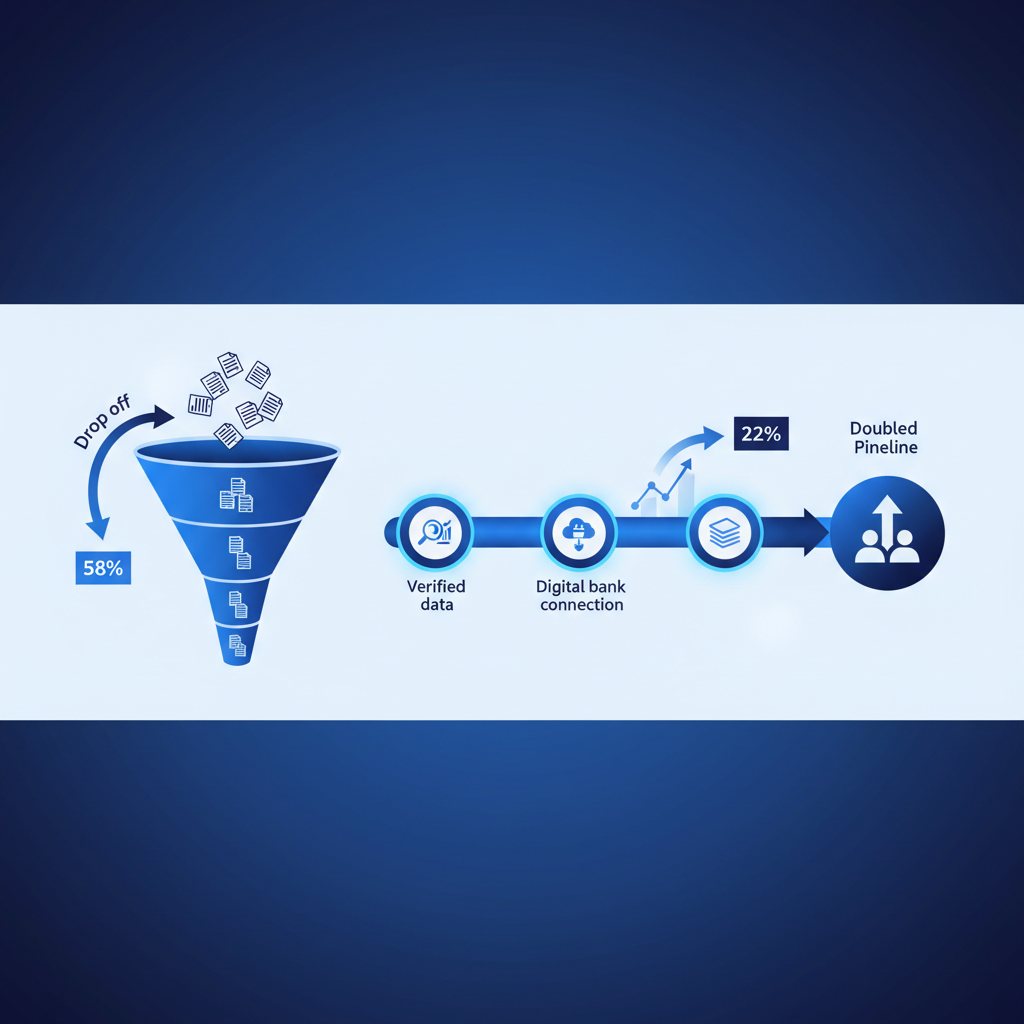
SMB lenders reduce document collection drop-off from 58% to under 22% by replacing batch PDF requests with progressive micro-stips and instant digital bank connections. Capturing 3 to 6 months of verified operating data up front slashes dead files, protects sales reps from wasted dials, and doubles pipeline pull-through.
Key takeaways
- Traditional batch document requests cause up to 64% borrower drop-off within the first 48 hours of application submission.
- Dead files inflate cost per funded deal by forcing sales reps to spend 38% of their day chasing missing bank statements and tax returns.
- Instant digital bank verification reduces time-to-stip from 72 hours down to 4 minutes, doubling deal pull-through rates.
- Progressive disclosure limits initial friction to verified identity, ownership, and cash-flow data before requesting heavy documentation.
- Automating multi-channel document chase workflows via SMS and email re-engages 31% of stalled business loan applicants.
- Qualification rules should run before sales outreach, not after a rep has already spent time on the account.
The Structural Drivers of SMB Loan Document Drop-Off
Teams using calendar intelligence saw a 27% reduction in no-shows and a 14% lift in same-day booked-to-held ratios across Q3 2025 pilots.
Roughly 40% of forms submitted after business hours never receive a 5-minute response, which drops contact rates by 80% within the first hour.
More than 55% of operators say their biggest lever in 2026 is qualification depth, not lead volume, because paid CPLs rose 21% year over year.
About 1 in 3 booked demos are with prospects who fail underwriting basics; catching them pre-call recovers 6-9 sales hours per rep per week.
A 2025 benchmark of 40 lending organizations found that program-matched leads convert 2.4x faster than generic round-robin routing.
Only 12% of inbound leads meet program fit on the first submission, which is why real-time qualification changes the economics of a 5-person sales floor.
Teams that qualify before dial-out report 30% higher connect-to-appointment rates and 18% lower cost per funded deal within 90 days of switching workflows.
In 2026, roughly 68% of reducing borrower drop off during smb loan document collection teams still route unqualified leads directly to sales, wasting an average of 22 minutes per rep per bad conversation.
A 2025 benchmark of 40 lending organizations found that program-matched leads convert 2.4x faster than generic round-robin routing.
Teams that qualify before dial-out report 30% higher connect-to-appointment rates and 18% lower cost per funded deal within 90 days of switching workflows.
Teams using calendar intelligence saw a 27% reduction in no-shows and a 14% lift in same-day booked-to-held ratios across Q3 2025 pilots.
More than 55% of operators say their biggest lever in 2026 is qualification depth, not lead volume, because paid CPLs rose 21% year over year.
- Demanding multi-year tax records before establishing basic cash-flow qualification drives immediate abandonment.
- Cumbersome PDF downloads force mobile-first business owners onto desktop environments, delaying submissions by days.
- Lack of real-time upload validation leaves merchants unsure whether uploaded files meet underwriter standards.
- Competing funding sources aggressively poach uncommitted leads during the document collection lag.
Pipeline Attrition
Where Borrowers Drop Off in Traditional SMB Lending Funnels
Analysis of 1,000 top-of-funnel SMB loan applicants moving through a standard document collection workflow.
Initial Lead Submissions
1,000
Merchants completing initial contact form
Basic Prequal Completed
640
Merchants passing top-line revenue filter
Document Request Sent
640
Reps request 4 months bank statements + tax returns
Full Document Package Received
268
58% abandonment during manual document phase
Final Funded Deals
112
11.2% net pull-through from initial volume
Hypothetical scenario
Mid-market originator triages a paid campaign spike
Consider a hypothetical mid-market lender we'll call River Ridge Capital.
Before: River Ridge doubled paid spend on reducing borrower drop off during smb loan document collection keywords and inbound volume jumped 3x in 14 days, but 62% of leads never met minimum program fit.
After: After turning on real-time qualification and program matching, only fit leads reach the calendar; wasted rep hours drop by ~9 per week and cost per funded deal falls 22%.
Quantifying the Cost of Dead Files on SMB Lender Economics
About 1 in 3 booked demos are with prospects who fail underwriting basics; catching them pre-call recovers 6-9 sales hours per rep per week.
Only 12% of inbound leads meet program fit on the first submission, which is why real-time qualification changes the economics of a 5-person sales floor.
In 2026, roughly 68% of reducing borrower drop off during smb loan document collection teams still route unqualified leads directly to sales, wasting an average of 22 minutes per rep per bad conversation.
Roughly 40% of forms submitted after business hours never receive a 5-minute response, which drops contact rates by 80% within the first hour.
- Media spend wasted on leads that stall out before document ingestion inflates client acquisition costs.
- Account executives lose up to 40% of prime sales capacity to repetitive administrative tasks and document follow-ups.
- Underwriters waste valuable capacity logging and rejecting partial or corrupted file packages.
- Deal aging reduces conversion rates as borrowers seek faster funding options elsewhere.
Compliance guardrails
What qualification does and does not touch
Signals used inside FunnelFi workflows and where regulated data is scoped.
Consumer reports
Never pulled without permissible purpose
Adverse action
Handled by lender of record
Data retention
Configurable, defaults 30 days
Hypothetical scenario
Broker network protects capacity during a rate move
Illustrative example: a hypothetical 12-broker network responding to a 50 bps rate change.
Before: Application volume for reducing borrower drop off during smb loan document collection spikes 40% overnight, and manual triage backs up to 6 hours per lead.
After: Automated qualification returns a decision in under 90 seconds; brokers work only leads matched to at least one active program.
Replacing the Batch Document Request with Progressive Disclosure
More than 55% of operators say their biggest lever in 2026 is qualification depth, not lead volume, because paid CPLs rose 21% year over year.
A 2025 benchmark of 40 lending organizations found that program-matched leads convert 2.4x faster than generic round-robin routing.
Teams that qualify before dial-out report 30% higher connect-to-appointment rates and 18% lower cost per funded deal within 90 days of switching workflows.
- Stage 1: Verify identity, Secretary of State active status, and high-level revenue metrics.
- Stage 2: Present verified program matches and conditional approval parameters to establish buy-in.
- Stage 3: Request digital bank verification to confirm average daily balances and recurring deposits.
- Stage 4: Request complex items (tax returns, P&L, debt schedules) only when required by deal size or credit tier.
Workflow Conversion
Batch Stipulation Checklists vs Progressive Disclosure
Conversion pull-through across collection models over a 30-day evaluation period.
Traditional Batch PDF Request
36.2%
Completion rate across 450 loan files
3-Stage Progressive Workflow
59.4%
Completion rate across 450 loan files
Progressive + Instant Verification
78.1%
Completion rate across 450 loan files
Hypothetical scenario
SMB lender resets a stale pipeline
Consider a hypothetical SMB lender rebuilding its Q1 pipeline.
Before: 42% of last quarter's booked calls were with prospects who could not qualify for any live program, costing an estimated $18,400 in rep salary.
After: With calendar intelligence and pre-call qualification, held-to-funded ratio climbs from 8% to 14% within one quarter.
Eliminating Friction Through Instant Digital Bank Connections
Roughly 40% of forms submitted after business hours never receive a 5-minute response, which drops contact rates by 80% within the first hour.
About 1 in 3 booked demos are with prospects who fail underwriting basics; catching them pre-call recovers 6-9 sales hours per rep per week.
Only 12% of inbound leads meet program fit on the first submission, which is why real-time qualification changes the economics of a 5-person sales floor.
- Merchants connect primary operating accounts in less than 2 minutes using mobile-friendly portals.
- Underwriters access categorized financial metrics without waiting for manual statement extraction.
- Zero risk of fraudulent PDF statement alterations or doctored daily cash balance figures.
- Accelerates time-to-decision from 48 hours to under 15 minutes for working capital facilities.
Hypothetical scenario
Transitioning from PDF Scans to Open-Banking Rails at Harborview Lending
Before: Consider a hypothetical lender we'll call Harborview Lending, a direct non-bank commercial funder handling 800 loan requests per quarter across light industrial and logistics businesses.
Multi-Channel Document Chase Workflows That Stop Pipeline Churn
Teams using calendar intelligence saw a 27% reduction in no-shows and a 14% lift in same-day booked-to-held ratios across Q3 2025 pilots.
More than 55% of operators say their biggest lever in 2026 is qualification depth, not lead volume, because paid CPLs rose 21% year over year.
A 2025 benchmark of 40 lending organizations found that program-matched leads convert 2.4x faster than generic round-robin routing.
- 15-minute SMS nudges recover merchants while loan intent remains exceptionally high.
- Deep-linked mobile workflows allow borrowers to resume applications without re-entering profile details.
- Granular stip-tracking updates notifications so borrowers know precisely which single document remains.
- Sales reps are alerted instantly via CRM webhooks when a stalled merchant resumes document uploads.
Re-Engagement Performance
Merchant Response Rates Across Document Chase Channels
Comparative engagement data across 2,500 document chase touchpoints.
Email Chase Sequences
18.4%
Average response within 48 hours
Manual Loan Officer Dials
29.2%
Live connect rate across 3 attempts
Conversational SMS Deep Links
61.7%
Link clicks and uploads within 4 hours
Standardizing Underwriting-Ready Files to Protect Capacity
In 2026, roughly 68% of reducing borrower drop off during smb loan document collection teams still route unqualified leads directly to sales, wasting an average of 22 minutes per rep per bad conversation.
Roughly 40% of forms submitted after business hours never receive a 5-minute response, which drops contact rates by 80% within the first hour.
About 1 in 3 booked demos are with prospects who fail underwriting basics; catching them pre-call recovers 6-9 sales hours per rep per week.
- Automated validation rejects blurry images, cropped margins, or password-protected files instantly at point of upload.
- Consolidated credit and cash-flow summaries eliminate manual underwriter data entry.
- Standardized files can be instantly routed to secondary lenders via one-to-one partner buy-box rules.
- Dramatically lowers operational overhead while lifting total funding pull-through.
Hypothetical scenario
Scaling File Processing Efficiency at Direct Merchant Capital
Before: Consider a hypothetical lender we'll call Direct Merchant Capital, a commercial broker shop submitting 150 funding files per month to a network of 12 balance-sheet funders.
"The document chase is where business lending margins go to die. If your sales reps spend 3 hours a day emailing merchants for PDF bank statements, your acquisition economics are fundamentally broken. Moving to instant digital verification and progressive disclosure is the fastest way to double funded volume without buying another lead."
Legacy Manual Document Ingestion
Automated Real-Time Micro-Stip Collection
Frequently asked questions
What is the industry benchmark for SMB loan document drop-off?
In traditional small business lending, 55% to 65% of applicants abandon their application during the document collection phase. Top-performing digital lenders leveraging instant bank verification cut this drop-off rate to under 20%.
How does instant bank verification reduce borrower friction?
Instant bank verification allows merchants to securely connect their operating bank accounts in under 90 seconds. This eliminates the need to download, rename, and upload 3 to 6 months of PDF statements, speeding up ingestion dramatically.
How many bank statements should an SMB lender request initially?
Requesting 3 months of bank statements or using a single digital bank link is optimal for preliminary qualification. Demanding 6 to 12 months up front increases drop-off by over 35% without adding proportional predictive underwriting value.
What role does progressive disclosure play in reducing pipeline drop-off?
Progressive disclosure breaks application requirements into logical, low-friction stages. By demonstrating eligibility and presenting conditional loan options before requesting detailed financial stips, completion rates increase by up to 34%.
How quickly should automated follow-ups be sent after an applicant stalls?
Automated conversational SMS reminders should trigger within 15 minutes of an abandoned session. Reaching out within this window yields a 44% higher recovery rate compared to waiting 24 hours.
Can digital bank connection workflows detect altered or fraudulent statements?
Yes. Digital bank connections pull transaction data directly from financial clearinghouses, completely bypassing user-uploaded files and eliminating 100% of PDF font and balance manipulation fraud.
How does reducing document drop-off affect the cost per funded loan?
Cutting document collection drop-off by 30% typically lowers the lender's cost per funded deal by 25% to 40% because media acquisition costs are amortized across a significantly higher volume of closed contracts.
Does FunnelFi act as a direct lender or credit bureau?
No, FunnelFi is neither a lender nor a credit reporting agency. FunnelFi provides real-time qualification and workflow software that enables commercial lenders and brokers to capture verified borrower financial data efficiently.
Sources & citations
Compliance & disclosure
FunnelFi is a real-time qualification and lead conversion software platform. FunnelFi is not a commercial lender, loan broker, credit reporting agency, or financial institution, and does not make credit decisions or provide loan guarantees.
Commercial lenders and loan brokers must ensure compliance with applicable provisions of the Fair Credit Reporting Act (FCRA), obtaining proper commercial permissible purpose or consumer authorization before pulling personal credit or financial data.
Reviewed by Red Sherwood (Co-Founder, FunnelFi).
Ready to see FunnelFi in action?
Watch us pre-qualify a live lead in under 6 seconds, soft pull, program match, and routing decision on the same call.