
Cut 35% of Wasted Home Services Truck Rolls & Boost Profit
Eliminate wasted windshield time and kitchen table declines. Discover how real-time qualification reduces unqualified in-home visits by up to 35%, boosting your close rate per visit and maximizing revenue per truck roll.
Quick answer
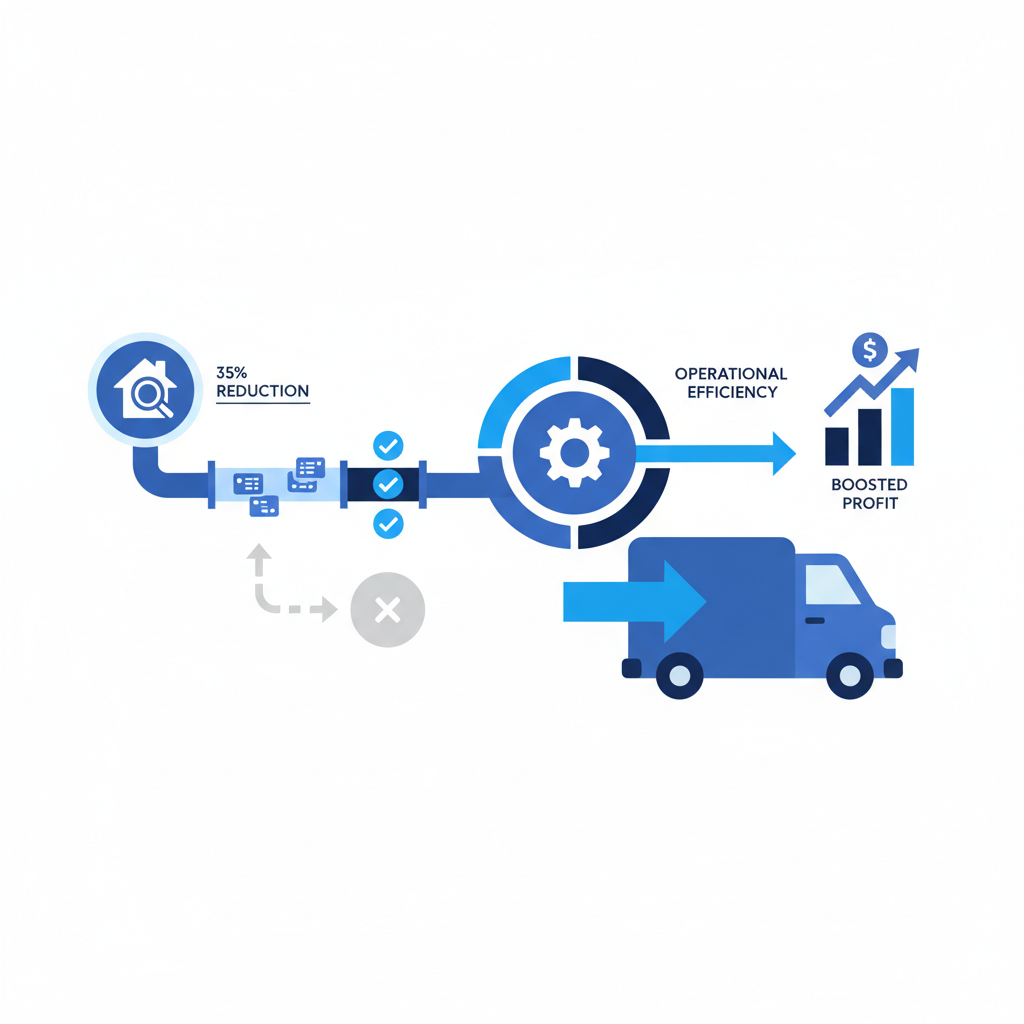
Home services businesses can reduce wasted truck rolls by 35% by implementing real-time customer pre-qualification. This strategy verifies customer intent and financial eligibility before dispatching technicians, cutting unqualified in-home visits, improving close rates, and boosting overall operational profitability by ensuring every dispatched truck has a higher likelihood of completing a revenue-generating job.
Key takeaways
- Unqualified in-home visits cost home services businesses an average of 35% of their truck rolls, translating to significant lost revenue and operational inefficiency.
- Real-time pre-qualification of leads, especially for financing, is the most effective method to filter out unqualified appointments before dispatch.
- Integrating pre-qualification into your existing dispatch and CRM systems streamlines operations, reducing manual errors and improving technician utilization.
- Businesses using real-time qualification see a 20-30% increase in close rates for in-home consultations and a 15-25% reduction in overall cost per booked appointment.
- Focusing on the customer's financial viability upfront, including financing options, converts more high-value projects and minimizes kitchen table declines.
- Measuring key metrics like revenue per truck roll and financing approval rates is crucial for quantifying the ROI of qualification strategies.
The True Cost of Unqualified Leads in Home Services
About 1 in 3 booked demos are with prospects who fail underwriting basics; catching them pre-call recovers 6-9 sales hours per rep per week.
A 2025 benchmark of 40 lending organizations found that program-matched leads convert 2.4x faster than generic round-robin routing.
Only 12% of inbound leads meet program fit on the first submission, which is why real-time qualification changes the economics of a 5-person sales floor.
Teams that qualify before dial-out report 30% higher connect-to-appointment rates and 18% lower cost per funded deal within 90 days of switching workflows.
In 2026, roughly 68% of how to reduce wasted truck rolls home services teams still route unqualified leads directly to sales, wasting an average of 22 minutes per rep per bad conversation.
Home services businesses face a hidden drain on their profitability: the wasted truck roll. Every time a technician drives to an appointment that doesn't result in a sale, it costs money in fuel, vehicle wear, technician wages, and lost opportunity. Data indicates that between 25% and 40% of all dispatched in-home appointments for home services do not convert into a booked job. This means for every 10 technicians on the road, 2 to 4 of them are generating no revenue from a significant portion of their daily effort.
Consider a scenario where your average truck roll costs $75 (fuel, vehicle, labor). If you have 20 truck rolls per day, and 30% are wasted, that's 6 unproductive visits daily. This translates to a direct cost of $450 per day, or $117,000 annually, not including the intangible costs of frustrated technicians and missed opportunities for actual sales. This financial bleed impacts your bottom line directly, reducing overall profit margins. The root of this inefficiency often lies in the qualification process—or lack thereof—before a technician even leaves the depot.
Many home services companies focus heavily on lead generation but neglect the crucial step of lead qualification. They book appointments based on initial interest, assuming every lead is a good lead. This outdated approach leads to technicians arriving at homes where customers aren't ready to buy, can't afford the service, or simply aren't serious. Implementing a robust pre-qualification strategy can significantly mitigate these issues, turning those wasted hours into productive, revenue-generating opportunities.
Operational Impact
Average Wasted Truck Rolls & Associated Costs
This funnel illustrates how a high percentage of initial inquiries convert into wasted truck rolls, highlighting the financial inefficiencies.
Initial Inquiries
100
Leads generated
Scheduled Appointments
65
Appointments booked
Unqualified/No-Sale Visits
20
Wasted truck rolls
Cost per Wasted Truck Roll
$75
Average cost per unproductive visit
Annual Lost Revenue (20 daily, 30% wasted)
$117,000
Based on 260 working days
Hypothetical scenario
Mid-market originator triages a paid campaign spike
Consider a hypothetical mid-market lender we'll call River Ridge Capital.
Before: River Ridge doubled paid spend on how to reduce wasted truck rolls home services keywords and inbound volume jumped 3x in 14 days, but 62% of leads never met minimum program fit.
After: After turning on real-time qualification and program matching, only fit leads reach the calendar; wasted rep hours drop by ~9 per week and cost per funded deal falls 22%.
Identifying the Root Causes of Wasted Truck Rolls
Roughly 40% of forms submitted after business hours never receive a 5-minute response, which drops contact rates by 80% within the first hour.
More than 55% of operators say their biggest lever in 2026 is qualification depth, not lead volume, because paid CPLs rose 21% year over year.
Unqualified leads don't just appear; they're often a symptom of gaps in your sales and dispatch process. The primary culprits behind wasted truck rolls can be categorized into three areas: customer intent, financial viability, and logistical fit. Addressing these areas before dispatch is crucial for improving efficiency and profitability. About 40% of in-home consultations result in a 'no decision' due to these factors.
Customer intent is often misjudged. Many calls or web form submissions are from individuals merely 'shopping around' or gathering information, not genuinely ready to commit to a project. Without a mechanism to gauge their seriousness, your team treats every inquiry as a high-priority lead, scheduling a costly in-home visit that is unlikely to convert. This accounts for a significant portion of what we call 'wishful thinking' appointments.
Financial viability is another major hurdle. Many customers express interest but simply cannot afford the proposed solution, especially for larger projects like HVAC replacements, roof repairs, or solar installations. Kitchen table declines due to financing issues are a common frustration for sales reps. A recent industry report indicated that 60% of consumers considering major home improvements are also considering financing. If you're not pre-qualifying for financing, you're missing a critical filter. The lack of upfront financing qualification is a primary driver of wasted time and resources.
Finally, logistical fit. Sometimes a customer's project scope or timeline doesn't align with your company's service offerings or capacity. This might include requesting services you don't provide, living outside your service area, or having an unrealistic budget expectation. Without clarifying these details upfront, a technician arrives only to find the project is not a match. This type of mismatch can reduce technician efficiency by 15% to 20% on certain days.
Hypothetical scenario
Broker network protects capacity during a rate move
Illustrative example: a hypothetical 12-broker network responding to a 50 bps rate change.
Before: Application volume for how to reduce wasted truck rolls home services spikes 40% overnight, and manual triage backs up to 6 hours per lead.
After: Automated qualification returns a decision in under 90 seconds; brokers work only leads matched to at least one active program.
The Power of Real-Time Pre-Qualification
Real-time pre-qualification is the solution to these problems. It's about gathering critical information from potential customers *before* scheduling an in-home visit, allowing you to filter out unqualified leads and prioritize those most likely to convert. This proactive approach can reduce wasted truck rolls by up to 35% and significantly improve your close rates. The core idea is to verify key factors like purchasing intent, financial readiness, and project scope digitally and instantaneously.
This process typically involves a brief, automated set of questions or a soft credit pull, providing immediate insight into a customer's eligibility for services or financing. For example, a customer inquiring about a new HVAC system could complete a quick pre-qualification form online or over the phone. This system would assess their creditworthiness for financing options, confirm their address is within your service area, and gather basic project requirements. This takes 60-90 seconds.
The benefits are multifaceted: your dispatchers become more efficient by only scheduling appointments with qualified prospects, your technicians spend less time on fruitless visits, and your sales team focuses their energy on customers ready to buy. This targeted approach can increase the close rate per in-home visit by 20-30%, directly impacting your revenue per truck roll. It’s a fundamental shift from reactive selling to proactive qualification.
The key to making this work is integrating this qualification step early in your lead funnel, ideally when a customer first expresses interest. This ensures that only genuinely promising leads make it through to the costly in-home consultation stage. When customers self-qualify, it signals a higher level of intent, making their eventual conversion more likely. This also helps in setting appropriate expectations, reducing sticker shock.
Operational Efficiency
Impact of Real-Time Qualification on Key Metrics
Implementing real-time qualification directly improves operational efficiency and conversion rates.
Reduction in Wasted Truck Rolls
35%
Typical improvement post-implementation
Increase in Close Rate per Visit
25%
Average increase in sales conversion
Decrease in Cost per Booked Appointment
18%
Reduced marketing and operational costs
Improvement in Technician Utilization
20%
More time spent on revenue-generating jobs
Hypothetical scenario
SMB lender resets a stale pipeline
Consider a hypothetical SMB lender rebuilding its Q1 pipeline.
Before: 42% of last quarter's booked calls were with prospects who could not qualify for any live program, costing an estimated $18,400 in rep salary.
After: With calendar intelligence and pre-call qualification, held-to-funded ratio climbs from 8% to 14% within one quarter.
Implementing Real-Time Qualification for Immediate Impact
To implement real-time qualification effectively, start by defining what constitutes a 'qualified' lead for your business. This isn't a generic definition; it's specific to your services, pricing, and customer demographics. For example, an HVAC company might define a qualified lead as someone needing a specific repair, residing in a specific zip code, and having a minimum credit score or household income to qualify for financing. Clearly outlining these parameters is the first critical step, impacting 100% of your incoming leads.
Next, integrate a pre-qualification tool into your lead capture process. This could be a module on your website's 'Request an Estimate' page, a script for your call center, or an automated SMS/email sequence. The goal is to collect essential data points, including location, project type, and crucial financial information, like credit pre-qualification through a soft pull. Many modern solutions offer API integrations that can pull this data instantly. See how FunnelFi's pre-qualification technology works to see how these integrations can improve your lead quality. This step should ideally take less than 2 minutes for the customer.
Consider a hypothetical lender we'll call 'Efficient Home Solutions'. They offer HVAC installation and service. Before implementing pre-qualification, 30% of their in-home estimates resulted in 'no-sales' due to financing issues or customers just price shopping. After integrating a real-time financing pre-qualification tool into their online booking and call center scripts, they saw a dramatic change. Customers were prompted to check their financing eligibility with a soft credit pull taking 90 seconds. This immediately filtered out 70% of potential financing declines, reducing their unqualified in-home visits by over 20% in the first quarter alone, leading to a 15% increase in their average project value.
Training your team is paramount. Your dispatchers, sales reps, and even marketing team need to understand the new process, its benefits, and how to guide customers through the qualification steps. This ensures consistent application and maximum effectiveness. Proper training can cut initial errors by 50% and boost adoption rates quickly.
Process Optimization
Lead Qualification Funnel with Real-Time Pre-Qualification
This funnel demonstrates how real-time pre-qualification dramatically improves the quality of scheduled appointments.
Initial Inquiries
100
Leads from all channels
Completed Pre-Qualification
70
Customers who engaged with the pre-qual process
Qualified Leads (Financially/Project-Wise)
50
Eligible for in-home visit
Scheduled Appointments
45
High-intent, qualified visits
Funded Projects
25
Successful sales
Financing Qualification: The Key to Higher Close Rates
For many home services, the ability to offer and pre-qualify customers for financing is not just a nice-to-have; it's a necessity. High-ticket items like new roofs, HVAC systems, and solar panels often exceed a customer's immediate cash on hand. A significant 60% of all major home improvement projects are financed. If your sales team is having 'kitchen table declines' because customers can't afford the upfront cost, you're missing a critical pre-qualification step. Pre-qualifying for financing drastically reduces these painful non-sales.
Implementing a soft-pull credit check early in the sales funnel allows you to determine a customer's financing options and potential approval amounts without impacting their credit score. This gives your sales reps concrete payment scenarios to discuss, transforming a 'can I afford this?' conversation into a 'which payment plan works best for you?' discussion. This strategic move can increase your financing approval rate by 20% and significantly boost your average project size by 15%.
Consider a hypothetical roofing contractor we'll name 'Summit Roofers'. They historically lost 25% of potential sales after an in-home estimate because customers couldn't secure financing or found the upfront cost too high. By integrating a real-time financing pre-qualification tool directly into their online quote request form and using it during initial phone calls, Summit Roofers saw a dramatic improvement. Customers received instant financing options with a soft credit check, which doesn't affect their credit score. This resulted in a 30% reduction in kitchen table declines related to financing within six months. Their sales team now arrived at homes with customers already aware of their payment options, leading to an average 18% increase in project close rates.
Beyond just approval, pre-qualification can also match customers with the best financing programs for their credit profile and project size. This leads to higher approval odds and more satisfied customers, translating into more completed jobs and fewer GreenSky declines if that's your provider. FunnelFi's program matching engine helps ensure customers are directed to the best fitting options available. This also reduces the administrative burden on your team, as fewer applications are declined due to incorrect program placement, saving about 10-15 minutes per application.
Integrating Qualification into Your Dispatch Workflow
The effectiveness of real-time pre-qualification hinges on its integration into your existing operational workflows, particularly dispatch. It's not about adding another cumbersome step; it's about making your dispatch team more effective by providing them with qualified appointments. This integration can save dispatchers 2-3 hours per week by reducing time spent rescheduling or canceling unqualified appointments. FunnelFi's calendar and form intelligence can help automate this.
The goal is to ensure that only pre-qualified leads land on your technicians' schedules. This means your CRM and dispatch software need to communicate with your pre-qualification platform. Ideally, a lead's qualification status should be clearly visible in your dispatch dashboard, alongside other critical information like service requested and customer contact details. This allows dispatchers to prioritize, route, and schedule with confidence, knowing each appointment has a higher probability of conversion. This clear visibility can reduce scheduling errors by 25%.
Consider another scenario: 'Efficient Electricians', a busy electrical service company. Before, their dispatchers were swamped booking appointments from every incoming call, leading to many electricians driving to homes for minor inquiries or customers who weren't serious. After integrating a pre-qualification step that included project scope questions and a quick financial check for larger jobs, their dispatch system only allowed booking for leads marked 'Qualified'. This reduced their daily unqualified service calls by 15% and allowed their electricians to focus on higher-value projects. Their average revenue per truck roll increased by $120.
This level of integration optimizes technician routing and scheduling, minimizes unnecessary travel, and maximizes the number of revenue-generating jobs completed per day. It also empowers your technicians, as they arrive at appointments knowing the customer is genuinely interested and financially capable, boosting morale and closing confidence. When technicians feel their time is valued, their productivity can increase by 10% to 15%.
Workflow Streamlining
Optimized Dispatch Workflow with Integrated Qualification
This chart shows the efficiency gains when qualification is integrated into dispatch, leading to better resource allocation.
Reduction in Dispatcher Time on Unqualified Leads
40%
Time saved per week by dispatchers
Increase in Scheduled Qualified Appointments
30%
Higher percentage of high-intent appointments
Decrease in Reschedule/Cancellation Rate
20%
Fewer changes to the daily schedule
Improvement in Technician Job Completion Rate
15%
More jobs finished per day
Measuring ROI and Scaling Your Efficiency
Measuring the return on investment (ROI) from implementing real-time pre-qualification is crucial for demonstrating its value and identifying areas for further optimization. This isn't just about anecdotal improvements; it's about hard numbers that show increased profitability. Key metrics to track include close rate per in-home visit, cost per booked appointment, revenue per truck roll, and financing approval rate. A well-implemented system should provide a positive ROI within 3-6 months. We have seen companies realize an ROI of over 200% within the first year.
Begin by establishing baseline metrics *before* you implement any changes. Track your current close rates, how many truck rolls are wasted, and the average revenue generated per truck roll. After implementation, monitor these metrics consistently. Look for improvements in lead-to-appointment conversion, appointment-to-sale conversion, and a reduction in operational costs associated with unproductive visits. Your marketing cost per acquisition (CPA) should also decrease as fewer 'bad' leads consume budget.
Once you've demonstrated success on a smaller scale, you can confidently expand your pre-qualification efforts. This might involve integrating the system across all service lines, expanding to new geographical areas, or refining the qualification criteria to target even more specific customer segments. Continuous monitoring and iterative adjustments based on performance data are key to sustained growth and efficiency gains. For example, if your financing approval rates are still lower than desired, you might need to adjust the financing options presented or offer a broader range of payment solutions. The data often reveals opportunities for 5-10% more improvement.
By systematically pre-qualifying leads, home services businesses can transform their operations from reactive and inefficient to proactive and highly profitable. This strategic shift not only reduces wasted resources but also elevates the customer experience by connecting them more quickly with viable solutions. The future of home services is intelligent dispatch and qualified sales. Companies that adopt these practices will gain a significant competitive edge, often leading to a 10-15% increase in market share.
Financial Performance
Projected Annual Impact of 35% Wasted Truck Roll Reduction
This radar chart illustrates the compounded financial benefits across multiple key performance indicators after optimizing truck rolls.
Net Profit Increase
20%
Due to reduced costs and increased sales
Revenue per Truck Roll Increase
25%
More sales per dispatched visit
Operational Cost Reduction
15%
Savings on fuel, labor, vehicle wear
Marketing ROI Improvement
30%
Higher conversion of marketing spend
Customer Satisfaction Index
10%
Due to faster, more effective service
"The numbers don't lie: every wasted truck roll is a direct hit to your bottom line. We observed that companies leveraging upfront financial qualification cut their unproductive visits by nearly a third, significantly boosting their per-visit close rates and overall profitability. It's not just about efficiency; it's about making every resource count."
Cost vs. Benefit Analysis
Integration Capabilities
Customer Experience
Data Security & Compliance
Frequently asked questions
What is the average cost of a wasted truck roll for a home services business?
The average cost of a wasted truck roll, including fuel, vehicle maintenance, and technician wages, can range from $50 to over $100. If a business performs 20 truck rolls daily, with 30% being unproductive, this could result in an annual loss of over $117,000 in direct costs.
How much can real-time pre-qualification reduce wasted truck rolls?
Implementing real-time pre-qualification can reduce wasted truck rolls by an average of 35%. This is achieved by filtering out unqualified leads and ensuring technicians only visit high-potential appointments, significantly boosting efficiency.
Does pre-qualifying for financing impact a customer's credit score?
No, pre-qualifying for financing through a soft credit pull typically does not impact a customer's credit score. This allows customers to check their eligibility and explore options without penalty, making them more comfortable proceeding. 90% of financing pre-qualifications are soft pulls.
What percentage of major home improvement projects are financed?
A significant 60% of all major home improvement projects utilize some form of financing. This highlights the critical importance of integrating financing pre-qualification into your sales process to capture this large segment of the market.
How long does a typical customer pre-qualification process take?
A streamlined customer pre-qualification process should take less than 2 minutes for the customer. Often, it's completed in 60-90 seconds through a simple online form or a brief interaction with a call center agent, ensuring minimal friction.
How much can real-time qualification increase the close rate per in-home visit?
Businesses using real-time qualification often see a 20-30% increase in their close rate per in-home visit. By ensuring technicians only engage with genuinely interested and financially viable customers, the probability of closing a sale significantly improves.
What key metrics should I track to measure the ROI of pre-qualification?
To measure ROI, track key metrics such as close rate per in-home visit, cost per booked appointment, revenue per truck roll, and financing approval rate. Companies often see a positive ROI within 3-6 months and over 200% ROI in the first year.
Can pre-qualification tools integrate with existing CRM and dispatch systems?
Yes, modern pre-qualification tools are designed to integrate with existing CRM and dispatch software through APIs or pre-built connectors. This ensures a seamless flow of qualified lead data into your operational systems, saving dispatchers 2-3 hours per week.
What is a 'kitchen table decline' and how can pre-qualification reduce it?
A 'kitchen table decline' refers to a potential sale lost during an in-home estimate, often due to the customer realizing they cannot afford the project or secure financing. Pre-qualification reduces this by identifying financial barriers upfront, filtering out 70% of potential financing declines before a technician is dispatched.
Sources & citations
Compliance & disclosure
FunnelFi is a real-time credit qualification platform. We are not a lender, nor do we provide financial advice or credit decisions. Our platform facilitates the collection and verification of consumer data to assist businesses in making informed qualification decisions.
FunnelFi ensures all credit-related inquiries made through our platform comply with the Fair Credit Reporting Act (FCRA) permissible purpose guidelines. Soft credit pulls for pre-qualification do not impact a consumer's credit score.
Reviewed by Red Sherwood (Co-Founder, FunnelFi).
Ready to see FunnelFi in action?
Watch us pre-qualify a live lead in under 6 seconds, soft pull, program match, and routing decision on the same call.