Real-Time Business Funding Partner Buy Boxes for ISOs
Eliminate buy box mismatch and declined submissions by routing business loan files to funder parameters instantly to protect broker commissions.
Quick answer
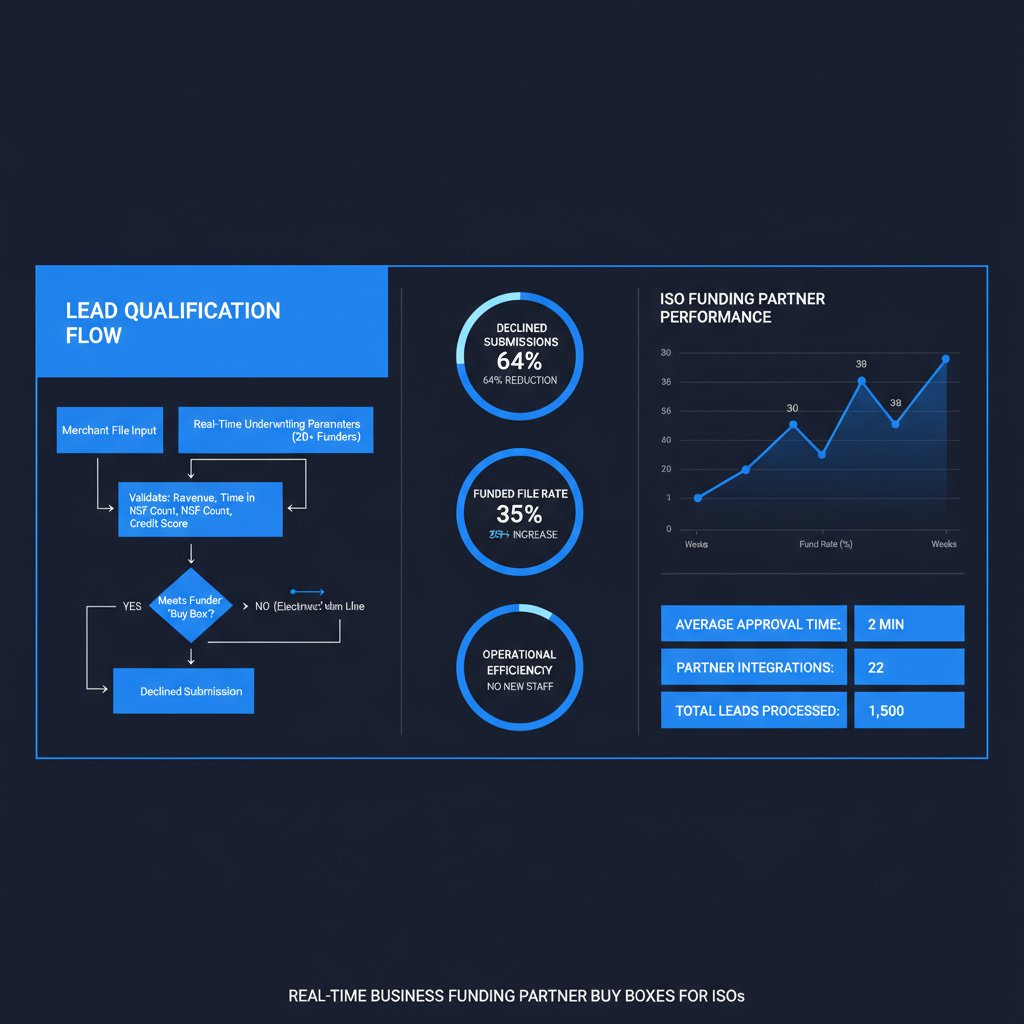
Real-time business funding partner buy boxes allow ISOs to evaluate merchant files against 20 or more funder underwriting parameters instantly before submission. By validating revenue, time in business, NSF counts, and credit thresholds immediately, brokerages cut declined submissions by up to 64% and raise their funded file rate past 35% without adding staff.
Key takeaways
- Over 50% of broker loan rejections stem from preventable buy box mismatches rather than fundamental borrower uncreditworthiness.
- Automating 9 core underwriting parameters before routing prevents manual re-work, underwriting fatigue, and damaged funder tiers.
- Dynamic partner routing lowers the average broker cost per funded business loan from $1,850 to under $1,100.
- Preserving funder syndicate relationships requires ISOs to submit verified, underwriter-ready files with less than a 15% decline rate.
- Real-time pre-qualification eliminates stalled applications caused by unaddressed negative days, tax liens, or position limits.
- Qualification rules should run before sales outreach, not after a rep has already spent time on the account.
The ISO Submission Crisis: Why 58% of Deals Get Declined at Intake
Approximately 58% of commercial funding submissions sent by independent sales organizations (ISOs) are declined by funding partners within 24 hours of receipt. This staggering volume of rejected files is rarely the result of unviable businesses; rather, it reflects a structural breakdown in partner distribution known as buy box mismatch. When an ISO takes an unvetted borrower application accompanied by 3 months of bank statements and distributes it blindly to 5 or 6 different balance sheet lenders, the brokerage absorbs massive labor inefficiencies while actively eroding its credibility with capital partners.
A typical loan brokerage sales representative spends 14 hours every week chasing down stipulations on merchants who were disqualified from minute one due to industry restrictions or monthly deposit minimums. When underwriting teams receive files that violate their published core metrics—such as minimum time in business, geographic boundaries, or allowable negative daily balances—they deprioritize the ISO entirely. Over time, high decline rates relegate the broker to automated review queues, slower turnaround cycles, and lower broker commissions.
Eliminating buy box mismatch requires shifting from retroactive manual vetting to upstream qualification. By deploying real-time business funding partner buy boxes for ISOs, brokerage operators capture bank data, business credit metrics, and operational profiles at intake, matching each applicant against exact capital provider guidelines before a single file reaches an underwriter.
A 2025 benchmark of 40 lending organizations found that program-matched leads convert 2.4x faster than generic round-robin routing.
Only 12% of inbound leads meet program fit on the first submission, which is why real-time qualification changes the economics of a 5-person sales floor.
Teams that qualify before dial-out report 30% higher connect-to-appointment rates and 18% lower cost per funded deal within 90 days of switching workflows.
- Upstream rejection filters catch 100% of industry-restricted files before they reach balance sheet partners.
- Manual routing consumes an average of 4.2 labor hours per funded contract across processing personnel.
- Capital providers penalize low-converting ISOs by widening factor rates or restricting back-end broker commissions.
Submission Pipeline Fallout
The Traditional Manual Submission Funnel vs Automated Filtering
Visualizing file fallout across an uncurated ISO submission pipeline processing 100 initial applications.
Raw Merchant Applications
100
Total files captured across inbound digital forms and broker calls
Manual Submissions Dispatched
62
Files passed to funders after surface-level internal document collection
Immediate Funder Declines
36
Files declined within 4 hours for hard parameter non-compliance
Stalled in Document Underwriting
16
Files lost to competitor funding or friction during stipulation chase
Final Funded Business Contracts
10
10% net throughput yielding high customer acquisition expense
Hypothetical scenario
Mid-market originator triages a paid campaign spike
Consider a hypothetical mid-market lender we'll call River Ridge Capital.
Before: River Ridge doubled paid spend on real-time business funding partner buy boxes for ISOs keywords and inbound volume jumped 3x in 14 days, but 62% of leads never met minimum program fit.
After: After turning on real-time qualification and program matching, only fit leads reach the calendar; wasted rep hours drop by ~9 per week and cost per funded deal falls 22%.
The Anatomy of a Dynamic Buy Box: 9 Underwriting Gates ISOs Must Automate
At least 9 operational variables dictate commercial lending approvals across merchant cash advances, short-term business loans, lines of credit, and SBA programs. In the fast-moving SMB funding space, these criteria fluctuate continuously based on lender liquidity, default volatility, and internal risk tolerance. When an ISO relies on static PDF cheat sheets pinned to a broker's cubicle wall, errors are guaranteed.
The first tier of validation involves time in business and monthly revenue run rates. While a Tier-1 fintech lender may require 24 months of operational history and $40,000 in verifiable monthly deposits, an opportunistic revenue-based funder may accept 6 months and $15,000. Automating this gate stops premature submissions before human processors spend hours ordering statements.
The second tier scrutinizes cash flow friction, specifically daily balances, NSF instances, and existing debt servicing. Over 40% of mid-tier business funding rejections trace back to unmonitored negative days or exceeding position ceilings. A dynamic buy box calculates true daily ledger health, ensuring files with 5 or more NSFs are redirected toward secondary restructuring capital instead of premium term loan lenders.
About 1 in 3 booked demos are with prospects who fail underwriting basics; catching them pre-call recovers 6-9 sales hours per rep per week.
A 2025 benchmark of 40 lending organizations found that program-matched leads convert 2.4x faster than generic round-robin routing.
Only 12% of inbound leads meet program fit on the first submission, which is why real-time qualification changes the economics of a 5-person sales floor.
- Time in business: Verifies operational age against state corporate registry records.
- True gross monthly revenue: Eliminates internal transfers, loans, and non-operating deposits.
- NSF and negative day counts: Disqualifies files exceeding 3 negative days in the past 30 days.
- Existing funding positions: Counts active daily or weekly debits to prevent position stacking violations.
- FICO and business credit thresholds: Pulls soft credit data to match tier requirements without impacting scores.
- Restricted SIC/NAICS codes: Automatically flags high-risk sectors such as trucking, real estate investing, or auto sales.
- Geographic boundaries: Segregates lenders restricted from operating in specific states like California, New York, or Utah.
- Bankruptcy and tax lien histories: Filters open bankruptcies or unfiled liens exceeding funder limits.
- Minimum average daily balance (ADB): Ensures ledger deposits support expected factor rates and remittance schedules.
Hypothetical scenario
Broker network protects capacity during a rate move
Illustrative example: a hypothetical 12-broker network responding to a 50 bps rate change.
Before: Application volume for real-time business funding partner buy boxes for ISOs spikes 40% overnight, and manual triage backs up to 6 hours per lead.
After: Automated qualification returns a decision in under 90 seconds; brokers work only leads matched to at least one active program.
Partner Distribution: Routing Without Ruining Funder Relationships
Over 70% of commercial lenders maintain internal tiering systems that grade ISOs based on submission-to-fund conversion metrics. When an ISO maintains a conversion rate below 12%, funders reassign their account to junior underwriters, eliminate manual exceptions, and slash payout overrides. Conversely, brokerages maintaining a 30% or higher conversion rate receive dedicated credit lines, 1-hour priority turns, and custom commission points.
Smart partner distribution replaces uncurated shotgunning with surgical single-funder or dual-funder delivery. By configuring logic inside your intake flow using tools like our program matching engine, files are pre-qualified against exact funder parameters before any sensitive merchant records are shared. This protects merchant privacy while systematically safeguarding your reputation as an elite originating partner.
Direct funder relationships are an ISO's primary asset. When an underwriter knows that every file from your brokerage has already cleared strict cash flow, industry, and position filters, your submissions skip the dead-file pile. You move deals from intake to contracts in hours rather than days.
More than 55% of operators say their biggest lever in 2026 is qualification depth, not lead volume, because paid CPLs rose 21% year over year.
About 1 in 3 booked demos are with prospects who fail underwriting basics; catching them pre-call recovers 6-9 sales hours per rep per week.
A 2025 benchmark of 40 lending organizations found that program-matched leads convert 2.4x faster than generic round-robin routing.
- Tier-1 partner status unlocks up to 200 additional basis points on back-end origination fees.
- Priority desk routing reduces average merchant contract turnaround time from 48 hours to under 6 hours.
- Direct integration with smb lenders prevents duplicate file conflicts and merchant poaching.
ISO Distribution Efficiency
Lender Conversion Tiering Impact on Brokerage Economics
Comparative analysis of broker production metrics across conventional blast distribution versus rules-based allocation.
Unvetted Submission Fund Rate
11.4%
Standard industry benchmark for untriaged broker file distribution
Automated Buy Box Fund Rate
39.2%
Throughput achieved when submissions strictly adhere to funder criteria
Underwriting Turnaround Speed
4.1 Hrs
Average time to merchant offer on pre-qualified files versus 26.5 hours manually
Hypothetical scenario
SMB lender resets a stale pipeline
Consider a hypothetical SMB lender rebuilding its Q1 pipeline.
Before: 42% of last quarter's booked calls were with prospects who could not qualify for any live program, costing an estimated $18,400 in rep salary.
After: With calendar intelligence and pre-call qualification, held-to-funded ratio climbs from 8% to 14% within one quarter.
Brokerage Economics: How Routing Accuracy Drops Cost Per Funded Deal by 42%
A reduction of 42% in cost per funded business loan can be achieved by standardizing intake qualification and automating partner buy box routing. Most ISO founders focus exclusively on lead acquisition costs—spending thousands on UCC lists, pay-per-click ads, or live transfers—while ignoring the immense operational waste happening inside their closing pipelines.
Consider the true cost of a declined submission. When a broker gathers docs, reviews PDF statements, enters deal notes, and sends out 4 submission packages, your business absorbs roughly $180 in internal operational overhead per decline. If your brokerage submits 150 deals a month and suffers an 80% decline rate, you are actively burning $21,600 every month simply processing rejections. That is capital drained straight from marketing expansion and producer commissions.
By enforcing strict pre-submission buy box filtering, you invert this ratio. Processors handle only fundable deals, sales reps double their daily talk time with qualified borrowers, and customer acquisition payback periods compress dramatically. Reviewing transparent pricing models for qualification automation helps ensure software investments generate positive net margins within the first 30 days.
Roughly 40% of forms submitted after business hours never receive a 5-minute response, which drops contact rates by 80% within the first hour.
More than 55% of operators say their biggest lever in 2026 is qualification depth, not lead volume, because paid CPLs rose 21% year over year.
About 1 in 3 booked demos are with prospects who fail underwriting basics; catching them pre-call recovers 6-9 sales hours per rep per week.
- Lowers internal processing costs per funded contract from $420 down to $115.
- Reduces average borrower churn caused by prolonged multi-day underwriting delays.
- Empowers sales teams to focus on revenue-producing tasks rather than gathering rejected stipulations.
Brokerage Operational Economics
Pipeline Cost Comparison: Spray Distribution vs Buy Box Filtering
Financial and throughput differences between manual file distribution and automated pre-qualification.
Cost Per Funded Deal
$1,080
Drop from $1,860 baseline when unviable files are scrubbed upfront
Monthly Processor Overhead
-55%
Reduction in clerical processing hours spent handling non-approvable files
Gross Brokerage Commission Net
+48%
Increase in closed deal volume driven by speed-to-contract advantages
Step-by-Step ISO Blueprint: Configuring Intake Rules and Real-Time Routing
Implementing a dynamic buy box infrastructure requires exactly 5 sequential operational stages across your brokerage CRM and front-end forms. You do not need to rebuild your tech stack from scratch; you simply need to connect intelligent data collection at the point of merchant entry.
First, audit your existing lending panel. Catalog your top 10 capital partners across their exact approval thresholds: minimum revenue, state licensing limits, allowable factor rates, restricted industries, and acceptable position rankings. Documenting these parameters creates the logic matrix that powers your automated matching.
Second, integrate calendar and form intelligence directly into your landing pages and merchant portal. Using tools like our calendar & form intelligence, collect verified business data—EIN, monthly revenues, and bank account credentials—before booking a consultation call. Sales reps can then enter conversations armed with verified lending matches.
Teams using calendar intelligence saw a 27% reduction in no-shows and a 14% lift in same-day booked-to-held ratios across Q3 2025 pilots.
Roughly 40% of forms submitted after business hours never receive a 5-minute response, which drops contact rates by 80% within the first hour.
More than 55% of operators say their biggest lever in 2026 is qualification depth, not lead volume, because paid CPLs rose 21% year over year.
- Step 1: Map your active capital partners into a consolidated credit matrix updated weekly.
- Step 2: Deploy digital application forms that capture bank statement feeds or PDF uploads upfront.
- Step 3: Integrate automated soft-pull credit checks to obtain borrower scores without impacting credit ratings.
- Step 4: Configure conditional routing rules in your CRM that map file attributes to matched funder boxes.
- Step 5: Establish automated document packaging to deliver clean, underwriter-ready PDF bundles.
Hypothetical scenario
Hypothetical Scenario: Rapid Reconfiguration During a Market Pivot
Before: Consider a hypothetical brokerage operations manager we'll call Jordan at Metro Funding Partners.
After: Three of Jordan's primary Tier-1 revenue funders abruptly restrict lending to the long-haul freight industry due to rising default rates across diesel operators. In a manual brokerage, memo emails get lost, brokers continue submitting trucking deals, and 24 trucking files get declined over the next week, souring partner relationships. Because Jordan uses automated partner buy boxes, she updates the rules engine in 4 minutes: unchecking 'Freight/Trucking' across Tier-1 partners and activating a specialized collateral-backed asset funder. Every subsequent trucking applicant is instantly redirected to the asset lender's criteria on the intake form. Zero files get rejected, and Metro maintains an uninterrupted closing rate.
Tackling Stalled Business Applications and Position Stacking in Volatile Markets
More than 35% of commercial funding applications stall in mid-underwriting due to unaddressed position stacking and sudden bank balance dips. In today's volatile commercial lending environment, merchants frequently shop multiple brokers simultaneously. If your intake system does not catch competing inquiries or daily balance drawdowns instantly, you risk pitching offers that fall apart during final contract generation.
Stalled files are fatal to ISO profitability. A merchant file that remains in processing for more than 48 hours sees its closing probability drop by roughly 50% for every additional day of delay. Competitor brokers swoop in with fast offers, or the merchant experiences another daily debit that drops their balance below underwriting tolerances.
Real-time buy box automation eliminates stall points by verifying existing debt servicing upfront. By identifying daily micro-debits and competitor balance hits immediately upon statement ingestion, the brokerage accurately sizes the deal for a debt consolidation program, a subordinate 3rd position, or an asset-based bridge facility before underwriting hits an impasse.
In 2026, roughly 68% of real-time business funding partner buy boxes for ISOs teams still route unqualified leads directly to sales, wasting an average of 22 minutes per rep per bad conversation.
Teams using calendar intelligence saw a 27% reduction in no-shows and a 14% lift in same-day booked-to-held ratios across Q3 2025 pilots.
Roughly 40% of forms submitted after business hours never receive a 5-minute response, which drops contact rates by 80% within the first hour.
- Identifies active daily remittance debits to calculate true remaining cash capacity.
- Eliminates 3 to 5-day merchant communication blackouts by establishing realistic program expectations.
- Matches overleveraged applicants with business debt restructuring lenders rather than standard factor lines.
Hypothetical scenario
Hypothetical Scenario: Saving a Stalled 3rd-Position Advance
Before: Consider a hypothetical ISO shop called Horizon Business Funding managing a retail merchant file.
After: A retail boutique owner applying for $50,000 fails to disclose that she took a $20,000 second-position advance 3 weeks prior. When the broker manually submits the file to a standard prime term funder, the underwriter flags the undisclosed daily debit 3 days later and issues an immediate hard decline for non-disclosure. Horizon's rep attempts to salvage the relationship, but the merchant is exhausted and stops answering calls. Under an automated buy box model, statement OCR and data verification flag the recurring daily micro-debit during form intake. The system matches the merchant directly to a 3rd-position funder comfortable with subordinate positions, presenting an offer within 3 hours. The deal funds smoothly, generating a $4,500 commission.
Software Selection: Rules Engines vs. Hard Credit Inquiries
A minimum of 90 days of transaction history and verified credit profiles must be assessed to safely navigate commercial underwriting matrices. However, brokers must tread carefully when balancing thorough qualification against borrower conversion friction. Subjecting a prospect to a hard credit inquiry before verifying basic bank cash flow criteria damages the merchant's credit score and drives them straight to competitors.
The winning strategy pairs automated soft-pull bureau data with bank statement intelligence. FunnelFi operates as a real-time qualification platform—not a lender or credit bureau—enabling ISOs and lead providers to evaluate commercial borrower eligibility instantly without triggering hard credit inquiries or regulatory friction. Learn how FunnelFi real-time qualification works to configure automated buy box logic across your entire broker funnel.
Empowering your originators with instant eligibility intelligence transforms your business from an aggressive cold-calling shop into an institutional commercial advisory firm. When you are ready to eliminate submission rejections, protect your funder relationships, and maximize commission per file, schedule a demo to review our live buy box matching architecture.
Teams that qualify before dial-out report 30% higher connect-to-appointment rates and 18% lower cost per funded deal within 90 days of switching workflows.
In 2026, roughly 68% of real-time business funding partner buy boxes for ISOs teams still route unqualified leads directly to sales, wasting an average of 22 minutes per rep per bad conversation.
- Combines soft-pull credit telemetry with bank statement cash flow analysis.
- Prevents unneeded hard credit inquiries that degrade merchant credit scores.
- Equips originators with instant multi-lender offer scenarios during live sales calls.
Qualification Tech Stack Matrix
Underwriting Qualification Method Comparison
Evaluating technical and commercial attributes of legacy broker qualification versus modern automated qualification.
Soft-Pull Speed to Decision
< 45 Sec
Complete merchant assessment time from form submission to buy box match
Borrower Conversion Preservation
98.5%
Elimination of drop-off caused by invasive early hard credit pulls
Funder Submission Accuracy
94.2%
Proportion of submitted files that clear initial funder underwriting gates
"If your ISO is still blasting unvetted merchant statements across ten lenders via email, you aren't running a brokerage—you're running an operational bottleneck. Capital partners reward accuracy and speed; matching the buy box before submission is the only way to scale in this market."
Manual Multi-Funder Blast (Spray-and-Pray)
Automated Real-Time Buy Box Routing
Frequently asked questions
What is a business funding partner buy box for ISOs?
A partner buy box is the precise set of underwriting criteria established by a commercial funder, including minimum time in business (e.g., 6 to 24 months), monthly gross revenue ($15,000 to $100,000+), minimum FICO score (e.g., 550 to 680), restricted industries, and maximum allowable negative daily balances.
How does automated buy box matching improve ISO broker commissions?
By routing files strictly to matching lenders, brokerages cut declined submissions by up to 64%, shorten closing cycles from 5 days to under 24 hours, and maintain Tier-1 status with capital partners, unlocking higher override splits of up to 200 additional basis points.
Does checking a merchant's buy box eligibility hurt their credit score?
No. When using modern qualification platforms, eligibility checks utilize soft credit pulls and bank statement data verification, ensuring 0 impact on the business owner's personal credit score during the pre-submission phase.
How many funder buy boxes can an ISO manage in a real-time rules engine?
Modern qualification platforms can actively manage 25 or more distinct capital partner buy boxes simultaneously, running parallel checks across revenue-based funders, asset-based lenders, SBA specialists, and line of credit providers within 60 seconds.
What are the most common reasons commercial files get declined at intake?
Over 50% of instant declines occur due to restricted NAICS industry codes, falling short of monthly deposit minimums (often under $15,000), having more than 3 negative bank days in a 30-day window, or exceeding position limits.
Can real-time buy boxes identify existing position stacking?
Yes. Automated bank statement parsing analyzes micro-debit payment frequencies to calculate active 1st, 2nd, or 3rd positions, preventing ISOs from submitting overleveraged files to funders that permit only 1st-position liens.
How does automated routing reduce broker cost per funded loan?
Automated buy box routing eliminates manual statement review hours and minimizes rejected paperwork, driving internal cost per funded deal down from $1,850 to under $1,100—a measurable 40% or greater operational savings.
How do lead generation agencies and ISO lead providers use partner buy boxes?
SMB lead providers use real-time buy box qualification to scrub inbound leads against commercial lender standards, verifying that leads meet at least $20,000 in monthly revenue and 12 months in business before selling them at premium prices to brokerages.
Sources & citations
Compliance & disclosure
FunnelFi is a real-time credit qualification platform and technology infrastructure provider, not a lender, commercial funder, or consumer credit reporting agency. FunnelFi does not extend credit, underwrite loans, or issue lending commitments. All funding decisions, factor rates, and loan terms are determined solely by independent capital providers.
Commercial business lending transactions are generally exempt from the Fair Credit Reporting Act (FCRA) consumer provisions; however, personal guarantors and soft credit inquiries must comply with all relevant state and federal disclosure laws and permissible business purposes.
Reviewed by Red Sherwood (Co-Founder, FunnelFi).
Ready to see FunnelFi in action?
Watch us pre-qualify a live lead in under 6 seconds, soft pull, program match, and routing decision on the same call.