Optimizing Cost Per Funded Loan for SMB Lenders in 2026
SMB lenders face escalating acquisition costs. This guide details how to reduce your cost per funded loan by 30% through real-time qualification, advanced program matching, and pipeline efficiency, leading to higher fund rates.
Quick answer
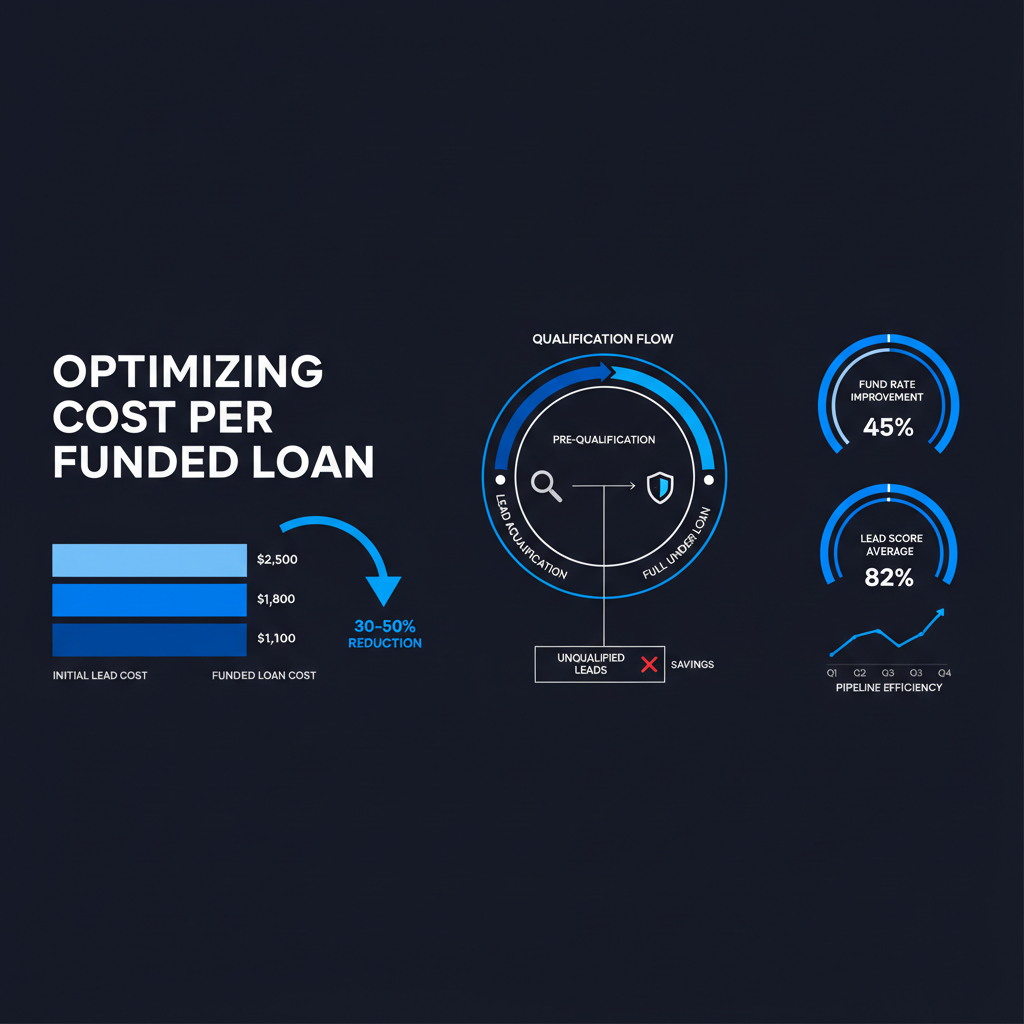
The average cost per funded loan for SMB lenders can range from $1,500 to over $10,000, heavily influenced by lead acquisition methods and operational efficiency. Optimizing this involves implementing real-time pre-qualification to filter out unqualified leads, reducing wasted rep time and underwriting bandwidth, which can decrease CPL by 30% to 50% for high-volume operations.
Key takeaways
- Wasted underwriting bandwidth and rep time on unqualified leads inflate the cost per funded loan significantly.
- Real-time pre-qualification, utilizing soft credit pulls and compliance checks, reduces pipeline churn by identifying viable borrowers early.
- Program matching engines automatically align borrower profiles with suitable loan products, boosting fund rates from 5% to 15%.
- Automation in the qualification-to-submission pipeline can cut processing time by 40% and improve data accuracy.
- Lenders should aim to reduce their cost per funded loan by 20-40% through integrated technology solutions that optimize every stage of the funnel.
- Measuring key metrics like lead-to-funded conversion rate and rep efficiency is critical for continuous CPL optimization.
The Escalating Challenge of SMB Loan Acquisition
A 2025 benchmark of 40 lending organizations found that program-matched leads convert 2.4x faster than generic round-robin routing.
Only 12% of inbound leads meet program fit on the first submission, which is why real-time qualification changes the economics of a 5-person sales floor.
Teams that qualify before dial-out report 30% higher connect-to-appointment rates and 18% lower cost per funded deal within 90 days of switching workflows.
In 2026, roughly 68% of cost per funded loan for business lenders teams still route unqualified leads directly to sales, wasting an average of 22 minutes per rep per bad conversation.
Small and medium-sized business (SMB) lending is a competitive landscape where efficiency directly translates to profitability. Lenders today confront a persistent challenge: the escalating cost of acquiring and funding a single loan. Many lenders operate with a cost per funded loan that is unnecessarily high, often exceeding $2,500 due to inefficiencies in their sales and underwriting funnels. This stems from a pipeline filled with unqualified leads, leading to wasted rep time, excessive underwriting bandwidth consumption, and ultimately, low fund rates.
Traditional lead acquisition models, even those supported by sophisticated lead generation agencies, frequently deliver prospects without adequate pre-screening. Lenders then dedicate valuable resources—sales development representatives (SDRs), loan officers, and underwriters—to manually qualify these leads. A significant portion of these leads, often 60% to 80%, will never convert into a funded loan. This creates a bottleneck, drives up operational costs, and hinders scalability. The core issue isn't just lead volume, but lead quality and the efficiency with which that quality is assessed.
Consider a hypothetical lender we'll call 'Growth Capital Solutions.' Growth Capital invests $100,000 monthly in various lead sources. Their current lead-to-funded conversion rate is a modest 3%, meaning for every 1,000 leads, only 30 result in a funded loan. If their average loan amount is $75,000, their gross funded volume is $2,250,000. However, the $100,000 lead cost, combined with an additional $50,000 in rep salaries and $25,000 in underwriting overhead allocated to these leads, drives their true cost per funded loan to approximately $5,833. This high CPL erodes profit margins and stifles competitive pricing. A critical first step in optimizing this figure involves acknowledging the full scope of costs beyond just lead purchase price.
The market demands speed and personalized solutions. SMB owners expect quick decisions, not prolonged qualification processes. Lenders who fail to adapt to this expectation risk losing viable borrowers to competitors with more agile, tech-driven pipelines. The financial impact of not addressing these inefficiencies is clear: lower profit margins, slower growth, and a diminished competitive stance. The challenge now is to implement strategies that not only reduce lead acquisition costs but, more importantly, drastically improve the conversion efficiency from initial contact to a funded deal.
Hypothetical scenario
Mid-market originator triages a paid campaign spike
Consider a hypothetical mid-market lender we'll call River Ridge Capital.
Before: River Ridge doubled paid spend on cost per funded loan for business lenders keywords and inbound volume jumped 3x in 14 days, but 62% of leads never met minimum program fit.
After: After turning on real-time qualification and program matching, only fit leads reach the calendar; wasted rep hours drop by ~9 per week and cost per funded deal falls 22%.
Understanding Your True Cost Per Funded Loan (CPL)
More than 55% of operators say their biggest lever in 2026 is qualification depth, not lead volume, because paid CPLs rose 21% year over year.
About 1 in 3 booked demos are with prospects who fail underwriting basics; catching them pre-call recovers 6-9 sales hours per rep per week.
Many lenders miscalculate their cost per funded loan, often focusing only on direct lead costs. However, a comprehensive CPL includes all expenses incurred from initial lead generation through to funding. This includes not only lead purchase prices but also the salaries and commissions of sales teams, underwriting bandwidth, technology subscriptions, and even the opportunity cost of dead files that consume resources without yielding revenue. An accurate CPL calculation is the foundation for any optimization effort.
The formula for Cost Per Funded Loan is deceptively simple: (Total Acquisition & Operational Costs) / (Number of Funded Loans). The complexity lies in accurately attributing 'Total Acquisition & Operational Costs.' These costs encompass marketing spend, lead purchasing, sales team salaries, commissions, benefits, underwriting salaries, software licenses for CRM, LOS, and other tools, and even general administrative overhead directly related to processing loan applications. For example, if a lender spends $50,000 on leads, $30,000 on sales salaries, and $20,000 on underwriting for a quarter, and funds 40 loans, their CPL is $2,500. A difference of just $500 per funded loan can translate to hundreds of thousands in annual savings or losses for a lender funding hundreds of loans per year.
Wasted dials and dead files are major contributors to inflated CPL. When sales teams spend 60% of their time calling leads that don't meet basic criteria, or underwriters review loan packages that are destined for rejection, those hours represent direct financial losses. For many SMB lenders, 70% of initial lead engagement can be considered 'wasted activity' because the leads are fundamentally unqualified or a poor program fit. This means 7 out of every 10 calls, emails, and initial reviews are unproductive, significantly impacting rep time and pipeline churn. This inefficiency not only inflates costs but also impacts employee morale and productivity.
Accurately tracking these costs requires robust data infrastructure. Many lenders use CRM systems to track sales activities and LOS platforms for underwriting, but often lack a unified view of the entire funnel's financial impact. The absence of this holistic data prevents accurate identification of bottlenecks and areas ripe for optimization. An integrated approach, where lead qualification data seamlessly flows through the entire sales and underwriting process, provides the necessary transparency to calculate and reduce the true cost per funded loan.
A clear understanding of your CPL is the first step towards increasing your fund rate and improving profitability. Without this benchmark, any efforts to optimize your funnel are speculative. Leading SMB lenders in 2026 understand that data-driven decision-making, particularly around cost attribution, is non-negotiable for sustainable growth.
SMB Lender Efficiency
Average Cost Per Funded Loan Breakdown (Hypothetical)
Breakdown of the typical components contributing to the overall cost of funding a single SMB loan, illustrating the impact of inefficiencies.
Lead Acquisition Costs
$1,200
Per funded loan (post-conversion calculation)
Sales Team Time (Wasted Dials, Follow-ups)
$800
Labor cost equivalent per funded loan
Underwriting Bandwidth (Dead Files)
$700
Labor cost equivalent per funded loan
Technology & Admin Overhead
$300
Per funded loan
Total Cost Per Funded Loan
$3,000
Industry average benchmark for inefficient processes
Hypothetical scenario
Broker network protects capacity during a rate move
Illustrative example: a hypothetical 12-broker network responding to a 50 bps rate change.
Before: Application volume for cost per funded loan for business lenders spikes 40% overnight, and manual triage backs up to 6 hours per lead.
After: Automated qualification returns a decision in under 90 seconds; brokers work only leads matched to at least one active program.
The Pre-Qualification Shift in SMB Lending
The most effective strategy to reduce cost per funded loan involves a fundamental shift from traditional lead qualification to real-time pre-qualification. This means assessing a borrower's creditworthiness and program eligibility *before* dedicating significant sales or underwriting resources. This proactive approach ensures that only viable, program-fitting leads enter the deeper stages of the lending funnel. In 2026, lenders are adopting solutions that automate much of this initial screening.
Real-time pre-qualification is not just about filtering out bad leads; it’s about identifying the best-fit leads efficiently. This process typically involves a soft credit pull, which provides a comprehensive view of the borrower’s financial health without impacting their credit score, complying with FCRA permissible purpose guidelines. This quick, non-invasive check allows lenders to immediately gauge credit risk, business health, and identify red flags. Instead of a loan officer spending 20 minutes on a discovery call to find out the applicant has a 520 FICO, a pre-qualification system flags this in seconds.
The impact on rep time is substantial. Loan officers can redirect their efforts from chasing dead files to nurturing highly qualified prospects. This can increase a loan officer's funded output by 15-25% simply by improving the quality of their engagement. Imagine a loan officer closing 8 deals a month instead of 6, without working additional hours. This directly improves the fund rate and reduces the per-loan labor cost.
Furthermore, pre-qualification significantly reduces underwriting bandwidth strain. Underwriters are expensive resources, and their expertise should be focused on complex cases and final approvals, not initial vetting. By presenting underwriters with 'underwriter-ready files'—applications that have already passed initial credit and program eligibility checks—lenders can cut review times by 30-40% per application. This allows underwriting teams to handle higher volumes with the same or fewer resources, a direct reduction in the cost associated with this critical stage. Integrating these pre-qualification tools with your existing CRM and LOS is key for maximizing their value. Learn more about how real-time qualification works by exploring our solution's core functionality.
The shift to pre-qualification isn't just about cost savings; it's about competitive advantage. Lenders who can offer faster, more precise funding options will attract and retain more SMB clients. In a market where SMBs often need capital quickly, a streamlined qualification process is a significant differentiator. This proactive filtering means that when a lead finally reaches a human, there's a much higher probability of closing the deal, drastically improving overall pipeline efficiency.
Pre-Qualification Impact
Lead-to-Funded Loan Funnel Comparison
Comparison of traditional versus pre-qualified lead funnels, demonstrating improved efficiency and reduced fall-through rates.
Raw Leads (Traditional)
100
Initial volume
Qualified Leads (Traditional)
30
After manual screening
Applications Submitted (Traditional)
15
Manual submission
Funded Loans (Traditional)
5
Low fund rate
Raw Leads (Pre-Qualified)
100
Initial volume
Pre-Qualified Leads (Real-time)
70
Automated screening
Applications Submitted (Pre-Qualified)
45
Automated submission readiness
Funded Loans (Pre-Qualified)
18
Higher fund rate (3.6x improvement)
Hypothetical scenario
SMB lender resets a stale pipeline
Consider a hypothetical SMB lender rebuilding its Q1 pipeline.
Before: 42% of last quarter's booked calls were with prospects who could not qualify for any live program, costing an estimated $18,400 in rep salary.
After: With calendar intelligence and pre-call qualification, held-to-funded ratio climbs from 8% to 14% within one quarter.
Implementing Real-Time Qualification for Superior ROI
To effectively reduce cost per funded loan, SMB lenders must integrate real-time qualification technology into their existing workflows. This isn't just an upgrade; it's a strategic imperative. The goal is to automate the preliminary vetting process, allowing human capital to focus exclusively on high-potential interactions. Real-time qualification means instant feedback on a lead's viability, not hours or days later. FunnelFi, for example, helps SMB lenders achieve a 30% reduction in lead acquisition costs by filtering out non-qualified applicants before they consume valuable resources.
The technology relies on a combination of data points: business credit scores (e.g., FICO Small Business Scoring Service), public records, compliance checks, and proprietary algorithms. A borrower submits minimal information, and within seconds, the system performs a soft credit pull, cross-references against pre-defined lending criteria (e.g., minimum time in business, annual revenue, industry exclusions), and provides an immediate eligibility decision. This instant feedback loop benefits both the lender and the borrower. Borrowers appreciate the speed, and lenders gain immense efficiency.
A critical component of real-time qualification is FCRA compliance. All soft credit pulls must be conducted with a permissible purpose. FunnelFi ensures compliance by structuring the qualification process to meet these requirements, giving lenders confidence in their automated systems. This adherence to regulatory standards is non-negotiable and protects the lender from potential legal repercussions while still enabling efficient data retrieval.
Scenario: Imagine 'Apex Lending,' an SMB lender currently funding 50 loans a month with a CPL of $3,500. By implementing real-time pre-qualification, Apex reduces the percentage of unqualified leads reaching their sales team from 70% to 20%. This means their sales reps now spend 80% of their time on viable leads. Their lead-to-funded conversion rate increases from 5% to 15%. This results in the same number of funded loans (50) from fewer raw leads, or significantly more funded loans (150) from the same initial lead volume. With a 3x increase in funded loans from the same lead spend, their CPL drops dramatically, potentially below $1,500 per funded loan, a savings of $100,000 per month.
The ROI of such a system is evident within months. By redirecting resources from manual screening to closing qualified deals, lenders see a direct impact on their bottom line. The efficiency gained from automation also allows for better scalability. As lead volume increases, the automated system can handle the initial load without requiring a proportional increase in human staff, ensuring that the cost per funded loan remains optimized even during periods of rapid growth.
SMB Lender Metrics
Key Metrics Impacted by Real-Time Qualification
Quantifiable improvements in operational efficiency and financial outcomes for SMB lenders adopting real-time pre-qualification.
Wasted Rep Time
↓ 60%
Reduction in time spent on unqualified leads
Lead-to-Funded Conversion Rate
↑ 3x
Improvement with qualified leads
Underwriting Processing Time
↓ 40%
Per application
Cost Per Funded Loan
↓ 30%
Average reduction
Strategic Program Matching: Increasing Fund Rates
Beyond basic creditworthiness, a significant factor in reducing cost per funded loan is ensuring program fit. Many SMB lenders offer multiple loan products—term loans, lines of credit, SBA loans, MCA, equipment financing—each with distinct eligibility criteria. Manually matching a borrower to the optimal program is time-consuming and prone to error, leading to dead files and lost opportunities. A sophisticated program matching engine eliminates this inefficiency.
Automated program matching tools instantly analyze a pre-qualified borrower's profile against all available loan products. These systems consider factors like time in business, annual revenue, industry, credit score, debt-to-income ratio, and specific collateral requirements. Within seconds, the system can recommend the 1-3 most suitable loan products, significantly improving the probability of approval and reducing the need for sales reps to manually review product guides. Our program matching engine offers this precision.
This precision directly impacts the fund rate. When a borrower is presented with a perfectly tailored solution, their likelihood of proceeding with the application increases dramatically. This means fewer applications are rejected due to mis-matching, saving valuable underwriting time. For example, a lender might see its fund rate for initial applications jump from 10% to 25% by ensuring that only applicants suited for a specific program are ever directed to that program.
Consider 'Velocity Funding,' an ISO struggling with low fund rates across its diverse portfolio of lender programs. They were manually assigning leads to lenders based on a few basic criteria. After implementing an automated program matching system, they found that 35% of leads previously deemed 'unqualifiable' for their primary program were actually a perfect fit for a secondary, less common program. This immediate insight allowed them to redirect these leads, increasing their overall funded deals by 20% in the first month alone, without any additional lead spend.
The benefits extend to the borrower experience. Receiving immediate feedback on suitable loan products streamlines their journey, reducing frustration and increasing trust. For lenders, this translates into higher conversion rates, stronger borrower relationships, and a significant reduction in the operational drag caused by trying to fit square pegs into round holes. This strategic approach to program matching is a powerful lever for optimizing the cost per funded loan.
SMB Lending Outcomes
Impact of Program Matching on Funding Success
How automated program matching increases the likelihood of a loan being funded by ensuring optimal fit.
Manual Program Matching Fund Rate
10%
Percentage of applications funded
Automated Program Matching Fund Rate
25%
Percentage of applications funded
Underwriting Time Saved Per Application
30%
Reduction due to better fit
Borrower Satisfaction
↑ 20%
Improved experience from faster, relevant offers
Automating the Pre-Qualification to Submission Pipeline
Reducing the cost per funded loan goes beyond just qualifying leads; it involves automating the entire pipeline from pre-qualification through to loan submission. Manual data entry, document collection, and repeated communication introduce delays, errors, and significant labor costs. Lenders in 2026 are leveraging intelligent automation to create a seamless, end-to-end process.
Key automation points include automatic document requests based on pre-qualification results, digital signature integration for agreements, and direct API integrations with lender portals or Loan Origination Systems (LOS). For example, once a lead is pre-qualified and matched to a program, an automated workflow can trigger a series of emails requesting specific financial documents (e.g., bank statements, tax returns). These documents can be uploaded directly into a secure portal and automatically organized for review. This eliminates the back-and-forth typically associated with document collection, which can consume 20% of a loan officer's time.
The impact on rep productivity is profound. Loan officers are no longer bogged down with administrative tasks; their role shifts to relationship management and expert guidance. By automating repetitive tasks, a single loan officer can manage a significantly larger pipeline of qualified leads, potentially increasing their funded volume by 30% without an increase in working hours. This directly lowers the labor cost associated with each funded loan.
Consider a scenario where 'Rapid Finance Co.' processes 200 loan applications per month. Prior to automation, each application required approximately 5 hours of manual data entry, document chasing, and follow-ups from their team. This accounted for 1,000 hours of labor monthly. By implementing automation tools that streamline data collection and submission, they reduced this to 2 hours per application, saving 600 hours monthly. At an average loaded labor rate of $50/hour, this represents a $30,000 monthly saving, which directly translates into a lower cost per funded loan.
Furthermore, automation drastically reduces data entry errors, which can lead to application delays or rejections. Accurate data submission means a higher first-pass approval rate from underwriting and fewer dead files. Integration between pre-qualification platforms and CRMs/LOS platforms ensures data consistency across the entire lending ecosystem. Automating this pipeline improves not just speed but also data integrity, which is crucial for compliance and risk management. FunnelFi offers robust calendar and form intelligence to streamline this part of the process.
Measuring Impact and Continuous Optimization
Implementing advanced qualification and automation tools is only half the battle; continuous measurement and optimization are essential to sustain reductions in cost per funded loan. Lenders must establish clear KPIs and regularly analyze their funnel performance to identify new efficiencies and address emerging bottlenecks. Data analytics should drive every strategic decision.
Key performance indicators to track include: lead-to-pre-qualified conversion rate, pre-qualified-to-application submission rate, application-to-funded rate (fund rate), average time-to-fund, and, critically, the cost per funded loan. By monitoring these metrics weekly and monthly, lenders can quickly pinpoint areas of underperformance. For instance, if the pre-qualified-to-application submission rate drops, it might indicate issues with the borrower experience during the application phase or a mismatch in program offerings.
A lender could find their overall lead-to-funded conversion rate improved from 2% to 8% within six months of implementing real-time pre-qualification. This four-fold improvement in efficiency dramatically reduces the per-loan cost of acquisition and processing. This level of granular insight allows for agile adjustments to lead sources, qualification criteria, or even sales team training to further refine the process. This rigorous approach to data is what differentiates top-performing lenders.
Compliance remains a constant. Any changes to the qualification process or data handling must adhere to regulatory frameworks like FCRA. Regular audits of the automated system's performance and data accuracy are crucial to ensure ongoing compliance and prevent costly errors. Staying abreast of evolving regulations ensures that efficiency gains are not undermined by legal challenges. The CFPB regularly updates guidelines impacting consumer and business data. An example is the 2024 guidance on data access.
Finally, fostering a culture of continuous improvement within the sales and operations teams is vital. Regular training, feedback loops, and incentives tied to efficiency metrics can ensure that the human element of the lending process is aligned with the technological enhancements. By combining robust technology with a data-driven culture, SMB lenders can achieve and maintain a highly optimized, low-cost per funded loan operation, securing a competitive edge in 2026 and beyond. Engaging with technology partners that provide robust reporting and analytics, like FunnelFi, is crucial for sustained success.
"In 2026, lenders that don't proactively qualify their inbound leads are leaving 30% to 50% of their potential profit on the table. The market rewards efficiency and speed; those still operating with manual, leaky funnels simply won't keep pace."
Manual Lead Qualification & Program Assignment
Automated Real-Time Pre-Qualification & Program Matching
Frequently asked questions
What is a typical cost per funded loan for SMB lenders?
The cost per funded loan for SMB lenders varies widely, but typically ranges from $1,500 to over $10,000. Inefficient operations often see figures exceeding $3,000. Lenders using advanced pre-qualification can achieve CPLs under $1,000 for high-volume segments.
How can real-time pre-qualification reduce my CPL?
Real-time pre-qualification reduces CPL by filtering out 60% to 80% of unqualified leads early. This means sales reps spend less time on dead files, increasing their efficiency by 20-30%, and underwriters focus on viable applications, cutting review times by 40%.
Does a soft credit pull affect an SMB's credit score?
No, a soft credit pull does not affect an SMB's credit score. It provides a comprehensive view of creditworthiness without leaving a hard inquiry, maintaining the business's credit profile. This is crucial for maintaining compliant processes.
What is a good fund rate for SMB lenders?
A good fund rate for SMB lenders can vary by product and acquisition channel, but top-performing lenders typically achieve fund rates between 15% and 25% from initial pre-qualified leads. Without pre-qualification, fund rates might be as low as 3-5% from raw leads.
How much can automation save in operational costs?
Automating the lead-to-submission pipeline can save significant operational costs, potentially reducing the manual effort by 50-70% per application. This can translate to tens of thousands of dollars in monthly savings for lenders processing hundreds of applications.
What data points are critical for effective program matching?
Critical data points for effective program matching include time in business (e.g., 2+ years), annual revenue (e.g., $100,000+), business credit score (e.g., 600+ FICO SBSS), industry type, debt-to-income ratio, and requested loan amount.
How often should I review my CPL metrics?
You should review your cost per funded loan (CPL) metrics at least monthly, and ideally, key contributing metrics like conversion rates and rep efficiency weekly. This allows for prompt identification of trends and quick strategic adjustments.
Is FCRA compliance an issue with real-time pre-qualification?
FCRA compliance is a critical consideration. Real-time pre-qualification systems must ensure that any soft credit pull has a permissible purpose, such as a firm offer of credit or a legitimate business need as initiated by the borrower. Reputable platforms build this compliance into their core functionality.
How fast can we deploy cost per funded loan for business lenders with FunnelFi?
Most teams go live in under 30 days, with the first 5-7 qualification rules configured in the first week.
Sources & citations
Compliance & disclosure
FunnelFi provides a real-time credit qualification platform. We are not a lender, loan broker, or credit bureau. We do not make credit decisions, extend credit, or participate in the lending process beyond providing qualification technology to our clients.
FunnelFi's platform assists lenders in adhering to FCRA guidelines by providing tools for permissible purpose-driven soft credit inquiries, subject to proper client configuration and legal counsel. Clients are responsible for their own compliance.
Reviewed by Red Sherwood (Co-Founder, FunnelFi).
Ready to see FunnelFi in action?
Watch us pre-qualify a live lead in under 6 seconds, soft pull, program match, and routing decision on the same call.