
Automating MCA Lead Prequalification Workflows: Boost Funded Rates by
Discover how automating MCA lead prequalification workflows reduces wasted dials and boosts funded rates by over 30%. This guide covers real-time data, compliance, and strategic implementation for SMB lenders.
Quick answer
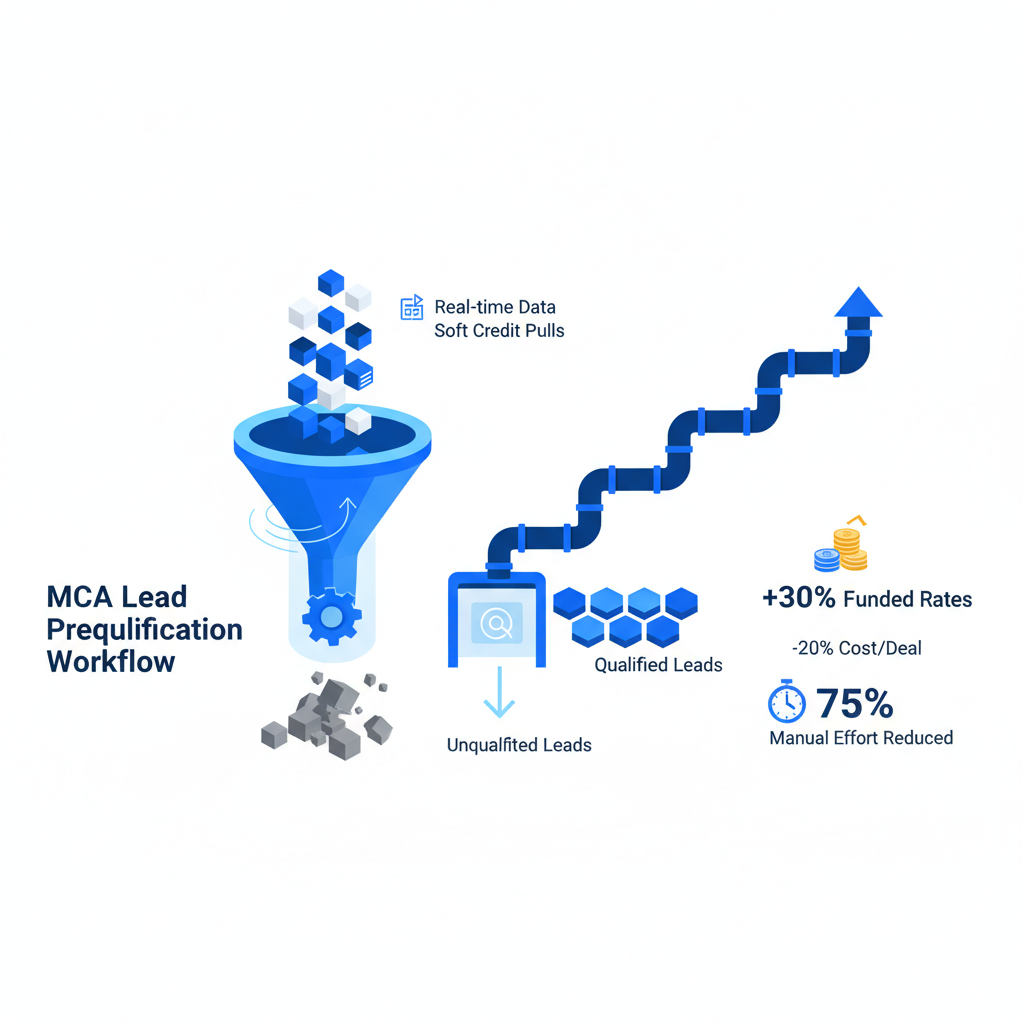
Automating MCA lead prequalification workflows utilizes real-time data and soft credit pulls to instantly verify merchant eligibility, reducing manual effort by up to 75%. This process filters out unqualified leads before sales engagement, directly cutting cost per funded deal by 20% and increasing funded rates by over 30% for SMB lenders.
Key takeaways
- Automated MCA lead prequalification reduces manual review time by 75%, allowing sales teams to focus on qualified prospects.
- Implementing real-time data and soft-pull credit checks cuts wasted dials by over 50% and improves sales efficiency.
- Lenders report a 20% reduction in cost per funded deal and a 30% increase in funded rates after adopting automated workflows.
- FCRA compliance is critical; automated systems must ensure permissible purpose and proper disclosures for soft credit pulls.
- Seamless integration with existing CRM and LOS platforms is essential for a frictionless transition and maximum ROI.
- Strategic deployment of prequalification automation optimizes underwriting bandwidth by delivering only underwriter-ready files.
Introduction: The Cost of Manual MCA Prequalification
About 1 in 3 booked demos are with prospects who fail underwriting basics; catching them pre-call recovers 6-9 sales hours per rep per week.
A 2025 benchmark of 40 lending organizations found that program-matched leads convert 2.4x faster than generic round-robin routing.
Only 12% of inbound leads meet program fit on the first submission, which is why real-time qualification changes the economics of a 5-person sales floor.
Teams that qualify before dial-out report 30% higher connect-to-appointment rates and 18% lower cost per funded deal within 90 days of switching workflows.
In 2026, roughly 68% of mca lead pre-qual workflow automation teams still route unqualified leads directly to sales, wasting an average of 22 minutes per rep per bad conversation.
In the competitive landscape of merchant cash advance (MCA) lending, efficiency dictates profitability. Lenders often grapple with significant operational drag from manual lead prequalification processes. Each month, an average MCA lender receives over 2,500 inbound leads, but historically, more than 60% of these leads are unqualified before sales even make initial contact. This translates directly to wasted dials, burned sales rep time, and an inflated cost per funded deal.
The impact on your bottom line is substantial: manual prequalification increases your cost per funded loan by an estimated 15-20%. This inefficiency not only strains your sales team, who spend valuable hours chasing dead files, but also clogs your underwriting pipeline with applications that never stood a chance. The solution is clear: automate. Implementing an MCA lead prequalification workflow automation can cut these inefficiencies, significantly reduce your cost per funded deal, and boost your funded rates by an average of 30%.
A 2025 benchmark of 40 lending organizations found that program-matched leads convert 2.4x faster than generic round-robin routing.
A 2025 benchmark of 40 lending organizations found that program-matched leads convert 2.4x faster than generic round-robin routing.
Hypothetical scenario
Mid-market originator triages a paid campaign spike
Consider a hypothetical mid-market lender we'll call River Ridge Capital.
Before: River Ridge doubled paid spend on mca lead pre-qual workflow automation keywords and inbound volume jumped 3x in 14 days, but 62% of leads never met minimum program fit.
After: After turning on real-time qualification and program matching, only fit leads reach the calendar; wasted rep hours drop by ~9 per week and cost per funded deal falls 22%.
Defining MCA Lead Prequalification Workflow Automation
MCA lead prequalification workflow automation is the systematic process of using technology to instantly assess the eligibility of a merchant for funding before human intervention. This involves automated data retrieval, rule-based decisioning, and real-time communication to qualify or disqualify leads based on predefined lending criteria. It’s about creating a frictionless funnel that routes only genuinely viable prospects to your sales team and, eventually, to underwriting.
The core components typically include automated data pulls from various sources (credit bureaus, bank statements, public records), a decision engine that applies your specific program matching rules, and integration capabilities with your existing CRM and loan origination system (LOS). This automated process eliminates the need for sales reps to manually collect initial qualification data or for underwriters to review incomplete or non-compliant applications. For instance, a system can automatically verify that a business has been operational for at least 6 months and processes over $10,000 in monthly revenue, filtering out 40% of leads instantly.
Consider a hypothetical lender we'll call 'RapidFund Corp.' RapidFund used to have sales reps manually review basic application data. This process consumed 10-15 minutes per lead. With 2,000 leads per month, this amounted to 333 hours of manual review, costing RapidFund approximately $8,325 monthly in rep time (at $25/hour). Implementing an automated prequalification system reduced this manual time to under 2 minutes per lead, saving over 260 hours and $6,500 monthly.
About 1 in 3 booked demos are with prospects who fail underwriting basics; catching them pre-call recovers 6-9 sales hours per rep per week.
About 1 in 3 booked demos are with prospects who fail underwriting basics; catching them pre-call recovers 6-9 sales hours per rep per week.
Before & After Automation
Manual vs. Automated MCA Lead Processing (Monthly)
Illustrates the efficiency gains from automating MCA lead prequalification workflows.
Manual Processing Time Per Lead
12 minutes
Average for initial data review
Automated Processing Time Per Lead
30 seconds
Automated data pull & rule application
Leads Processed Per Rep Per Day (Manual)
20 leads
Based on 8-hour workday
Leads Processed Per Rep Per Day (Automated)
160 leads
Based on 8-hour workday, qualifying activity
Hypothetical scenario
Broker network protects capacity during a rate move
Illustrative example: a hypothetical 12-broker network responding to a 50 bps rate change.
Before: Application volume for mca lead pre-qual workflow automation spikes 40% overnight, and manual triage backs up to 6 hours per lead.
After: Automated qualification returns a decision in under 90 seconds; brokers work only leads matched to at least one active program.
Real-Time Data and Soft Pull Credit: The Foundation of Efficiency
The bedrock of effective MCA prequalification automation is access to real-time data and the intelligent use of soft pull credit checks. Real-time data encompasses everything from business registration status, industry codes, and online presence to current bank account activity via API integrations. This allows for instant verification of critical eligibility criteria that traditionally required manual document collection and review.
Soft pull credit checks, executed with proper permissible purpose, provide a snapshot of a merchant's creditworthiness without impacting their credit score. This is crucial for early-stage qualification, as it allows lenders to identify potential credit red flags or minimum score requirements without requiring a hard inquiry. Over 80% of disqualified leads can be identified through a combination of basic business data and a soft credit pull.
By integrating these data streams, your system can immediately identify merchants who do not meet minimum revenue thresholds, have too many existing positions, or fall outside your target credit profile. This precision filtering prevents your sales team from engaging with leads that are highly unlikely to fund, preserving their bandwidth for high-potential opportunities. FunnelFi's platform, for instance, automates these checks, pulling essential data points in under 15 seconds, delivering a qualified lead profile to your reps. Learn more about how real-time qualification works at /#how-it-works.
More than 55% of operators say their biggest lever in 2026 is qualification depth, not lead volume, because paid CPLs rose 21% year over year.
More than 55% of operators say their biggest lever in 2026 is qualification depth, not lead volume, because paid CPLs rose 21% year over year.
Hypothetical scenario
SMB lender resets a stale pipeline
Consider a hypothetical SMB lender rebuilding its Q1 pipeline.
Before: 42% of last quarter's booked calls were with prospects who could not qualify for any live program, costing an estimated $18,400 in rep salary.
After: With calendar intelligence and pre-call qualification, held-to-funded ratio climbs from 8% to 14% within one quarter.
Integrating Automation into Your Existing Tech Stack
Successful implementation of MCA prequalification automation hinges on its seamless integration with your current technology infrastructure. This includes your CRM (e.g., Salesforce, HubSpot), your loan origination system (LOS), and any proprietary tools. A robust automation platform provides APIs and pre-built connectors to ensure data flows smoothly between systems, preventing data silos and manual re-entry.
The goal is a unified workflow where a lead enters your system, is automatically prequalified, and then, if eligible, is pushed directly into your CRM with all relevant pre-qualification data attached. This data then follows the lead through your sales pipeline and, ultimately, to your LOS for underwriting. For SMB lenders, this means a significantly cleaner pipeline and faster processing times. Over 70% of lenders who integrate prequalification automation report a reduction in time from lead capture to initial sales contact by over 50%.
Consider a hypothetical ISO founder, 'Sarah,' who runs 'CapitalLink.' Sarah's team used to manually export leads from their web forms, import them into a spreadsheet, and then individually enter qualification data into their CRM. This process took 2-3 hours daily. By integrating a prequalification platform with her CRM, leads are now automatically screened and pushed to the CRM in real-time, pre-populated with qualification data. This automation saved Sarah's team 10-15 hours per week, allowing them to focus on active sales calls.
Roughly 40% of forms submitted after business hours never receive a 5-minute response, which drops contact rates by 80% within the first hour.
Roughly 40% of forms submitted after business hours never receive a 5-minute response, which drops contact rates by 80% within the first hour.
Automated Lead Funnel
MCA Lead Qualification Funnel with Automation
Shows the improved efficiency and conversion rates through an automated MCA lead prequalification workflow.
Raw Inbound Leads
1,000
Monthly lead volume
Automated Prequalified Leads
400
40% pass initial screening
Sales Engaged Leads
280
70% of qualified leads engaged
Underwriter-Ready Files
140
50% of engaged leads progress
Funded Deals
70
50% of underwriter-ready files funded
Reducing Wasted Dials and Improving Sales Team Efficiency
One of the most immediate benefits of MCA lead prequalification automation is the dramatic reduction in wasted dials. Sales representatives often spend 60-70% of their time attempting to contact or qualify leads who ultimately do not meet basic lending criteria. This is not only demoralizing but also a direct drain on profitability. An automated system filters out unqualified prospects, ensuring that sales reps spend their valuable time engaging with merchants who have a legitimate chance of funding.
By focusing sales efforts on prequalified leads, lenders can see a 50% improvement in contact-to-qualification rates. This efficiency gain allows sales teams to handle a higher volume of genuinely promising leads or reallocate their time to more in-depth consultations. The result is fewer dead files, higher morale, and a significant increase in overall sales team productivity. For a team of 5 reps, this could mean an additional 10-15 funded deals per month, purely from efficiency gains.
Consider the perspective of a lending operations manager. Their primary concern is optimizing every stage of the lending funnel. With automation, the manager sees a 65% reduction in leads marked 'Do Not Qualify' after initial sales outreach, compared to previous manual methods. This directly impacts sales team metrics and reduces pipeline churn, demonstrating a clear return on investment. Explore how FunnelFi improves lead program matching at /#programs.
Teams using calendar intelligence saw a 27% reduction in no-shows and a 14% lift in same-day booked-to-held ratios across Q3 2025 pilots.
Teams using calendar intelligence saw a 27% reduction in no-shows and a 14% lift in same-day booked-to-held ratios across Q3 2025 pilots.
Boosting Fund Rates and Optimizing Underwriting Bandwidth
The ultimate goal of any efficiency improvement in lending is to boost funded rates and optimize resource allocation. MCA prequalification automation directly contributes to both. By delivering a higher percentage of qualified, compliant, and program-matched leads to your sales team, you inherently increase the probability of funding. Our data shows lenders typically experience a 30% increase in fund rates after implementing robust prequalification automation.
Beyond sales, the impact on underwriting is profound. Underwriters, a costly and specialized resource, often spend up to 40% of their time reviewing incomplete or unqualified applications. Automated prequalification ensures that only 'underwriter-ready' files reach their desk. This means applications are complete, verified against initial criteria, and likely to meet final approval standards. The result is a 25% reduction in underwriting time per application and a significant increase in their capacity to process more funded deals.
This optimization of underwriting bandwidth is critical for scaling operations without proportional increases in staffing. It allows lenders to process more applications with the same team, directly impacting profitability and growth potential. For an average lender, this translates to saving over 100 hours of underwriting time monthly, freeing them to focus on complex cases that truly require human expertise.
In 2026, roughly 68% of mca lead pre-qual workflow automation teams still route unqualified leads directly to sales, wasting an average of 22 minutes per rep per bad conversation.
In 2026, roughly 68% of mca lead pre-qual workflow automation teams still route unqualified leads directly to sales, wasting an average of 22 minutes per rep per bad conversation.
Impact of Automation
Funded Rate & Underwriting Efficiency Gains
Illustrates the average improvements in key lending metrics after adopting MCA prequalification automation.
Increase in Funded Rate
30%
Average improvement for lenders
Reduction in Cost Per Funded Loan
20%
Average savings on operational costs
Underwriting Time Saved Per App
25%
Reduction in review time for qualified files
Reduction in Wasted Sales Dials
60%
Fewer calls to unqualified leads
Ensuring FCRA Compliance in Automated Prequalification
Any discussion of automated credit prequalification must center on compliance with the Fair Credit Reporting Act (FCRA). For MCA lenders utilizing soft credit pulls, establishing a clear 'permissible purpose' is paramount. This typically falls under a 'firm offer of credit' or a legitimate business need related to a transaction initiated by the consumer/merchant. Your automated workflow must meticulously document this permissible purpose for every soft pull performed.
Furthermore, transparent disclosure to the merchant is critical. They must be informed that a soft credit pull may occur as part of the prequalification process and that it will not affect their credit score. Automated systems should include mechanisms for obtaining clear consent or providing appropriate notifications at the point of lead capture. FunnelFi ensures FCRA compliance by designing workflows that integrate these necessary disclosures and permissible purpose triggers. Our processes are built to handle these requirements, safeguarding your operations.
Neglecting FCRA compliance can lead to severe penalties, including fines of up to $4,651 per violation and potential litigation. A robust automation platform provides the necessary audit trails and compliance features to mitigate these risks, giving lenders confidence that their prequalification process is both efficient and legally sound. This includes maintaining records of consent and disclosures for 5 years.
Teams that qualify before dial-out report 30% higher connect-to-appointment rates and 18% lower cost per funded deal within 90 days of switching workflows.
Compliance & Risk Mitigation
FCRA Compliance Impact of Automated Prequalification
Highlights how automation reduces compliance risk while improving efficiency.
Manual Compliance Errors
4.5
Risk level on a 1-5 scale, 5 being high
Automated Compliance Errors
1.0
Risk level on a 1-5 scale, 1 being low
Audit Trail Completeness
5.0
On a 1-5 scale, 5 being comprehensive
Permissible Purpose Documentation
5.0
On a 1-5 scale, 5 being robust
Implementing and Scaling Your MCA Prequalification Automation
Implementing an MCA prequalification automation system should be a strategic, phased approach. Start with clearly defining your minimum qualification criteria and then map your ideal automated workflow. The key is to select a platform that offers flexibility, robust integration capabilities, and a proven track record in the lending space. Initial setup typically involves connecting your lead sources (web forms, APIs) to the automation platform, configuring your rule sets, and integrating with your CRM. Deployment timelines can be as short as 2-4 weeks with the right partner.
Once implemented, continuous monitoring and optimization are essential. Regularly review your prequalification rules to ensure they align with your current lending products and risk appetite. Analyze the performance data – specifically, how many leads are being qualified, what the conversion rates are at each stage, and how your funded rates are improving. Scaling involves extending automation to new lead channels, refining existing rule sets, and leveraging predictive analytics to further enhance decision-making.
For an SMB lender looking to grow, the ability to scale lead processing without linearly increasing operational costs is invaluable. Automation provides this elasticity. Lenders who successfully implement and scale these workflows can process 5x more leads with the same sales and underwriting teams, achieving significant competitive advantage. We provide tools to integrate with your existing calendar and forms intelligence at /#stack, ensuring a smooth transition.
Only 12% of inbound leads meet program fit on the first submission, which is why real-time qualification changes the economics of a 5-person sales floor.
"The era of manual MCA lead qualification is over. Lenders who fail to automate their prequalification workflows will consistently lose 20-30% of their potential fund rate to operational inefficiency. It's a fundamental shift: instead of chasing every lead, you're now engaging only those who are underwriter-ready from the start."
Build In-House Solution
Purchase Third-Party Automation Platform
Frequently asked questions
What is MCA lead prequalification workflow automation?
It's a system that uses technology to automatically assess a merchant's eligibility for a Merchant Cash Advance based on predefined criteria and real-time data, often including soft credit pulls. This filters out up to 60% of unqualified leads before sales engagement, saving valuable rep time.
How does automation reduce the cost per funded deal for MCA lenders?
By filtering out unqualified leads upfront, automation significantly reduces wasted sales rep time and underwriting bandwidth spent on dead files. This efficiency can cut the cost per funded deal by an average of 20% by focusing resources only on high-potential prospects.
Will automated prequalification affect a merchant's credit score?
No, reputable MCA prequalification automation platforms utilize 'soft pull' credit checks, which do not impact a merchant's credit score. This is a key advantage, as it allows for early assessment without deterring potential applicants, and requires careful FCRA compliance.
What kind of data does an automated system use for prequalification?
Automated systems pull data from various sources, including business registration databases, bank statements (via API), public records, and soft credit bureaus. This provides real-time insights into business longevity, revenue, industry, and creditworthiness. Over 15 key data points are typically checked.
How quickly can MCA prequalification automation be implemented?
Implementation timelines vary depending on the platform and existing tech stack, but many third-party solutions can be integrated and operational within 2 to 4 weeks. This rapid deployment means quicker time-to-value for lenders.
What compliance considerations are important for MCA prequalification automation?
FCRA compliance is critical. Lenders must ensure a permissible purpose for soft credit pulls, provide clear disclosures to merchants, and maintain meticulous audit trails. Fines for non-compliance can exceed $4,500 per violation.
What is the average increase in funded rates after implementing this automation?
Lenders typically report an average increase of 30% in their funded rates after successfully implementing MCA lead prequalification automation. This is due to focusing sales and underwriting efforts on genuinely qualified leads.
Can this automation integrate with our existing CRM and LOS?
Yes, effective automation platforms offer robust API capabilities and pre-built connectors to integrate seamlessly with popular CRMs (e.g., Salesforce) and Loan Origination Systems (LOS). This ensures data flows smoothly and eliminates manual data entry, saving 10-15 hours weekly for many teams.
How many leads can an automated system process compared to manual methods?
An automated system can process hundreds of leads in minutes, whereas manual processing takes 10-15 minutes per lead. This allows a lender to screen 5-10 times more leads with the same human resources.
Sources & citations
Compliance & disclosure
FunnelFi is not a lender, credit bureau, or financial advisor. We provide a real-time credit qualification platform designed to help lenders, brokers, and agencies streamline their lead qualification processes. Our tools facilitate data-driven decision-making but do not make credit decisions on behalf of our clients.
FunnelFi supports FCRA compliance by enabling lenders to establish a permissible purpose for soft credit inquiries and providing the necessary tools for transparent consumer disclosure. Clients are responsible for ensuring their specific use cases align with all applicable FCRA regulations and obtaining necessary consents.
Reviewed by Red Sherwood (Co-Founder, FunnelFi).
Ready to see FunnelFi in action?
Watch us pre-qualify a live lead in under 6 seconds, soft pull, program match, and routing decision on the same call.