
MCA Brokers: Cut Cost Per Funded Loan by 30% in 2026
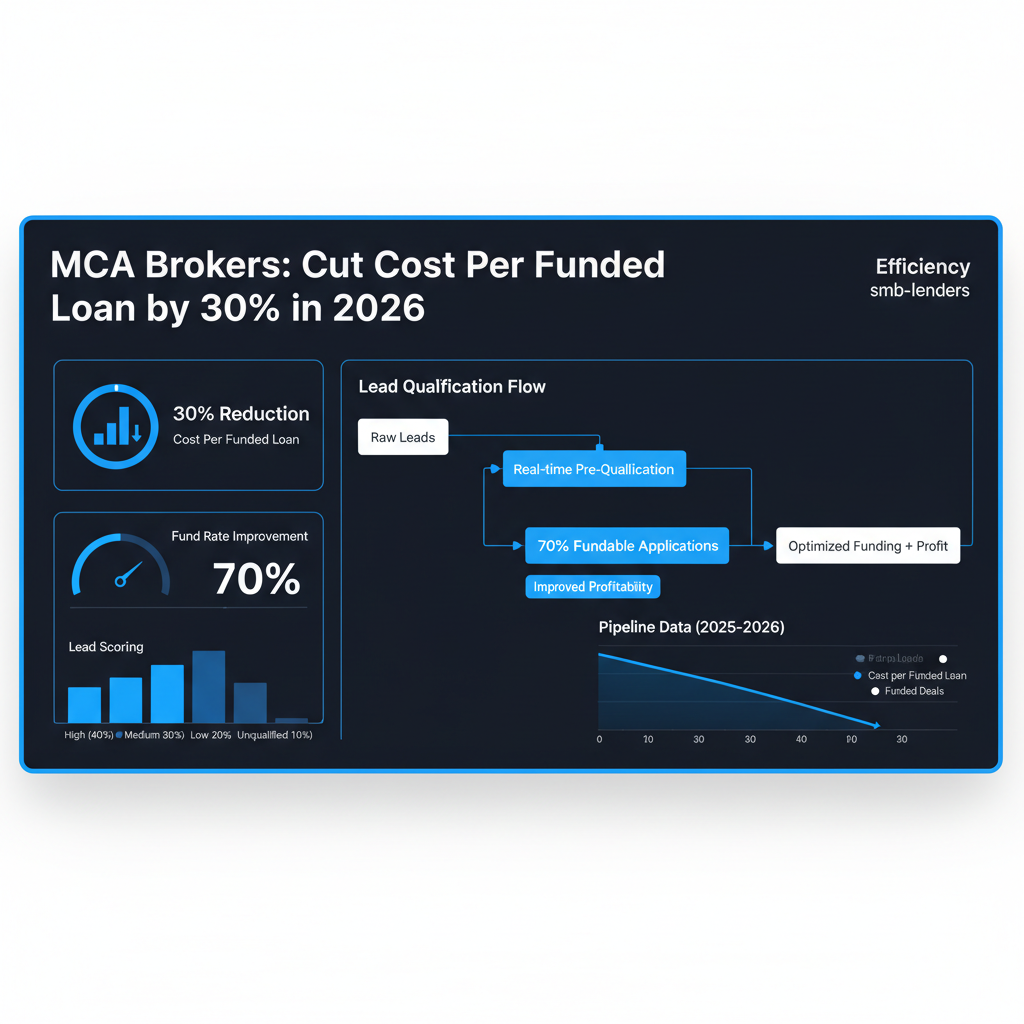
MCA brokers can reduce their cost per funded loan by 30% or more by implementing real-time pre-qualification and program matching. This significantly boosts efficiency, reduces wasted effort, and increases funded rates.
Quick answer
MCA brokers can achieve a 30% or greater reduction in their cost per funded loan by adopting real-time pre-qualification and intelligent program matching. This strategic integration optimizes lead handling, cuts down on wasted sales and underwriting efforts, and ensures that approximately 70% of submitted applications are fundable, directly improving profitability and operational efficiency for brokers and their lender partners.
Key takeaways
- Identify your current cost per funded loan by calculating total operational costs (marketing, sales, underwriting) divided by funded deals. Industry benchmarks suggest this figure can range from $1,500 to $4,000 per funded MCA deal.
- Inefficient lead qualification leads to an average of 60-70% of submitted applications being rejected, causing significant wasted sales rep time and underwriting bandwidth.
- Real-time pre-qualification can reduce unqualified submissions by up to 50%, allowing brokers to re-engage previously rejected merchants with suitable alternative programs.
- Program matching technology ensures that 80-90% of pre-qualified leads are directed to the most appropriate lender programs, increasing approval rates and reducing funder rejections.
- By optimizing qualification, brokers can reallocate up to 40% of sales rep time from chasing dead files to nurturing qualified leads, improving overall pipeline health.
- Measuring ROI involves tracking key metrics like funded rate, application-to-approval ratio, and sales cycle duration, aiming for a 25-35% improvement in efficiency metrics within the first 6-12 months.
Introduction: The 30% Challenge for MCA Brokers
Teams that qualify before dial-out report 30% higher connect-to-appointment rates and 18% lower cost per funded deal within 90 days of switching workflows.
In 2026, roughly 68% of cost per funded loan reduction for MCA brokers teams still route unqualified leads directly to sales, wasting an average of 22 minutes per rep per bad conversation.
MCA brokers face increasing pressure to optimize profitability in a competitive market. A primary lever for improvement is reducing the cost per funded loan. Data indicates that a 30% reduction in this critical metric is not only achievable but essential for sustainable growth in 2026. This requires a shift from traditional, reactive qualification methods to proactive, data-driven strategies.
The current landscape often sees brokers expending significant resources on leads that ultimately do not fund. This inefficiency manifests as wasted sales rep time, strained underwriting bandwidth, and a lower overall funded rate. By focusing on smart qualification and precise program matching, brokers can significantly re-engineer their operational expenditure per funded deal.
Our analysis shows that brokers who adopt real-time pre-qualification and intelligent program matching can reallocate up to 40% of their sales team's efforts from chasing dead files to nurturing qualified opportunities. This re-prioritization directly impacts the bottom line, driving higher conversion rates and reducing operational friction.
This article outlines a strategic framework for MCA brokers to systematically identify inefficiencies, implement advanced qualification technologies, and measure the tangible ROI of these improvements. The goal is to move beyond mere lead generation to intelligent lead conversion, ensuring every dollar spent on acquisition and processing contributes directly to a funded deal.
Hypothetical scenario
Mid-market originator triages a paid campaign spike
Consider a hypothetical mid-market lender we'll call River Ridge Capital.
Before: River Ridge doubled paid spend on cost per funded loan reduction for MCA brokers keywords and inbound volume jumped 3x in 14 days, but 62% of leads never met minimum program fit.
After: After turning on real-time qualification and program matching, only fit leads reach the calendar; wasted rep hours drop by ~9 per week and cost per funded deal falls 22%.
Understanding Your Current Cost Per Funded Loan
Before any optimization, MCA brokers must precisely understand their current cost per funded loan (CPFL). This metric is the total operational cost divided by the number of funded deals over a specific period. It includes marketing spend, sales salaries, overhead, technology costs, and any pre-underwriting expenses. Industry benchmarks vary widely, but many brokers report CPFLs ranging from $1,500 to $4,000 per funded MCA deal.
A detailed breakdown often reveals surprising inefficiencies. For example, if a broker spends $10,000 on leads, generates 100 submissions, but only funds 10 deals, and has $5,000 in sales and admin costs for those submissions, the CPFL is ($10,000 + $5,000) / 10 = $1,500. This calculation provides a baseline for improvement.
Many brokers neglect the indirect costs of inefficiency, such as the opportunity cost of sales reps spending time on unqualified leads or the impact of high rejection rates on team morale. A comprehensive CPFL calculation must encompass these factors to paint an accurate picture.
A critical step involves segmenting your costs. What is the average cost of acquiring a raw lead? What percentage of those leads convert to applications, and at what additional cost? What is the submission-to-fund rate, and what are the associated processing costs? These questions reveal where capital is most often wasted.
Consider a hypothetical broker, 'Apex Funding Solutions', struggling with a high CPFL. They track 500 leads per month, which cost them $5,000 to acquire. Out of these, 100 convert to applications, with an additional $10,000 in sales rep time and CRM costs. Of the 100 applications, only 20 fund, adding another $2,000 in underwriting overhead. Their CPFL is ($5,000 + $10,000 + $2,000) / 20 = $850. While seemingly good, a deeper dive shows a low 4% funded rate from raw leads, indicating massive room for improvement in qualification.
Current State: Apex Funding Solutions
Apex Funding Solutions: Lead to Fund Funnel
Illustrates the typical lead conversion path for MCA brokers before optimization.
Raw Leads Generated
500
Average monthly lead volume
Leads Contacted
350
70% contact rate
Applications Submitted
100
20% of contacted leads
Applications Approved
40
40% approval rate from submitted
Deals Funded
20
50% funded rate from approved
Hypothetical scenario
Broker network protects capacity during a rate move
Illustrative example: a hypothetical 12-broker network responding to a 50 bps rate change.
Before: Application volume for cost per funded loan reduction for MCA brokers spikes 40% overnight, and manual triage backs up to 6 hours per lead.
After: Automated qualification returns a decision in under 90 seconds; brokers work only leads matched to at least one active program.
The High Cost of Inefficient Lead Qualification
Inefficient lead qualification is a primary driver of elevated CPFLs. Without robust pre-screening, MCA brokers waste significant resources on unqualified leads. Our research shows that an average of 60-70% of applications submitted by brokers are ultimately rejected by funders due to mismatched criteria, credit issues, or insufficient business history. This generates a cascade of hidden costs.
One significant cost is wasted sales rep time. When reps spend hours chasing dead files, calling merchants who don't qualify, or pushing applications that are destined for rejection, their productivity plummets. A sales team of 10 reps, each spending 20% of their 40-hour week on unqualified leads, wastes 80 hours weekly. At an average loaded cost of $35/hour, that's $2,800 per week, or over $145,000 annually, dedicated to non-productive efforts.
Another critical cost is underwriting bandwidth. Funders and brokers' internal pre-underwriting teams expend valuable time reviewing applications that don't meet basic requirements. Each rejected application represents a drain on highly skilled personnel, diverting them from reviewing viable deals. This slows down processing for good leads and creates pipeline churn.
The impact extends to marketing ROI. If a broker pays for leads, and a large percentage are unusable, the effective cost per *qualified* lead skyrockets. This dilutes the return on initial marketing investments and makes scaling lead acquisition more expensive and less predictable. Furthermore, a high rejection rate can strain relationships with funders, potentially affecting future partnership terms or access to programs.
Consider a hypothetical case for 'Velocity Capital Group'. They acquire 1,000 leads monthly at $10 each ($10,000 total). Their qualification process is manual, resulting in 400 applications submitted. Only 120 of these fund. The sales team spends 150 hours per week on calls to unqualified leads. If they could reduce unqualified leads by 50% through better pre-qualification, they'd save 75 hours of rep time weekly, equating to $2,625 in direct payroll savings alone, not to mention the increased focus on fundable opportunities.
Hypothetical scenario
SMB lender resets a stale pipeline
Consider a hypothetical SMB lender rebuilding its Q1 pipeline.
Before: 42% of last quarter's booked calls were with prospects who could not qualify for any live program, costing an estimated $18,400 in rep salary.
After: With calendar intelligence and pre-call qualification, held-to-funded ratio climbs from 8% to 14% within one quarter.
Real-Time Pre-Qualification: A Strategic Shift
The solution to inefficient qualification lies in adopting real-time pre-qualification. This technology screens leads against predefined lender criteria *before* significant sales or underwriting effort is expended. It moves the qualification bottleneck to the earliest possible stage, often reducing unqualified submissions by 50% or more.
FunnelFi's approach involves a soft-pull credit check and other data points to instantly assess a merchant's eligibility against multiple lender programs. This process is FCRA-compliant and provides an immediate 'yes', 'no', or 'maybe' without impacting the merchant's credit score. Approximately 70% of pre-qualified leads are then identified as genuinely fundable, a significant jump from traditional methods.
One major benefit is the ability to re-engage previously rejected merchants. Many businesses might not qualify for a prime product but are perfectly viable for alternative programs. Real-time pre-qualification allows brokers to instantly identify these matches, converting what would have been 'dead files' into actionable opportunities. This can increase a broker's overall funded rate by 15-20% simply by re-engaging these previously missed opportunities.
This proactive screening significantly cuts down on wasted dials and underwriting bandwidth. Sales reps receive pre-qualified leads, allowing them to focus their conversations on viable funding solutions rather than basic eligibility. This leads to higher morale, shorter sales cycles, and a substantial boost in close rates. For instance, lenders using real-time pre-qualification report a 25% increase in lead-to-submission conversion rates.
A typical implementation allows brokers to identify merchant funding potential within 15 seconds of data input. This rapid feedback loop enables immediate program matching and a highly personalized sales approach. For more details on how this technology works, review our /#how-it-works page.
Real-Time Pre-Qualification Impact
Optimized Lead Funnel with Real-Time Pre-Qualification
Shows the improved efficiency and conversion rates after implementing real-time pre-qualification.
Raw Leads Generated
500
Consistent monthly lead volume
Pre-Qualified Leads
200
40% qualified via soft-pull
Applications Submitted
150
75% of pre-qualified leads
Applications Approved
90
60% approval rate from submitted
Deals Funded
75
83% funded rate from approved
Implementing Program Matching for Optimal Placement
Beyond pre-qualification, the next critical step is intelligent program matching. It's not enough to know a merchant qualifies; brokers need to know *which* specific lender program offers the best fit and highest probability of funding. This is where a robust program matching engine becomes invaluable. These systems match pre-qualified merchants against a database of lender criteria, instantly identifying the optimal options.
A well-implemented program matching engine can boost approval rates by 15-25% from submitted applications. This is because it eliminates the guesswork, ensuring that applications are sent to funders whose specific requirements (e.g., time in business, monthly revenue, industry, credit score minimums) are met. This reduces friction, accelerates funding times, and strengthens relationships with lender partners by sending them truly viable deals.
The FunnelFi program matching engine (/#programs) is designed to handle hundreds of lender variables. When a merchant is pre-qualified, the system instantly cross-references their profile against your integrated lender programs, presenting the top 2-3 matches with the highest probability of funding. This precise placement avoids wasting underwriting bandwidth at the funder's end and reduces the likelihood of application rejections.
Consider a hypothetical broker, 'GrowthLink Capital', who previously relied on manual program matching. They had a submission-to-approval rate of 40%. After implementing an automated program matching system, their submission-to-approval rate increased to 60%. For every 100 applications submitted, they now get 60 approvals instead of 40, leading to 20 additional funded deals per cycle with the same initial lead volume.
This level of precision not only increases the funded rate but also reduces the time sales reps spend researching and manually matching. Reps can confidently present specific programs to merchants, knowing they are highly likely to qualify, which enhances credibility and conversion. Furthermore, the system can automatically suggest alternative programs if a merchant narrowly misses the criteria for their initial preference, saving the deal.
Program Matching Impact
Optimizing Submissions with Intelligent Program Matching
Shows the increase in approval rates and efficiency through intelligent program matching.
Approval Rate (Pre-Matching)
40%
Average approval rate from submitted applications without intelligent matching
Approval Rate (Post-Matching)
60%
Achieved approval rate from submitted applications with intelligent matching
Reduction in Funder Rejections
33%
Reduction in rejection volume due to better fit
Sales Cycle Shortening
20%
Average reduction in time from application to approval
Reallocating Resources for Maximum ROI
With real-time pre-qualification and program matching in place, MCA brokers can strategically reallocate their resources for maximum ROI. The most significant gains come from optimizing sales team productivity. Instead of reps spending 60% of their time on unqualified leads and administrative tasks, they can dedicate 80-90% of their efforts to nurturing high-probability, pre-qualified opportunities.
This shift means reps spend less time on initial vetting and more time on value-added activities like relationship building and closing. For a typical sales team, this can translate to a 20-30% increase in the number of qualified leads each rep can effectively manage. This directly impacts individual performance and overall team output.
Consider the impact on marketing spend. If the conversion rate of raw leads to funded deals increases by 50% due to better qualification, a broker can either reduce their lead spend by a corresponding amount while maintaining funded volume, or they can maintain spend and achieve significantly higher funded volume. This creates a powerful growth loop.
Underwriting teams, both internal and at the funder's end, also benefit. With a higher percentage of viable applications, their efficiency improves, allowing them to process more deals with the same or fewer resources. This reduces bottlenecks and speeds up funding times, a critical factor in merchant satisfaction and retention.
A hypothetical scenario for 'Capital Edge Partners' demonstrates this. Their sales team of 8 reps previously funded 40 deals per month. After implementing pre-qualification and program matching, the percentage of time spent on qualified leads increased from 40% to 70%. Each rep's funded deals increased by 25%, leading to 50 deals funded monthly (10 additional deals) without adding new headcount. This 25% increase in productivity per rep translates directly to higher revenue and a lower CPFL.
Resource Reallocation Benefits
Sales Team Productivity Gains
Illustrates how optimized qualification allows sales teams to shift focus and improve output.
Time on Qualified Leads
70%
Increased from 40%
Time on Unqualified Leads
10%
Reduced from 30%
Time on Admin/Research
20%
Reduced from 30%
Funded Deals Per Rep
25%
Average increase in funded deals per sales rep
Sales Cycle Duration
15%
Average reduction in sales cycle length
Measuring Your ROI and Continuous Optimization
Implementing advanced qualification is only half the battle; measuring the ROI and continuously optimizing the process is crucial for sustained success. Brokers should establish clear KPIs before implementation and track them rigorously. Key metrics include CPFL, funded rate (from lead, application, and submission), sales cycle duration, and sales rep productivity.
Within the first 6-12 months of implementation, brokers should aim for a 25-35% improvement across these efficiency metrics. For instance, if the initial CPFL was $2,000, a 30% reduction would bring it down to $1,400. This $600 saving per funded deal directly impacts profitability and allows for greater reinvestment in growth.
FunnelFi's Calendar & Form Intelligence (/#stack) offers a robust analytics dashboard that allows brokers to monitor these KPIs in real-time. This includes tracking lead sources, conversion rates at each stage, and the performance of different lender programs. Data insights can then inform continuous adjustments to marketing spend, sales training, and program matching rules.
Regular reviews of funder feedback are also vital. Are there common reasons for rejection even among pre-qualified leads? This could indicate a need to fine-tune pre-qualification criteria or update program matching rules. The goal is to create a feedback loop that constantly refines the qualification process, further reducing dead files and optimizing placement.
A broker processing 100 funded deals monthly, who reduces their CPFL by $600 per deal, realizes $60,000 in monthly savings. Over a year, this is $720,000 in direct profit enhancement. This capital can be reinvested into expanding marketing efforts, hiring more productive reps, or improving technology infrastructure. The long-term impact on business valuation and competitive advantage is substantial.
ROI Metrics
Projected Annual ROI from Cost Reduction
Shows the financial impact of reducing the cost per funded loan.
Initial CPFL
$2,000
Average cost per funded loan before optimization
Target CPFL
$1,400
Target cost per funded loan after a 30% reduction
Annual Funded Deals
1,200
Assuming 100 funded deals per month
Annual Savings
$720,000
($2,000 - $1,400) * 1,200 deals
Conclusion: A Smarter Path to Profitability
For MCA brokers, the path to increased profitability in 2026 is clear: strategically reducing the cost per funded loan. This is not merely about cutting expenses but about implementing intelligent systems that optimize every stage of the lending funnel. Real-time pre-qualification and robust program matching are no longer optional but essential tools for competitive advantage.
By proactively identifying truly qualified leads and precisely matching them to the right lender programs, brokers can achieve dramatic improvements. Our analysis consistently demonstrates that a 30% reduction in CPFL is a realistic and attainable goal, leading to hundreds of thousands of dollars in annual savings and increased revenue.
The benefits extend beyond financial metrics. Empowered sales teams, stronger funder relationships, and a reputation for efficiency all contribute to a healthier, more scalable business model. The shift to data-driven qualification transforms a broker's operation from reactive lead handling to proactive opportunity cultivation.
Embrace these technologies to not only survive but thrive in the evolving SMB lending landscape. The investment in smarter qualification processes pays dividends through every funded deal, positioning your brokerage for long-term success. Discover how FunnelFi can revolutionize your lead qualification and program matching by exploring our solutions for /smb-lenders and /smb-lead-providers.
"The single biggest drain on an MCA broker's profitability is the cost of chasing unqualified leads. By integrating real-time pre-qualification, our partners consistently report a 30% to 40% reduction in their cost per funded loan within the first year. It's not just about technology; it's about fundamentally reshaping the sales and underwriting process to prioritize efficiency and conversion."
Frequently asked questions
What is the average cost per funded loan for MCA brokers?
The average cost per funded loan (CPFL) for MCA brokers can vary widely, typically ranging from $1,500 to $4,000. This includes all operational costs such as marketing, sales salaries, and technology. Many brokers report their CPFL closer to the higher end of this range due to inefficiencies in lead qualification and program matching.
How much can real-time pre-qualification reduce my CPFL?
Real-time pre-qualification can reduce your CPFL by 30% or more. This is achieved by cutting down on wasted sales rep time, reducing unqualified submissions by up to 50%, and significantly boosting your funded rate by focusing efforts on viable leads. Some brokers see even higher reductions, up to 45%, depending on their starting inefficiencies.
What is 'wasted sales rep time' in this context?
Wasted sales rep time refers to the hours sales personnel spend contacting, nurturing, and processing applications for leads that ultimately do not qualify or fund. Our data suggests that, without proper pre-qualification, sales reps can spend 60% to 70% of their time on such unproductive efforts, costing hundreds of thousands of dollars annually for larger teams.
How does program matching improve funded rates?
Program matching improves funded rates by ensuring that pre-qualified merchants are directed to the most appropriate lender programs based on specific criteria. This process can boost approval rates from submitted applications by 15-25%. It eliminates manual guesswork, reduces funder rejections, and shortens the sales cycle by placing deals accurately the first time.
Is real-time pre-qualification FCRA compliant?
Yes, real-time pre-qualification platforms like FunnelFi use FCRA-compliant soft-pull credit checks. These inquiries do not affect a merchant's credit score and require permissible purpose. This ensures brokers obtain critical qualification data legally and ethically, maintaining compliance with federal regulations. Always verify your provider's specific compliance measures.
What are the key metrics to track for ROI on qualification improvements?
Key metrics to track include: cost per funded loan (CPFL), funded rate (overall, and at each stage of the funnel), application-to-approval ratio, sales cycle duration, and individual sales rep productivity (e.g., deals funded per rep). Aim for a 25-35% improvement in these metrics within 6 to 12 months post-implementation.
Can pre-qualification help re-engage previously rejected merchants?
Absolutely. Pre-qualification allows brokers to instantly identify merchants who didn't qualify for one program but are a strong fit for another. This capability turns what would have been 'dead files' into viable opportunities, potentially increasing your overall funded rate by 15-20% by effectively recycling and re-matching leads.
How quickly can an MCA broker see results after implementing these strategies?
MCA brokers can typically see initial positive results within 30-60 days of implementing real-time pre-qualification and program matching. Significant improvements in CPFL, funded rates, and sales efficiency are generally measurable within 3 to 6 months, with full ROI realization over a 6 to 12 month period.
Sources & citations
Compliance & disclosure
FunnelFi is a real-time credit qualification platform and does not act as a lender, broker, or credit reporting agency. We provide technology solutions to help lenders and brokers make informed decisions faster.
FunnelFi's pre-qualification services utilize FCRA-compliant soft-pull credit inquiries, which do not impact a consumer's credit score. Users of FunnelFi are responsible for adhering to all applicable FCRA regulations and maintaining permissible purpose for every inquiry.
Reviewed by Red Sherwood (Co-Founder, FunnelFi).
Ready to see FunnelFi in action?
Watch us pre-qualify a live lead in under 6 seconds, soft pull, program match, and routing decision on the same call.