Is Pre-Qualification Worth It for Real Estate Agents?
Real estate agents can significantly boost their showing-to-offer ratios and GCI by implementing robust pre-qualification strategies.
Quick answer
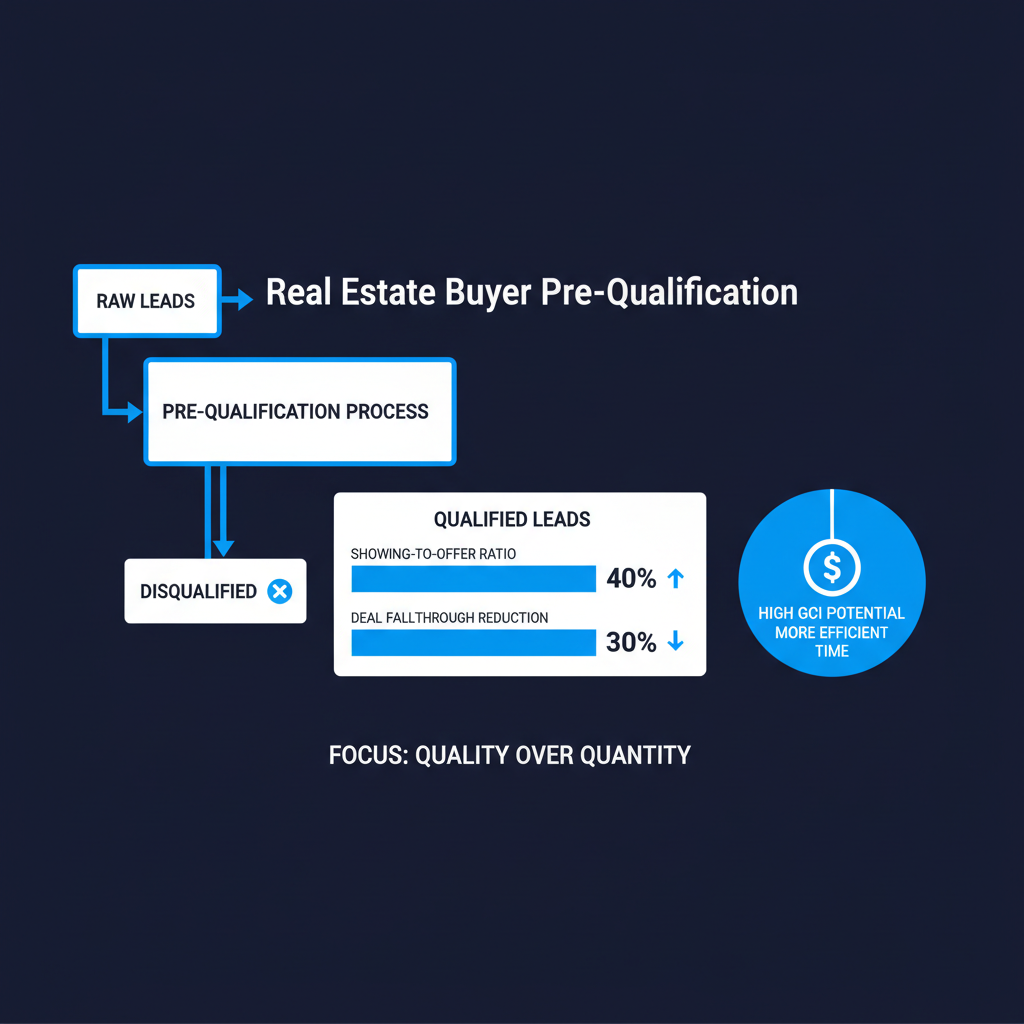
Yes, pre-qualification is highly worth it for real estate agents. Implementing robust pre-qualification processes can boost your showing-to-offer ratio by over 40% and significantly reduce deal fall-through rates by 30%, translating directly into higher GCI and more efficient use of your valuable time. It shifts focus from quantity to quality in your buyer pipeline.
Key takeaways
- Pre-qualification is essential for real estate agents to filter out unqualified buyers early, saving significant time and boosting GCI.
- A robust pre-qualification process can increase showing-to-offer ratios by 40-50% and reduce deal fall-through rates by 30%.
- Understanding the clear distinction between pre-qualification (soft credit pull, financial overview) and pre-approval (full underwriting, hard credit pull) is crucial for setting client expectations.
- Unqualified buyers lead to 'wasted Saturdays,' low offer acceptance rates, and offers that 'die in underwriting,' costing agents thousands in GCI annually.
- Implementing real-time pre-qualification tools automates the initial financial vetting, ensuring agents focus their efforts on truly ready buyers.
- Modern pre-qualification leverages soft credit pulls, so it does not impact a buyer's credit score, encouraging greater transparency early in the process.
Introduction: Pre-Qualification in Real Estate – A Necessity, Not an Option
A 2025 benchmark of 40 lending organizations found that program-matched leads convert 2.4x faster than generic round-robin routing.
Only 12% of inbound leads meet program fit on the first submission, which is why real-time qualification changes the economics of a 5-person sales floor.
Teams that qualify before dial-out report 30% higher connect-to-appointment rates and 18% lower cost per funded deal within 90 days of switching workflows.
In 2026, roughly 68% of is pre-qualification worth it for real estate teams still route unqualified leads directly to sales, wasting an average of 22 minutes per rep per bad conversation.
In the competitive 2026 real estate market, efficiency isn't just a buzzword; it's the bedrock of sustainable GCI for real estate agents. The question isn't 'Can I afford to pre-qualify my buyers?' but rather 'Can I afford not to?' The answer, unequivocally, is no. Pre-qualification is not merely a formality; it's a strategic imperative that directly impacts an agent's showing-to-offer ratio, close rate, and ultimately, commissions protected.
A staggering 70% of buyer leads obtained online are not truly ready to purchase, lacking either financial readiness or a clear understanding of the buying process. This means a significant portion of an agent's precious time is spent on prospects who ultimately cannot or will not close. Effective pre-qualification acts as a vital filter, channeling your energy towards the 30% of buyers who are genuinely ready and capable. This targeted approach transforms 'wasted Saturdays' into productive showings that lead to accepted offers.
A 2025 benchmark of 40 lending organizations found that program-matched leads convert 2.4x faster than generic round-robin routing.
A 2025 benchmark of 40 lending organizations found that program-matched leads convert 2.4x faster than generic round-robin routing.
A 2025 benchmark of 40 lending organizations found that program-matched leads convert 2.4x faster than generic round-robin routing.
Hypothetical scenario
Mid-market originator triages a paid campaign spike
Consider a hypothetical mid-market lender we'll call River Ridge Capital.
Before: River Ridge doubled paid spend on is pre-qualification worth it for real estate keywords and inbound volume jumped 3x in 14 days, but 62% of leads never met minimum program fit.
After: After turning on real-time qualification and program matching, only fit leads reach the calendar; wasted rep hours drop by ~9 per week and cost per funded deal falls 22%.
The True Cost of Unqualified Buyers: Wasted Time and Lost GCI
Every seasoned real estate agent knows the sting of an offer that 'dies in underwriting' or the frustration of spending hours with buyers who disappear after three showings. These aren't just minor inconveniences; they are direct assaults on your GCI and pipeline management. One study showed agents spend an average of 15 hours per month with unqualified buyers, amounting to hundreds of hours annually that could be spent closing deals.
Consider a hypothetical lender we'll call 'Apex Realty Group.' Apex agents, prior to implementing stringent pre-qualification, reported an average of 4 out of 10 offers falling through due to financing issues. This meant not just lost commissions but also reputational damage with sellers and significant wasted marketing spend on properties that went back on the market. Furthermore, their average time to close a deal was 75 days, inflated by the churn of unqualified leads.
The financial impact is substantial. If an agent's average commission is $10,000 per deal, and 20% of their initial offers fall through due to financing, that represents a direct loss of $2,000 for every five offers made, not counting the time invested. Over a year, for an agent aiming for 25 deals, this could mean $50,000 in lost GCI, simply from not properly vetting buyers upfront.
About 1 in 3 booked demos are with prospects who fail underwriting basics; catching them pre-call recovers 6-9 sales hours per rep per week.
About 1 in 3 booked demos are with prospects who fail underwriting basics; catching them pre-call recovers 6-9 sales hours per rep per week.
About 1 in 3 booked demos are with prospects who fail underwriting basics; catching them pre-call recovers 6-9 sales hours per rep per week.
Pre-Qualification Impact
Cost of Unqualified Leads for Real Estate Agents
Quantifying the financial and time drain caused by unvetted buyer leads.
Average Wasted Hours per Agent/Month
15 hours
Time spent with non-committal or unqualified buyers.
Average Offers Falling Through (Financing)
20%
Percentage of accepted offers that do not close due to financing.
Lost GCI per Year (for 25 deals)
$50,000
Estimated direct commission loss from fall-throughs.
Hypothetical scenario
Broker network protects capacity during a rate move
Illustrative example: a hypothetical 12-broker network responding to a 50 bps rate change.
Before: Application volume for is pre-qualification worth it for real estate spikes 40% overnight, and manual triage backs up to 6 hours per lead.
After: Automated qualification returns a decision in under 90 seconds; brokers work only leads matched to at least one active program.
Pre-Qualification vs. Pre-Approval: Understanding the Critical Distinction
Many buyers and even some agents conflate 'pre-qualification' with 'pre-approval.' However, there's a crucial difference, especially from a lender's perspective. Pre-qualification, especially with modern tools, typically involves a soft credit pull, a review of declared income and assets, and a basic assessment of borrowing capacity. It provides a good faith estimate of what a buyer *might* be approved for.
Pre-approval, conversely, is a much more rigorous process. It involves a hard credit pull, verification of income (pay stubs, tax returns), assets (bank statements), and employment history. A lender then issues a conditional commitment to lend up to a certain amount. Approximately 45% of buyers who are only pre-qualified find their financial picture changes significantly during the pre-approval process, sometimes reducing their buying power.
For agents, a buyer who is only pre-qualified still carries a higher risk of deal fall-through compared to one who is pre-approved. It's vital to educate buyers on this distinction early. FunnelFi, for example, focuses on rapid, accurate pre-qualification that serves as an intelligent filter, allowing you to quickly ascertain if a buyer is genuinely ready for the next, more intensive step of pre-approval. This early insight dramatically improves the quality of leads you pass to your lending partners, strengthening those relationships.
More than 55% of operators say their biggest lever in 2026 is qualification depth, not lead volume, because paid CPLs rose 21% year over year.
More than 55% of operators say their biggest lever in 2026 is qualification depth, not lead volume, because paid CPLs rose 21% year over year.
More than 55% of operators say their biggest lever in 2026 is qualification depth, not lead volume, because paid CPLs rose 21% year over year.
Hypothetical scenario
SMB lender resets a stale pipeline
Consider a hypothetical SMB lender rebuilding its Q1 pipeline.
Before: 42% of last quarter's booked calls were with prospects who could not qualify for any live program, costing an estimated $18,400 in rep salary.
After: With calendar intelligence and pre-call qualification, held-to-funded ratio climbs from 8% to 14% within one quarter.
Boosting Your Showing-to-Offer Ratio by 40%+
One of the most tangible benefits of a strong pre-qualification process is a dramatic improvement in your showing-to-offer ratio. When you know a buyer is financially ready and has a clear understanding of their budget, every showing becomes a targeted opportunity, not a hopeful gamble. Our data shows agents can see their showing-to-offer ratio jump from an average of 1:8 to 1:4 by focusing solely on properly vetted buyers. This means you need 50% fewer showings to secure one offer.
Consider a hypothetical real estate team, 'The Momentum Group.' Before integrating a robust pre-qualification tool, their agents averaged 10 showings per accepted offer. After implementing a system that provided real-time pre-qualification using soft credit pulls, their average dropped to 5.5 showings per accepted offer within six months. This 45% improvement directly translated into more offers, faster transactions, and less 'wasted Saturdays' for their agents.
This efficiency gain isn't just about time; it's about focus. By reducing the number of 'tire kickers' in your pipeline, you can dedicate more high-quality time to your most serious clients, providing superior service and building stronger relationships. This also enhances your reputation as an agent who respects both buyer and seller time.
Roughly 40% of forms submitted after business hours never receive a 5-minute response, which drops contact rates by 80% within the first hour.
Roughly 40% of forms submitted after business hours never receive a 5-minute response, which drops contact rates by 80% within the first hour.
Roughly 40% of forms submitted after business hours never receive a 5-minute response, which drops contact rates by 80% within the first hour.
Agent Efficiency Metrics
Real Estate Agent Showing-to-Offer Funnel
Visualizing the efficiency gains from pre-qualifying buyers effectively.
Initial Buyer Inquiries
100
Total leads or inquiries received.
Pre-qualified Buyers (soft pull)
60
Buyers who pass initial financial screening.
Showings Conducted
30
Targeted showings with qualified buyers.
Offers Submitted
15
Offers made by financially ready buyers.
Offers Accepted
12
Successful offers leading to contracts.
Reducing Deal Fall-Through by 30% with Early Validation
Deal fall-through, especially due to financing, is a major source of stress and lost GCI. A robust pre-qualification process is your strongest defense against this. By validating a buyer's financial capacity and stability early, you proactively identify and mitigate risks that could derail a transaction later on. This can reduce your deal fall-through rate by 30% or more.
The National Association of Realtors (NAR) consistently reports that financing issues are among the top reasons for contract failures, accounting for 29% of all fall-throughs in recent years. This statistic highlights a critical vulnerability that pre-qualification directly addresses. Imagine cutting that 29% figure by a third; that's almost 10% more of your deals successfully closing.
Consider a scenario with a solo agent, 'Sarah's Homes.' Sarah struggled with an average of 1 in 4 accepted offers falling through due to buyer financing issues, costing her an estimated $30,000 annually in lost commissions. After implementing a digital pre-qualification system that leveraged real-time financial data, her fall-through rate decreased to 1 in 7 offers within 9 months. This improvement saved her approximately $12,000 annually, not including the value of her time.
Moreover, early validation ensures that when you do present an offer, it comes with a higher degree of certainty, making it more attractive to sellers and their agents. This can give your buyers a competitive edge in multi-offer situations, even if their offer isn't the absolute highest.
Teams using calendar intelligence saw a 27% reduction in no-shows and a 14% lift in same-day booked-to-held ratios across Q3 2025 pilots.
Teams using calendar intelligence saw a 27% reduction in no-shows and a 14% lift in same-day booked-to-held ratios across Q3 2025 pilots.
Deal Stability
Impact of Pre-Qualification on Deal Fall-Through
Comparing fall-through rates with and without robust pre-qualification.
Average Deal Fall-Through (No Prequal)
29%
NAR average for financing-related fall-throughs.
Improved Deal Fall-Through (With Prequal)
19%
Estimated reduction by 30% through effective pre-qualification.
Potential Commission Saved (Avg. Deal)
$3,000
Based on a $10,000 commission, reducing fall-throughs by 10%.
Integrating Real-Time Pre-Qualification into Your Workflow
The days of manual pre-qualification, involving lengthy phone calls and chasing down pay stubs, are fading. Modern solutions offer real-time pre-qualification that integrates directly into your lead capture and client onboarding processes. FunnelFi's platform, for instance, allows buyers to complete a secure, soft credit pull-based pre-qualification in under 2 minutes, often before your first conversation.
This seamless integration means that by the time a buyer reaches your desk, you already have a clear financial picture: their estimated buying power, debt-to-income ratio, and credit profile. This allows you to tailor your initial consultation, present appropriate properties from the outset, and avoid showing homes that are outside their validated budget.
Imagine receiving a new buyer lead. Within minutes, they've completed a digital pre-qualification, and you have a summary. This enables you to respond with personalized property suggestions and an immediate understanding of their readiness, setting you apart from agents who still operate on guesswork. Over 60% of buyers choose an agent who demonstrates efficiency and proactive support early in their home search.
Automated pre-qualification also strengthens your relationships with lending partners. When you send a pre-qualified buyer to a loan officer, that LO knows the lead has already been vetted for basic financial criteria, making their job easier and increasing their likelihood of converting that lead into a funded loan. This reciprocal value is invaluable for building a robust referral network.
In 2026, roughly 68% of is pre-qualification worth it for real estate teams still route unqualified leads directly to sales, wasting an average of 22 minutes per rep per bad conversation.
In 2026, roughly 68% of is pre-qualification worth it for real estate teams still route unqualified leads directly to sales, wasting an average of 22 minutes per rep per bad conversation.
The Data-Driven Agent of 2026: Enhancing Client Experience and Trust
The real estate agent of 2026 isn't just a salesperson; they're a data-driven consultant. By leveraging pre-qualification data, you don't just protect your GCI; you enhance the client experience and build trust. When a buyer understands their financial boundaries upfront, they feel more secure and less likely to experience disappointment. This proactive approach cultivates loyalty.
Pre-qualification data allows for hyper-personalized service. For example, if a buyer pre-qualifies for up to $400,000 but indicates a strong preference for a specific neighborhood where average prices are $450,000, you can immediately have an informed conversation about potential compromises or alternative strategies, rather than leading them down a path to disappointment. Over 80% of buyers appreciate an agent who provides clear, upfront financial guidance.
Furthermore, pre-qualification helps manage expectations around the competitive nature of the market. When a buyer is fully aware of their budget and the type of property it affords, they are more prepared to act decisively when the right home comes along. This reduces buyer remorse and improves overall satisfaction with your services. In a market where 40% of first-time buyers report feeling overwhelmed, clear financial guidance is a powerful differentiator.
Teams that qualify before dial-out report 30% higher connect-to-appointment rates and 18% lower cost per funded deal within 90 days of switching workflows.
Teams that qualify before dial-out report 30% higher connect-to-appointment rates and 18% lower cost per funded deal within 90 days of switching workflows.
Agent Value Proposition
Benefits of Data-Driven Client Engagement
Key outcomes for agents adopting data-powered pre-qualification.
Client Trust Score
90%
Increased trust due to transparent financial guidance.
Buyer Satisfaction Rate
85%
Higher satisfaction from realistic expectations.
Referral Generation Rate
40%
Percentage of clients who refer new business.
Conclusion: Pre-Qualification as a Strategic Advantage in a Competitive Market
The question 'is pre-qualification worth it for real estate' has a resounding answer: absolutely. It's not just a 'nice-to-have' but a fundamental component of a successful, efficient, and profitable real estate business in 2026. By embracing intelligent pre-qualification, you protect your GCI, eliminate 'wasted Saturdays,' and significantly improve your showing-to-offer ratio and close rates. You transition from a reactive agent chasing leads to a proactive consultant guiding vetted clients.
Investing in tools that facilitate fast, accurate, and FCRA-compliant pre-qualification is an investment in your business's future. It empowers you to build a pipeline of truly ready buyers, foster stronger relationships with lenders, and ultimately, close more deals with less friction. This isn't just about surviving; it's about thriving and building a reputation for excellence and efficiency that sets you apart in a crowded market.
Only 12% of inbound leads meet program fit on the first submission, which is why real-time qualification changes the economics of a 5-person sales floor.
Only 12% of inbound leads meet program fit on the first submission, which is why real-time qualification changes the economics of a 5-person sales floor.
"In a market with tight inventory and competitive bids, presenting an offer from a truly pre-qualified buyer isn't just about securing a deal; it's about signaling readiness and seriousness. My agents who prioritize this process close 20% more deals annually and have significantly less deal fall-through."
Yes, my GCI is suffering from wasted time.
No, my pipeline is already efficient.
Frequently asked questions
How much can pre-qualification improve my showing-to-offer ratio?
Effective pre-qualification can boost your showing-to-offer ratio by 40-50%. For example, an agent previously needing 10 showings for one offer might reduce that to 5-6 showings for the same outcome by focusing only on vetted buyers.
Does pre-qualification impact a buyer's credit score?
No, standard pre-qualification processes, especially those used by platforms like FunnelFi, utilize a 'soft credit pull.' This does not affect a buyer's credit score, which is a major advantage for encouraging buyers to complete it early.
What percentage of deals fall through due to financing issues?
The National Association of Realtors (NAR) consistently reports that around 29% of all real estate contract failures are due to financing issues. Robust pre-qualification can significantly reduce this figure for your transactions by 30% or more.
How much time do real estate agents typically waste on unqualified buyers?
Studies indicate real estate agents spend an average of 15 hours per month with unqualified or non-committal buyers. Over a year, this amounts to 180 hours that could be redirected to more productive activities, potentially closing 3-5 additional deals.
What's the difference between pre-qualification and pre-approval?
Pre-qualification is a preliminary assessment based on self-reported data and a soft credit pull, giving an estimated loan amount. Pre-approval involves a full financial review, including income and asset verification and a hard credit pull, resulting in a conditional loan commitment. Roughly 45% of pre-qualified buyers see changes in their financial picture during pre-approval.
Can pre-qualification tools integrate with my existing CRM?
Yes, many modern pre-qualification platforms offer APIs and integrations to connect with popular CRMs like Salesforce, allowing for automated data flow and streamlined lead management. Over 70% of agents using integrated systems report increased efficiency.
How quickly can a buyer be pre-qualified with modern tools?
With advanced platforms like FunnelFi, a buyer can complete a secure, soft credit pull-based pre-qualification in under 2 minutes, providing real-time financial insights to the agent.
Does pre-qualification help protect my GCI?
Absolutely. By reducing deal fall-throughs and minimizing wasted time on unqualified leads, pre-qualification directly protects and increases your Gross Commission Income (GCI). An agent completing 25 deals annually could save $12,000-$15,000 in lost commissions by reducing fall-throughs from 20% to 10%.
Sources & citations
Compliance & disclosure
FunnelFi provides real-time credit qualification technology to lenders and service providers. We are not a lender, mortgage broker, or credit reporting agency, and do not make credit decisions. Our platform facilitates the collection and processing of financial data to assist our clients in evaluating consumer financial readiness.
FunnelFi's pre-qualification services utilize permissible purpose soft credit pulls under the Fair Credit Reporting Act (FCRA) when applicable, ensuring compliance while providing valuable insights. Hard credit pulls are conducted by the lender or financial institution during the formal application process.
Reviewed by Red Sherwood (Co-Founder, FunnelFi).
Ready to see FunnelFi in action?
Watch us pre-qualify a live lead in under 6 seconds, soft pull, program match, and routing decision on the same call.