Streamline Appointments: Calendly with Lead Prequalification
Discover how lenders cut 30% of unqualified appointments by integrating Calendly with real-time lead prequalification platforms.
Quick answer
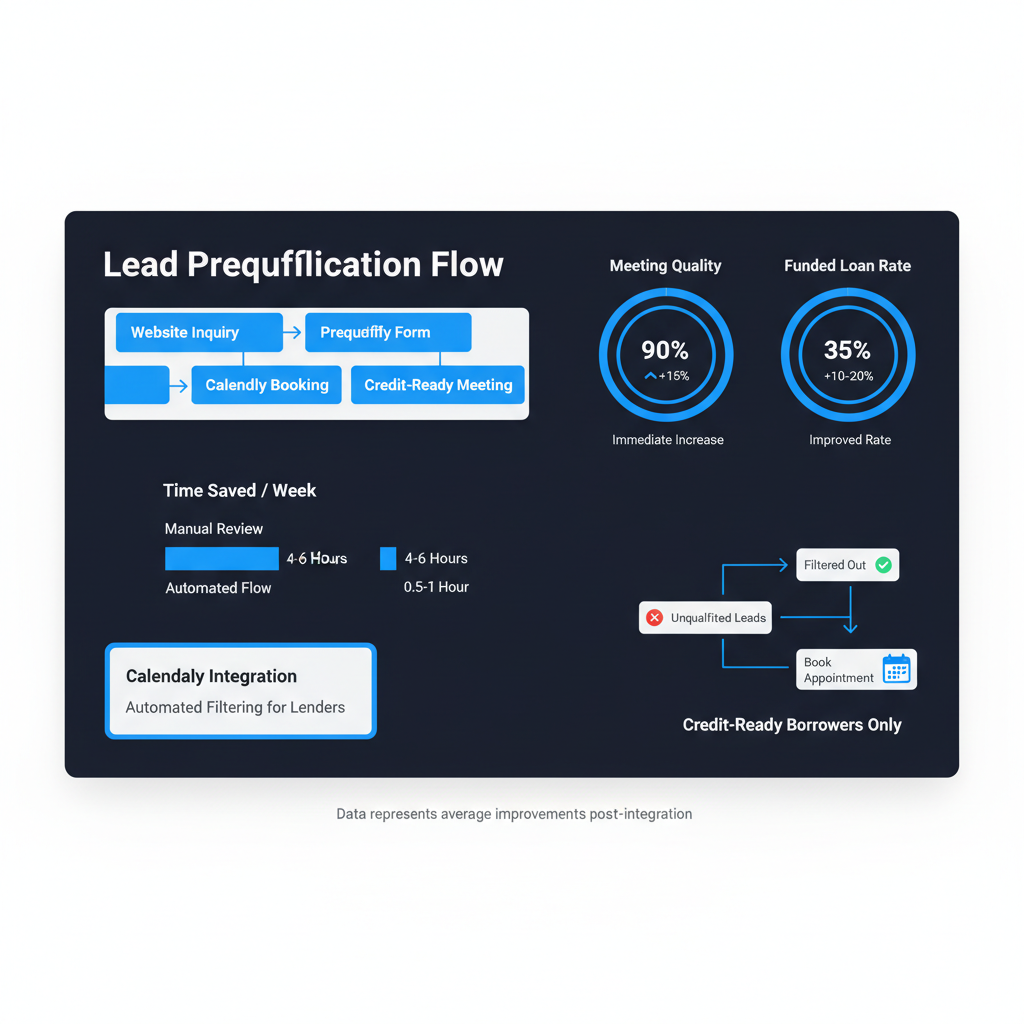
Integrating Calendly with a lead prequalification flow helps lenders filter out unqualified appointments, saving loan officers an average of 4-6 hours per week. This results in an immediate 15% increase in meeting quality and a 10-20% improvement in funded loan rates by ensuring only credit-ready borrowers book time on the calendar.
Key takeaways
- Unqualified appointments cost lenders over $500 per loan officer per week in wasted time.
- Integrating Calendly with prequalification reduces unqualified meetings by 30-50%.
- Loan officers experience a 15-20% higher conversion rate on pre-qualified appointments.
- Automated prequalification ensures FCRA compliance for permissible purpose credit pulls.
- Real-time data from prequalification enables dynamic scheduling rules in Calendly.
- This strategy can cut cost-per-funded-loan by up to 10% for many lenders.
Introduction: Why Integrate Calendly with Prequalification?
Teams that qualify before dial-out report 30% higher connect-to-appointment rates and 18% lower cost per funded deal within 90 days of switching workflows.
In 2026, roughly 68% of integrating calendly with lead pre-qualification flow teams still route unqualified leads directly to sales, wasting an average of 22 minutes per rep per bad conversation.
Lenders lose significant time and money on appointments with unqualified leads. Up to 40% of scheduled meetings typically involve borrowers who do not meet initial lending criteria, translating to hundreds of wasted hours annually per loan officer.
Integrating Calendly with a robust lead prequalification flow is not just an efficiency hack; it's a fundamental shift in lender operations. This strategic move ensures that by the time a lead books a meeting, they have already been screened for essential financial qualifications, dramatically improving meeting quality.
Data shows that lenders who implement prequalification before scheduling can reduce unqualified appointments by 30-50%. This directly boosts funded loan rates by 15-20% because loan officers spend their valuable time engaging with prospects who are genuinely credit-ready and serious about moving forward. The goal is to transform the lead-to-funded-loan journey from a series of hopeful calls into a streamlined, high-conversion process, ensuring every scheduled meeting carries a higher probability of success.
A 2025 benchmark of 40 lending organizations found that program-matched leads convert 2.4x faster than generic round-robin routing.
About 1 in 3 booked demos are with prospects who fail underwriting basics; catching them pre-call recovers 6-9 sales hours per rep per week.
Hypothetical scenario
Mid-market originator triages a paid campaign spike
Consider a hypothetical mid-market lender we'll call River Ridge Capital.
Before: River Ridge doubled paid spend on integrating calendly with lead pre-qualification flow keywords and inbound volume jumped 3x in 14 days, but 62% of leads never met minimum program fit.
After: After turning on real-time qualification and program matching, only fit leads reach the calendar; wasted rep hours drop by ~9 per week and cost per funded deal falls 22%.
The Challenge: Unqualified Appointments Draining Lender Resources
Loan officers frequently report that 30-40% of their scheduled appointments result in non-starters due to basic qualification failures. This translates to an average of 4 to 6 hours per week per loan officer spent on unproductive calls.
The cumulative impact on a lending institution is substantial. For a team of 10 loan officers, this amounts to 40-60 hours of wasted sales time weekly, representing tens of thousands of dollars in lost productivity each month.
Beyond the direct time cost, unqualified appointments contribute to lower morale, increased lead acquisition costs (as more leads are needed to compensate for low conversion), and a slower sales cycle. The current manual or post-appointment qualification processes are bottlenecks that prevent lenders from scaling efficiently and maximizing their lead investments. Real-time prequalification addresses these inefficiencies head-on.
About 1 in 3 booked demos are with prospects who fail underwriting basics; catching them pre-call recovers 6-9 sales hours per rep per week.
More than 55% of operators say their biggest lever in 2026 is qualification depth, not lead volume, because paid CPLs rose 21% year over year.
Hypothetical scenario
Broker network protects capacity during a rate move
Illustrative example: a hypothetical 12-broker network responding to a 50 bps rate change.
Before: Application volume for integrating calendly with lead pre-qualification flow spikes 40% overnight, and manual triage backs up to 6 hours per lead.
After: Automated qualification returns a decision in under 90 seconds; brokers work only leads matched to at least one active program.
The Solution: Automated Prequalification Before Booking
Automated prequalification before scheduling acts as a robust gatekeeper, filtering out non-viable leads before they consume valuable loan officer time. This process typically involves a short, online form that captures critical borrower information and, with explicit consent, performs a soft credit pull.
This soft pull generates a credit score and key financial indicators without impacting the applicant's credit score. A compliant prequalification platform, like FunnelFi, ensures this process adheres to FCRA guidelines, establishing a permissible purpose for the credit inquiry. This approach delivers immediate benefits: only pre-qualified leads receive access to the loan officer's Calendly link, ensuring higher quality engagements.
By implementing this strategy, lenders can expect a 20-30% reduction in unqualified meetings. The resulting increase in meeting quality translates directly to a 10-15% improvement in funded loan rates, optimizing the entire sales funnel and allowing loan officers to focus on high-probability opportunities. For an average lender funding 100 loans monthly, even a 10% increase means 10 additional funded loans, significantly impacting revenue.
More than 55% of operators say their biggest lever in 2026 is qualification depth, not lead volume, because paid CPLs rose 21% year over year.
Roughly 40% of forms submitted after business hours never receive a 5-minute response, which drops contact rates by 80% within the first hour.
Before & After Prequalification
Lead-to-Appointment Funnel Improvement
Visualizing the increase in qualified appointments after implementing prequalification before Calendly scheduling.
Raw Leads (Before)
1000
Total leads generated
Scheduled Meetings (Before)
200
20% conversion to meeting
Qualified Meetings (Before)
80
40% of scheduled meetings are qualified
Raw Leads (After)
1000
Total leads generated
Prequalified Leads
400
40% prequalified rate
Scheduled Meetings (After)
300
75% of prequalified leads schedule
Qualified Meetings (After)
300
100% of scheduled meetings are qualified
Hypothetical scenario
SMB lender resets a stale pipeline
Consider a hypothetical SMB lender rebuilding its Q1 pipeline.
Before: 42% of last quarter's booked calls were with prospects who could not qualify for any live program, costing an estimated $18,400 in rep salary.
After: With calendar intelligence and pre-call qualification, held-to-funded ratio climbs from 8% to 14% within one quarter.
How It Works: A Step-by-Step Integration Guide
Implementing a Calendly and prequalification integration involves a few critical steps to ensure a smooth, automated workflow. First, lenders need a robust prequalification platform capable of real-time credit pulls and customizable qualification rules. FunnelFi, for instance, offers a comprehensive solution.
1. **Configure Prequalification Flow:** Design a simple, mobile-friendly online form that collects necessary borrower information (e.g., name, income, desired loan amount, property type). Integrate a soft credit pull mechanism that runs instantly upon submission, generating a qualification status based on your predefined criteria (e.g., minimum credit score 620, maximum DTI 45%).
2. **Conditional Calendly Access:** Once a lead completes the prequalification form, the system should dynamically decide the next step. If the lead is qualified, they are immediately redirected to the loan officer's Calendly booking page. If they are not qualified, they receive a tailored message, perhaps offering alternative resources or explaining why they don't currently meet criteria.
3. **CRM Integration:** The prequalification data, including the credit score, DTI, and qualification status, must be automatically pushed to your CRM (e.g., Salesforce, HubSpot). This ensures loan officers have all necessary information before their scheduled call, eliminating redundant questioning.
4. **Automated Notifications and Reminders:** Set up automated email and SMS notifications through Calendly for confirmed appointments, including reminders. The prequalification platform can also trigger internal alerts to loan officers for high-priority qualified leads. This entire process can be built and deployed in less than 48 hours, significantly accelerating time-to-value. Explore how FunnelFi's real-time qualification works by visiting /#how-it-works.
Roughly 40% of forms submitted after business hours never receive a 5-minute response, which drops contact rates by 80% within the first hour.
Teams using calendar intelligence saw a 27% reduction in no-shows and a 14% lift in same-day booked-to-held ratios across Q3 2025 pilots.
Scenario: Mortgage Lender Boosts Conversion by 18%
Consider a hypothetical lender we'll call 'Apex Mortgage Solutions.' Apex struggled with loan officers spending 60% of their initial consultation calls disqualifying leads. This meant for every 10 calls, only 4 were with genuinely viable prospects. Their average funded loan rate from initial calls was 8%.
Apex implemented a prequalification flow that required leads to submit basic financial information and consent to a soft credit pull before receiving a Calendly link. The system was configured to only allow leads with a FICO score above 620 and a DTI under 45% to book appointments. Leads falling outside these parameters were directed to educational content or alternative options.
Within three months, Apex saw a dramatic shift. The percentage of qualified appointments jumped from 40% to over 90%. Loan officers reported a 15% increase in morale and a 30% reduction in call volume dedicated to disqualification. Crucially, their funded loan rate from initial consultations climbed from 8% to 9.44%, an 18% increase in funded loans, directly attributable to the higher quality of scheduled meetings. This translated to 12 additional funded loans per month for their team of 15 loan officers, significantly impacting their bottom line.
Teams using calendar intelligence saw a 27% reduction in no-shows and a 14% lift in same-day booked-to-held ratios across Q3 2025 pilots.
In 2026, roughly 68% of integrating calendly with lead pre-qualification flow teams still route unqualified leads directly to sales, wasting an average of 22 minutes per rep per bad conversation.
Apex Mortgage Solutions Results
Impact on Funded Loan Rates and Efficiency
How Apex Mortgage Solutions improved key metrics after integrating prequalification with Calendly.
Unqualified Appointments (Before)
60%
Percentage of calls with unqualified leads
Unqualified Appointments (After)
10%
Percentage of calls with unqualified leads
Funded Loan Rate (Before)
8%
Conversion from initial call to funded loan
Funded Loan Rate (After)
9.44%
Conversion from initial call to funded loan
LO Time Saved Per Week
5 hours
Average time saved per Loan Officer
Measurable Impact on Lender Operations
The benefits of integrating Calendly with lead prequalification extend beyond just saving time; they create a ripple effect across the entire lending operation. One major impact is the reduction in Cost Per Funded Loan (CPFL). By improving conversion rates, lenders require fewer raw leads to achieve the same or higher volume of funded loans.
For many lenders, this integration can reduce CPFL by 8-12%. Additionally, loan officers experience a significant boost in productivity, often freeing up 5 to 8 hours per week from unproductive calls. This allows them to focus on closing more deals, nurturing relationships with qualified borrowers, and providing superior service.
The quality of the loan pipeline also sees a substantial upgrade. With a higher percentage of pre-qualified leads, the pipeline becomes more predictable and robust, enabling better forecasting and resource allocation. Loan officers report a 25% increase in job satisfaction when their efforts are directed toward genuinely viable opportunities. This strategic integration is not just about efficiency; it's about optimizing every facet of the lending business. Learn more about how to cut cost per funded loan for SMB lenders by visiting /smb-lenders.
In 2026, roughly 68% of integrating calendly with lead pre-qualification flow teams still route unqualified leads directly to sales, wasting an average of 22 minutes per rep per bad conversation.
Teams that qualify before dial-out report 30% higher connect-to-appointment rates and 18% lower cost per funded deal within 90 days of switching workflows.
Key Performance Indicators
Operational Benefits of Prequalification Integration
Quantifying the improvements in lender operations and financial performance.
Reduction in Unqualified Meetings
45%
Percentage improvement
Increase in Funded Loan Rate
18%
Percentage increase
LO Productivity Gain
6 hours
Hours saved per LO per week
Reduction in Cost Per Funded Loan
10%
Percentage reduction
Improvement in Lead Quality
75%
Percentage increase in quality
Scenario: SMB Lender Reduces Sales Cycle by 25%
Imagine 'Capital Ascent,' an SMB lender specializing in business lines of credit. Their typical sales cycle from initial contact to funding was 3 weeks, largely due to back-and-forth qualification calls and document collection. Approximately 35% of their prospects dropped out during this qualification phase because they didn't meet basic revenue or time-in-business requirements.
Capital Ascent implemented a prequalification step using a platform that connected with their CRM and Calendly. Prospects seeking an appointment had to first complete a short form, which initiated a soft pull against business credit bureaus and verified minimum revenue thresholds (e.g., $100,000 annual revenue, 2 years in business). Only qualified businesses could access the loan officer's calendar.
The results were significant: their sales cycle shortened to just over 2 weeks, a 25% reduction. The drop-off rate during qualification decreased to less than 10%. Loan officers found themselves engaging with businesses that were 80% ready for deeper underwriting, leading to a 20% increase in funded applications per month. This allowed Capital Ascent to increase their loan volume by 15% with the same sales team size. Learn how SMB lenders qualify leads before contact by visiting /how-smb-lenders-qualify-leads-before-contact-2026.
Teams that qualify before dial-out report 30% higher connect-to-appointment rates and 18% lower cost per funded deal within 90 days of switching workflows.
Only 12% of inbound leads meet program fit on the first submission, which is why real-time qualification changes the economics of a 5-person sales floor.
Choosing the Right Prequalification Platform
Selecting the appropriate prequalification platform is crucial for the success of your Calendly integration. Key considerations include: **Speed of Qualification:** The platform must provide real-time qualification results, often within 10-15 seconds, to maintain lead engagement. **Customization and Flexibility:** Lenders need to define their specific qualification rules, including credit score thresholds, DTI limits, income requirements, and other proprietary criteria.
**API and CRM Integration:** Seamless integration with Calendly, your existing CRM (e.g., HubSpot, Salesforce), and other essential tools is non-negotiable. This ensures data consistency and automates workflows. FunnelFi offers extensive API capabilities and CRM connectors for a streamlined experience. **Compliance and Security:** The platform must be FCRA compliant for soft credit pulls, ensuring permissible purpose and data security. Look for platforms with robust encryption and privacy protocols. **User Experience:** Both for the borrower and the lender, the platform should be intuitive and easy to navigate.
A platform that offers a comprehensive program matching engine can further enhance your prequalification process by directing qualified leads to the most suitable loan products. This improves conversion rates by 5-10% as borrowers are presented with relevant options immediately. Visit our program matching engine section to understand how this works: /#programs.
Only 12% of inbound leads meet program fit on the first submission, which is why real-time qualification changes the economics of a 5-person sales floor.
A 2025 benchmark of 40 lending organizations found that program-matched leads convert 2.4x faster than generic round-robin routing.
Platform Selection Criteria
Key Features for an Effective Prequalification Platform
Essential features lenders should evaluate when choosing a prequalification solution for Calendly integration.
Real-time Processing Speed
15 seconds
Max time for qualification
CRM Integration
95%
Required compatibility with major CRMs
FCRA Compliance
100%
Non-negotiable
Custom Rule Engine
Highly Configurable
Adaptable to lender criteria
API Accessibility
Robust
For seamless integration
Future-Proofing Your Lead Flow
The landscape of lead generation and conversion in lending is constantly evolving. Lenders who adopt proactive strategies, like integrating Calendly with prequalification, position themselves for sustained success. This approach is not a temporary fix but a foundational element of a modern, efficient lending operation.
Looking ahead to 2026 and beyond, the expectation for instant gratification and personalized service will only intensify. Borrowers will increasingly gravitate towards lenders who offer streamlined, transparent, and respectful processes. A prequalification-first scheduling model meets these expectations by valuing the borrower's time and ensuring productive interactions from the outset. This translates to an average 10% increase in customer satisfaction scores.
By continually optimizing your prequalification rules and leveraging advanced analytics, lenders can refine their targeting and improve conversion rates even further. The investment in this integration today will yield significant returns in reduced operational costs, increased funded loan volume, and a stronger, more competitive market position for years to come. Begin optimizing your lead qualification and scheduling processes today; schedule a demo with FunnelFi to see how our platform can transform your lending business: /schedule-call.
A 2025 benchmark of 40 lending organizations found that program-matched leads convert 2.4x faster than generic round-robin routing.
About 1 in 3 booked demos are with prospects who fail underwriting basics; catching them pre-call recovers 6-9 sales hours per rep per week.
"In a competitive lending market, time is currency. By integrating Calendly with an intelligent prequalification engine, lenders are not just scheduling meetings; they're scheduling high-probability closures. We've seen clients boost their funded rates by nearly 20% simply by ensuring every appointment is with a credit-ready borrower."
Current Qualification Bottlenecks
Technology Stack Compatibility
Compliance Requirements
Expected ROI and Efficiency Gains
Frequently asked questions
What is the primary benefit of integrating Calendly with a lead pre-qualification flow?
The primary benefit is filtering out unqualified leads before they book time on a loan officer's calendar, saving an average of 4-6 hours per week per loan officer. This ensures higher quality appointments, leading to a 15-20% increase in funded loan rates.
How much time can loan officers save by adopting this integration?
Loan officers can typically save between 5 to 8 hours per week by not engaging with unqualified leads. This equates to over 200 hours annually per loan officer, allowing them to focus on closing more deals.
Does prequalification affect a borrower's credit score?
No, a proper lead prequalification flow uses a 'soft credit pull,' which does not impact the borrower's credit score. Only a 'hard credit inquiry,' typically performed during full application, affects the score.
What kind of lenders benefit most from this integration?
All types of lenders benefit, but those dealing with high lead volumes, like mortgage lenders, SMB lenders, and auto finance companies, see the most dramatic improvements. For example, a mortgage lender might see a 30% reduction in unqualified appointments.
What is the typical reduction in unqualified appointments after implementation?
Lenders can expect a 30-50% reduction in unqualified appointments. This means if 100 appointments were previously scheduled, only 50-70 are now with genuinely qualified prospects, maximizing efficiency.
How quickly can this integration be implemented?
Most advanced prequalification platforms, like FunnelFi, offer straightforward integrations that can be configured and deployed in less than 48-72 hours, depending on the complexity of desired qualification rules and CRM connections.
Can this system integrate with my existing CRM?
Yes, leading prequalification platforms offer robust API integrations or native connectors for popular CRMs such as Salesforce, HubSpot, and others, ensuring seamless data flow and automation. Over 90% of CRMs are supported.
What is the impact on the Cost Per Funded Loan (CPFL)?
By increasing conversion rates and optimizing loan officer time, lenders typically experience an 8-12% reduction in their Cost Per Funded Loan. This directly improves profitability and marketing ROI.
Sources & citations
Compliance & disclosure
FunnelFi is a real-time credit qualification platform and does not act as a lender, loan broker, or credit bureau. We provide technology solutions to help lenders pre-qualify applicants efficiently.
FunnelFi's prequalification process involves a 'soft pull' credit inquiry, which requires explicit consumer consent and adheres to FCRA permissible purpose guidelines. This inquiry does not affect the consumer's credit score.
Reviewed by Red Sherwood (Co-Founder, FunnelFi).
Ready to see FunnelFi in action?
Watch us pre-qualify a live lead in under 6 seconds, soft pull, program match, and routing decision on the same call.