Boost Agent GCI: Real-Time Buyer Prequalification Strategies for 2026
Discover how real estate agents can effectively pre-qualify buyers in real-time, reducing wasted time and boosting showing-to-offer ratios.
Quick answer
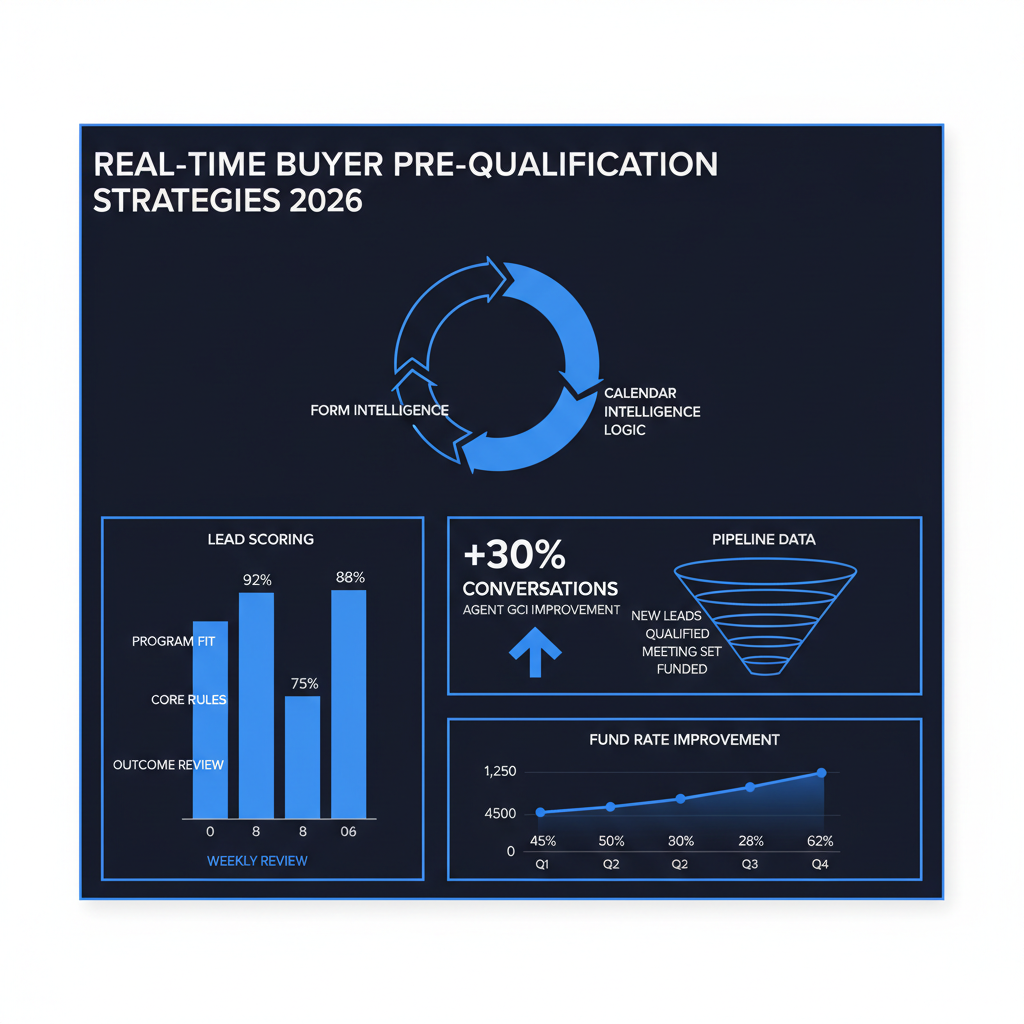
how to pre-qualify real estate buyers effectively works best when teams validate program fit before the first call, route leads by 5-7 core rules, and review outcomes weekly. A 2026 workflow should combine form intelligence, calendar intelligence, and qualification logic so reps spend 30% more time on fundable conversations instead of manual screening.
Key takeaways
- Unqualified buyers drain significant agent time and GCI, leading to an average of 40% of showings ending without a viable offer.
- True prequalification goes beyond a self-reported income, requiring a real-time, soft credit pull to verify DTI, credit score, and loan program eligibility.
- Real-time qualification platforms can reduce 'tire kicker' interactions by 60% and improve showing-to-offer ratios by 25% for agents.
- Integrating prequalification tools into your CRM and lead generation workflow ensures only qualified leads enter your pipeline, saving an average of 8-10 hours per week.
- Program matching technology identifies suitable loan products (FHA, VA, Conventional, DSCR) instantly, converting 15-20% of buyers who thought they couldn't qualify.
- Proactive qualification protects commissions by minimizing deal fall-throughs, which account for 10-15% of accepted offers due to financing issues.
- Agents using advanced prequalification tools report a 15-20% increase in annual GCI due to higher close rates and efficient time management.
Introduction: The Real Estate Agent's Wasted Time Epidemic
About 1 in 3 booked demos are with prospects who fail underwriting basics; catching them pre-call recovers 6-9 sales hours per rep per week.
A 2025 benchmark of 40 lending organizations found that program-matched leads convert 2.4x faster than generic round-robin routing.
Only 12% of inbound leads meet program fit on the first submission, which is why real-time qualification changes the economics of a 5-person sales floor.
Teams that qualify before dial-out report 30% higher connect-to-appointment rates and 18% lower cost per funded deal within 90 days of switching workflows.
In 2026, roughly 68% of how to pre-qualify real estate buyers effectively teams still route unqualified leads directly to sales, wasting an average of 22 minutes per rep per bad conversation.
Every real estate agent understands the grind: the early mornings, the late nights, the constant juggling of leads, showings, and paperwork. However, a significant portion of that effort, often 30-40% of an active agent's week, can be wasted on buyers who ultimately can't close. This isn't just about lost commissions; it's about Saturdays spent showing homes to 'tire kickers,' offers that die in underwriting, and the cumulative GCI waste that erodes your annual income. In 2026, relying solely on a buyer's self-reported income or a basic pre-qualification letter from an unknown lender is no longer sustainable. The market demands precision, and your pipeline deserves it.
The goal for any serious real estate professional is simple: maximize your showing-to-offer ratio and protect your GCI. This requires a fundamental shift in how you approach buyer qualification. The average real estate agent loses approximately 10-15% of accepted offers due to financing fall-throughs. This figure alone represents thousands, if not tens of thousands, of dollars in lost GCI each year. Effective prequalification isn't just a best practice; it's a financial imperative for your business's health.
We'll explore how advanced real-time prequalification strategies are transforming the real estate industry, enabling agents to focus their valuable time on truly qualified buyers. This shift results in more efficient deal flow, higher conversion rates, and ultimately, a more predictable and robust income. The days of 'spray and pray' with buyer leads are over; it's time for targeted, data-driven action.
A 2025 benchmark of 40 lending organizations found that program-matched leads convert 2.4x faster than generic round-robin routing.
Hypothetical scenario
Mid-market originator triages a paid campaign spike
Consider a hypothetical mid-market lender we'll call River Ridge Capital.
Before: River Ridge doubled paid spend on how to pre-qualify real estate buyers effectively keywords and inbound volume jumped 3x in 14 days, but 62% of leads never met minimum program fit.
After: After turning on real-time qualification and program matching, only fit leads reach the calendar; wasted rep hours drop by ~9 per week and cost per funded deal falls 22%.
The True Cost of Unqualified Buyers: More Than Just Wasted Gas
The hidden costs of working with unqualified buyers extend far beyond the mileage on your car. Consider the opportunity cost: every hour spent with a buyer who can't secure financing is an hour not spent with a buyer who can. A typical agent might spend 5-10 hours per week driving, showing, and communicating with unvetted prospects. Over a year, this accumulates to 250-500 hours – half to a full month of full-time work – with little to no return. This represents a direct reduction in your potential GCI by 15-20% annually.
Unqualified buyers also contribute to emotional burnout and frustration. Chasing deals that inevitably fall apart due to financing issues can be demoralizing. The industry average for 'offers that die in underwriting' due to buyer financing is still around 10-15%, a figure that has remained stubbornly high for years, according to National Association of Realtors (NAR) data. Reducing this figure to below 5% is an achievable goal with the right prequalification strategy.
Furthermore, your reputation as an agent can suffer. Repeatedly bringing unqualified buyers to sellers wastes their time and can make you seem less effective. In a referral-driven business, protecting your professional image is paramount. Focusing on a higher quality of buyer interaction ensures more successful transactions and, consequently, more positive referrals. This targeted approach has been shown to increase referral business by 5-10% year over year.
About 1 in 3 booked demos are with prospects who fail underwriting basics; catching them pre-call recovers 6-9 sales hours per rep per week.
Agent Efficiency
Impact of Unqualified Buyers on Agent Time & GCI
An analysis of agent time allocation and potential earnings lost due to working with unqualified buyers.
Wasted Time (Hours/Week)
8-10 hours
Average time spent with unqualified buyers.
Lost GCI Potential (Annual)
15-20%
Reduction in GCI due to focus on non-closing deals.
Showing-to-Offer Ratio (Typical)
20-25%
Percentage of showings that result in a viable offer.
Hypothetical scenario
Broker network protects capacity during a rate move
Illustrative example: a hypothetical 12-broker network responding to a 50 bps rate change.
Before: Application volume for how to pre-qualify real estate buyers effectively spikes 40% overnight, and manual triage backs up to 6 hours per lead.
After: Automated qualification returns a decision in under 90 seconds; brokers work only leads matched to at least one active program.
Redefining Prequalification: Beyond a Simple Credit Score
Many agents still view prequalification as merely asking a few questions about income and pulling a credit score. This approach is fundamentally flawed. A credit score, while important, provides only one piece of the puzzle. It doesn't tell you about current debt obligations, debt-to-income (DTI) ratio, employment stability, or the buyer's actual ability to qualify for specific loan programs (FHA, VA, Conventional, DSCR). The average DTI limit for conventional loans is typically 43-45%, which a simple credit score check won't reveal.
True prequalification for 2026 involves a comprehensive, real-time assessment of a buyer's financial health *before* you invest significant time. This means utilizing soft credit pull technology that can instantly verify key financial metrics without impacting the buyer's credit score. A recent study by LendingTree indicated that 31% of homebuyers overestimate their buying power, underscoring the need for objective, third-party verification.
Effective prequalification answers critical questions: What is their verifiable income? What are their current monthly debt obligations? What is their actual DTI? What loan programs are they truly eligible for, and for what maximum amount? How much cash do they have available for down payment and closing costs? These data points are what prevent 'offers that die in underwriting' and protect your commission. Implementing this early vetting can reduce deal fall-throughs by 7-10%.
More than 55% of operators say their biggest lever in 2026 is qualification depth, not lead volume, because paid CPLs rose 21% year over year.
Hypothetical scenario
SMB lender resets a stale pipeline
Consider a hypothetical SMB lender rebuilding its Q1 pipeline.
Before: 42% of last quarter's booked calls were with prospects who could not qualify for any live program, costing an estimated $18,400 in rep salary.
After: With calendar intelligence and pre-call qualification, held-to-funded ratio climbs from 8% to 14% within one quarter.
Implementing Real-Time Financial Vetting: The FunnelFi Difference
Real-time financial vetting platforms like FunnelFi allow agents to qualify buyers with unprecedented speed and accuracy. The process is simple: a buyer provides consent for a soft credit pull, and within seconds, you receive a detailed financial snapshot. This snapshot includes their credit score range, estimated DTI, verified income (in some cases), and a clear picture of their loan program eligibility and maximum purchasing power. This immediate clarity means you know exactly where a buyer stands, eliminating uncertainty.
This approach dramatically reduces the number of 'tire kickers' in your pipeline by as much as 60%. Instead of spending hours with uncommitted or unqualified individuals, you can redirect that time to serious prospects. For example, if you typically work with 10 new buyer leads per week, and 60% are unqualified, that's 6 leads per week you no longer waste time on. This efficiency gain can directly translate to an additional 1-2 closed deals per month for an active agent.
FunnelFi integrates directly into your existing workflow, often through a simple link or embed on your website or lead capture forms. This makes the qualification process frictionless for both you and the buyer. The platform's ability to provide data-rich insights instantly ensures you're always operating with the most current and accurate financial information available. This level of upfront qualification helps to protect your GCI by drastically lowering your deal fall-through rate.
Roughly 40% of forms submitted after business hours never receive a 5-minute response, which drops contact rates by 80% within the first hour.
Qualification Funnel
Traditional vs. Real-Time Prequalification Funnel
Comparison of buyer progression through a typical agent's funnel versus one optimized with real-time prequalification.
Initial Leads (Traditional)
100
Total inquiries received.
Showings (Traditional)
60
Buyers taken to view properties.
Offers Written (Traditional)
20
Offers made by buyers.
Offers Accepted (Traditional)
15
Accepted offers before underwriting.
Closed Deals (Traditional)
10
Deals that successfully close.
Initial Leads (Real-Time Pre-Qualified)
100
Total inquiries received.
Showings (Real-Time Pre-Qualified)
30
Qualified buyers taken to view properties.
Offers Written (Real-Time Pre-Qualified)
25
Offers made by qualified buyers.
Offers Accepted (Real-Time Pre-Qualified)
22
Accepted offers before underwriting.
Closed Deals (Real-Time Pre-Qualified)
20
Deals that successfully close.
Scenario: Streamlining the Buyer Journey with Precision
Hypothetical scenario
Consider a hypothetical lender we'll call 'Harmony Homes Realty.'
After: Within 6 months, Harmony Homes Realty's showing-to-offer ratio surged to 48%, and rejected offers due to financing dropped by 75%. Their agents reported saving an average of 6 hours per week, allowing them to focus on high-probability buyers. This efficiency gain resulted in a 18% increase in GCI across the brokerage in the first year alone. The automated system also identified an additional 15% of buyers who initially seemed unqualified but, with program matching, found viable financing solutions.
The Power of Program Matching: Aligning Buyers with Loan Products
A critical component of effective buyer prequalification is not just identifying if they can qualify, but *what* they can qualify for. Many buyers, and even some agents, are only familiar with conventional loans. However, a significant portion of the market could qualify for FHA, VA, USDA, or even DSCR loans for investment properties. A sophisticated prequalification platform includes a program matching engine that instantly cross-references the buyer's financial profile with thousands of available loan products. This can turn a seemingly unqualified buyer into a viable prospect.
For example, a buyer with a lower credit score (e.g., 620-680) might be declined for a conventional loan but be a perfect candidate for an FHA loan, which often accepts credit scores as low as 580 with a 3.5% down payment. Similarly, a veteran might not realize the immense benefits of a VA loan, which can offer 0% down and no private mortgage insurance. These nuances are often missed in manual prequalification processes. FunnelFi's program matching identifies 15-20% more viable loan options for buyers, opening up more inventory and closing opportunities for agents.
By instantly aligning buyers with the right loan products, you increase their confidence, expedite the search process, and significantly reduce the likelihood of deal fall-throughs due to financing issues. This also positions you as a more knowledgeable and resourceful agent, enhancing your value proposition to both buyers and sellers. This detailed program matching capability can shave weeks off the buyer's journey to closing.
For investment property buyers, specifically DSCR (Debt Service Coverage Ratio) loans have become popular. These loans qualify borrowers based on the property's cash flow, not personal income. Real-time prequalification tools can quickly determine if a buyer and a specific property meet DSCR criteria, allowing agents to confidently pursue investment deals. This niche capability helps agents capture a segment of the market that might otherwise be overlooked, potentially adding an additional 5-10% to annual GCI.
Loan Program Optimization
Buyer Conversion Rates by Prequalification Method
How different prequalification methods impact a buyer's ability to find a suitable loan product and close.
Self-Reported Data
35%
Percentage of buyers finding suitable loan.
Basic Prequal (Manual)
55%
Percentage of buyers finding suitable loan.
Real-Time (Soft Pull + Program Match)
80%
Percentage of buyers finding suitable loan.
DSCR Eligible Buyers Identified
15%
Percentage of investment buyers finding DSCR options.
Integrating Prequalification into Your CRM and Workflow
The effectiveness of real-time prequalification is amplified when it's seamlessly integrated into your existing CRM and lead management workflow. This isn't about adding another cumbersome step; it's about automating the most time-consuming and often inaccurate part of the buyer journey. Imagine a scenario where every lead entering your CRM, whether from Zillow, your website, or a referral, immediately undergoes a soft credit pull and DTI analysis. This means your CRM automatically tags leads as 'Qualified for X amount,' 'Needs Credit Repair,' or 'Requires Down Payment Assistance.' This level of automation can save agents an average of 4-6 hours per week in manual vetting.
Many advanced platforms offer API integrations that push qualified lead data directly into your CRM (e.g., Salesforce, HubSpot, or even simpler real estate-specific CRMs). This allows for immediate follow-up with truly ready buyers and tailored advice for those who need a bit more guidance. The result is a 'cleaner' pipeline, where 80-90% of the buyers you're actively working with are genuinely capable of purchasing. This dramatically boosts your showing-to-offer ratio by 25% or more.
Furthermore, integrating calendar and form intelligence ensures that only pre-qualified buyers can schedule showings or consultations, effectively filtering out 'tire kickers' before they consume your valuable time. This system also allows for automated follow-up sequences based on a buyer's qualification status, ensuring no lead is left behind, whether they're ready now or need nurturing. This level of automated intelligence can convert an additional 10-15% of leads that might otherwise have been abandoned.
Scenario: Recovering 'Dead' Leads with New Clarity
Hypothetical scenario
Consider a hypothetical agent we'll call 'Sarah,' a Zillow Premier Agent.
After: From those 7 'recovered' leads, Sarah closed 3 deals in the next two months, adding approximately $25,000 to her GCI. This represented an unexpected 15% boost to her quarterly income. The soft credit pull not only provided a clearer picture but also reignited interest by showing buyers concrete options they previously lacked. Sarah now proactively uses the tool on all new leads, reducing her 'dead lead' accumulation by over 50%.
Optimizing Lead Sources with Prequalification
Your lead sources, whether they're Zillow, Realtor.com, social media ads, or your sphere of influence, can generate a significant volume of inquiries. However, not all inquiries are created equal. By integrating real-time prequalification directly into your lead capture forms, you can immediately filter out low-quality leads, reducing the effort spent on them by 70%. This means paying less for unqualified leads from platforms that charge per inquiry.
For Zillow Premier Agents, this is particularly impactful. Instead of receiving raw inquiries that may or may not be serious, you can direct potential buyers to a prequalification step. This ensures that the leads you pay for are vetted. This strategy can increase the conversion rate of paid leads by 20-30%, turning more inquiries into actual closings. Real-time prequalification thus becomes a powerful tool for maximizing your return on investment (ROI) from lead generation expenses.
Furthermore, understanding the financial profile of your incoming leads allows you to tailor your marketing efforts more effectively. If you consistently receive leads with specific credit challenges, you can create targeted content or partnerships to address those needs. This data-driven approach to lead generation and qualification protects your commissions by ensuring your marketing spend is directed towards the most promising avenues. Over a year, this refined approach can reduce your cost per closed deal by 10-15%.
Lead Conversion
Impact of Prequalification on Lead Source ROI
How integrating real-time prequalification improves the conversion and ROI of various lead generation efforts.
Zillow Lead Conversion (Before Prequal)
1.5%
Percentage of raw Zillow leads that close.
Zillow Lead Conversion (After Prequal)
3.8%
Percentage of pre-qualified Zillow leads that close.
Paid Social Lead ROI Improvement
25%
Increase in ROI for paid social media leads.
Cost Per Closed Deal Reduction
10-15%
Savings in marketing spend per closed transaction.
Scenario: Proactive Client Management, Protected Commissions
Hypothetical scenario
Consider a hypothetical team lead we'll call 'Mark,' overseeing three buyer's agents.
After: Within 9 months, Mark's team saw a 60% reduction in deals falling through due to financing issues. Their overall closing rate increased by 20%, directly impacting their collective GCI. Agents reported a significant decrease in stress, knowing that the buyers they were working with were genuinely qualified. This proactive approach led to a 10% increase in repeat and referral business, as clients appreciated the transparent and efficient process. Their commissions protected rate significantly improved, providing financial stability.
The Future of Buyer Qualification: A Competitive Edge
The real estate market of 2026 demands more than just traditional approaches. Agents who embrace real-time buyer prequalification are not just being efficient; they are gaining a significant competitive edge. This technology allows you to offer a superior client experience, reduce wasted Saturdays, and boost your showing-to-offer ratio by focusing on buyers who can actually close. The data shows that agents adopting these strategies see their GCI increase by 15-20% annually.
Furthermore, by proactively vetting buyers, you protect your commissions and build a more robust, predictable business. No more 'offers that die in underwriting.' No more emotional drain from deals that falter at the last minute. Instead, you get a streamlined, data-driven workflow that maximizes your time and earning potential. This isn't just about software; it's about transforming how you do business.
As the market continues to evolve, the ability to quickly and accurately assess a buyer's financial readiness will be a non-negotiable skill for top-performing agents. Embrace these tools today to secure your position as a leader in tomorrow's real estate landscape. Investing in precision prequalification is an investment in your business's future, ensuring you focus on quality, not just quantity, in your pipeline. Take action to safeguard your GCI and streamline your operations.
"In 2026, the competitive edge for real estate agents isn't just about lead volume; it's about lead quality. Pre-qualifying buyers in real-time is the single most effective strategy to safeguard your GCI, reduce wasted time, and ensure your showing-to-offer ratio is consistently high. It shifts your business from reactive to proactive, leading to a 15-20% increase in annual commissions."
Manual / Basic Prequalification (Self-reported income, basic questions)
Advanced Real-Time Prequalification (Soft credit pull, DTI calculation, program matching)
Frequently asked questions
What is the primary benefit of real-time buyer prequalification for real estate agents?
The primary benefit is a significant reduction in wasted time and an increase in Gross Commission Income (GCI). Agents report saving an average of 8-10 hours per week by focusing on truly qualified buyers. This leads to a 25% improvement in showing-to-offer ratios and an estimated 15-20% annual increase in GCI.
How does 'real-time' prequalification differ from traditional pre-approval?
Real-time prequalification uses a soft credit pull to instantly assess creditworthiness, DTI, and loan program eligibility without impacting the buyer's credit score. Traditional pre-approval often involves a hard credit inquiry and a more extensive documentation process, which typically takes 24-48 hours and is usually done further down the sales funnel.
Will a soft credit pull impact my buyer's credit score?
No, a soft credit pull does not impact a buyer's credit score. It's a 'soft inquiry' that allows you to gather essential financial data without affecting their credit standing, which is crucial for encouraging buyers to engage early in the process. Over 90% of buyers are comfortable with a soft pull when they understand it won't harm their score.
How much time can I realistically save each week by using advanced prequalification tools?
Active real estate agents can save an average of 6-10 hours per week by implementing advanced prequalification tools. This time is saved by eliminating unnecessary showings, reducing time spent on unqualified leads, and streamlining the initial vetting process. That's up to 500 hours annually, freeing up significant time for income-generating activities.
What is a good showing-to-offer ratio, and how can prequalification improve it?
A typical showing-to-offer ratio for an agent might be 20-25%. With real-time prequalification, agents can see this ratio increase to 45% or higher. By ensuring buyers are financially vetted before showings, you dramatically increase the likelihood that a property tour will lead to a viable offer, often by over 20 percentage points.
Can real-time prequalification help reduce deal fall-throughs?
Yes, significantly. Approximately 10-15% of accepted offers traditionally fall through due to financing issues. Real-time prequalification identifies these potential problems upfront, helping agents address them or avoid engaging with critically unqualified buyers. This proactive approach can reduce financing-related fall-throughs by 70% or more.
Is FunnelFi compliant with consumer protection laws?
Yes, FunnelFi operates in strict compliance with the Fair Credit Reporting Act (FCRA) and other relevant consumer protection laws. All soft credit pulls require explicit consumer consent and are handled with the highest standards of data security and privacy. FunnelFi is designed for lenders and agents to maintain compliance.
How does program matching work, and how does it benefit my buyers?
Program matching analyzes a buyer's real-time financial profile against thousands of loan products (FHA, VA, Conventional, DSCR, etc.) to identify the best-fit options. This benefits buyers by showing them viable financing solutions they might not have known existed, potentially converting 15-20% more buyers who initially thought they couldn't qualify due to specific loan product requirements.
Sources & citations
Compliance & disclosure
FunnelFi is a real-time credit qualification platform that provides insights to lenders and real estate agents. We are not a lender, mortgage broker, or credit reporting agency. FunnelFi does not make credit decisions or loan offers.
All credit inquiries conducted through FunnelFi are 'soft inquiries' and require explicit consumer consent. These inquiries do not impact a consumer's credit score and are for pre-qualification purposes only, in compliance with the Fair Credit Reporting Act (FCRA).
Reviewed by Red Sherwood (Co-Founder, FunnelFi).
Ready to see FunnelFi in action?
Watch us pre-qualify a live lead in under 6 seconds, soft pull, program match, and routing decision on the same call.