How Business Loan Lead Providers Price Verified Bank Statements
Discover how SMB lead generators price verified bank statement files at $180-$350, reducing client return rates from 30% to sub-4% and protecting agency margins.
Quick answer
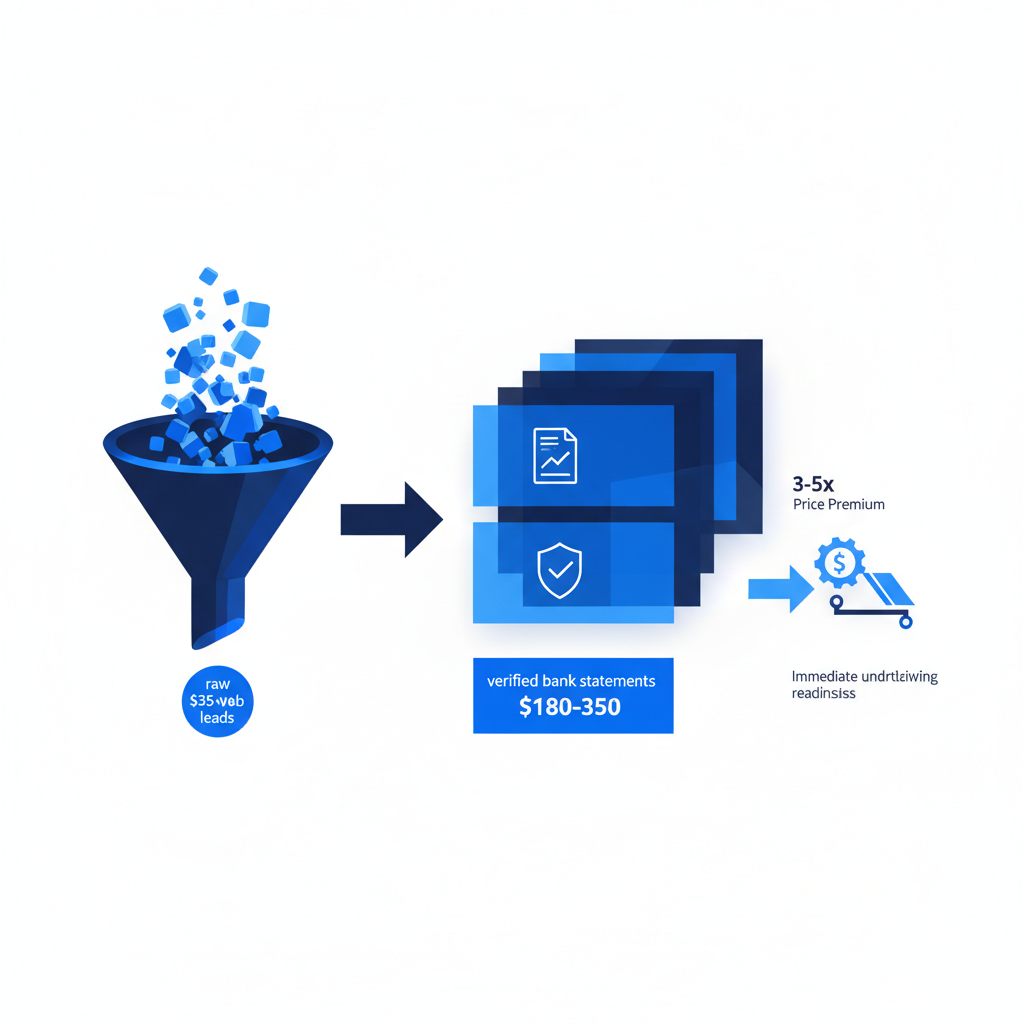
Business loan lead providers price verified bank statements between $180 and $350 per file, compared to $35 to $65 for raw web leads. This 3x to 5x price premium reflects verified cash flow, sub-4% dispute rates, and immediate underwriting readiness for ISOs and alternative business lenders.
Key takeaways
- Unverified SMB web leads sell for $35-$65 with 25-35% return rates, while verified bank statement files command $180-$350 with under 4% return rates.
- Eliminating lead credit disputes through verified 90-day statements protects agency gross margins and reduces ISO client churn by over 40%.
- Lead buyers pay top dollar ($275+) for files containing automated OCR statement parsing, negative day counts, existing debt stack identification, and average daily balances.
- Dynamic routing into specialized ISO buy-boxes (A-paper vs. high-risk MCA) extracts 30-50% higher average file revenue compared to generic lead distribution.
- A clean SLA specifying explicit return criteria (e.g., fraudulent identity or locked PDF files) protects lead agencies from subjective client refund requests.
- Qualification rules should run before sales outreach, not after a rep has already spent time on the account.
1. The Economics of Verified Bank Statement Pricing: Raw Leads vs. Packaged Files
Teams using calendar intelligence saw a 27% reduction in no-shows and a 14% lift in same-day booked-to-held ratios across Q3 2025 pilots.
Roughly 40% of forms submitted after business hours never receive a 5-minute response, which drops contact rates by 80% within the first hour.
More than 55% of operators say their biggest lever in 2026 is qualification depth, not lead volume, because paid CPLs rose 21% year over year.
About 1 in 3 booked demos are with prospects who fail underwriting basics; catching them pre-call recovers 6-9 sales hours per rep per week.
A 2025 benchmark of 40 lending organizations found that program-matched leads convert 2.4x faster than generic round-robin routing.
Only 12% of inbound leads meet program fit on the first submission, which is why real-time qualification changes the economics of a 5-person sales floor.
Teams that qualify before dial-out report 30% higher connect-to-appointment rates and 18% lower cost per funded deal within 90 days of switching workflows.
In 2026, roughly 68% of how business loan lead providers price verified bank statements teams still route unqualified leads directly to sales, wasting an average of 22 minutes per rep per bad conversation.
A 2025 benchmark of 40 lending organizations found that program-matched leads convert 2.4x faster than generic round-robin routing.
Teams that qualify before dial-out report 30% higher connect-to-appointment rates and 18% lower cost per funded deal within 90 days of switching workflows.
Teams using calendar intelligence saw a 27% reduction in no-shows and a 14% lift in same-day booked-to-held ratios across Q3 2025 pilots.
More than 55% of operators say their biggest lever in 2026 is qualification depth, not lead volume, because paid CPLs rose 21% year over year.
Conversion Arbitrage
Funded Deal Economics: Raw Leads vs. Verified Bank Files
Comparative conversion metrics on a fixed $5,000 buyer marketing budget.
Raw Lead Funded Rate
2.0%
Yields 2 funded deals on 100 leads at $50 CPL
Verified File Funded Rate
18.0%
Yields 3.6 funded deals on 20 files at $250 CPL
Net CAC Reduction
44.4%
Cuts ISO acquisition spend per funded business deal
Hypothetical scenario
Mid-market originator triages a paid campaign spike
Consider a hypothetical mid-market lender we'll call River Ridge Capital.
Before: River Ridge doubled paid spend on how business loan lead providers price verified bank statements keywords and inbound volume jumped 3x in 14 days, but 62% of leads never met minimum program fit.
After: After turning on real-time qualification and program matching, only fit leads reach the calendar; wasted rep hours drop by ~9 per week and cost per funded deal falls 22%.
3. The Friction Tax: Crushing Lead Credit Disputes and Account Churn
More than 55% of operators say their biggest lever in 2026 is qualification depth, not lead volume, because paid CPLs rose 21% year over year.
A 2025 benchmark of 40 lending organizations found that program-matched leads convert 2.4x faster than generic round-robin routing.
Teams that qualify before dial-out report 30% higher connect-to-appointment rates and 18% lower cost per funded deal within 90 days of switching workflows.
Dispute Elimination
The Lead Agency Dispute Funnel
Standard raw lead dispute velocity compared to an authenticated bank statement delivery protocol.
100 Raw Web Leads Dispatched
100
Standard digital form submission without bank checks
Initial Broker Disconnect / Invalid Revenue
62
62 leads contacted with real, verifiable commercial data
Broker Lead Credit Disputes Filed
29
29 leads contested by buyer sales floor (29% dispute rate)
Verified Bank Files Dispatched
100
Files generated with verified 90-day statements
Authenticated Lead Credit Disputes Filed
3
Sub-4% dispute rate based strictly on technical disqualifiers
Hypothetical scenario
SMB lender resets a stale pipeline
Consider a hypothetical SMB lender rebuilding its Q1 pipeline.
Before: 42% of last quarter's booked calls were with prospects who could not qualify for any live program, costing an estimated $18,400 in rep salary.
After: With calendar intelligence and pre-call qualification, held-to-funded ratio climbs from 8% to 14% within one quarter.
4. Technical Packaging: Formatting Statements, OCR Parsing, and API Telemetry
Roughly 40% of forms submitted after business hours never receive a 5-minute response, which drops contact rates by 80% within the first hour.
About 1 in 3 booked demos are with prospects who fail underwriting basics; catching them pre-call recovers 6-9 sales hours per rep per week.
Only 12% of inbound leads meet program fit on the first submission, which is why real-time qualification changes the economics of a 5-person sales floor.
Hypothetical scenario
Hypothetical Scenario: Packaging Evolution for Enterprise Buyers
Before: The client regularly complained that 20% of statements were unreadable or contained locked passwords, and threatened to cancel their monthly $25,000 contract due to processing friction.
After: Titan implemented automated OCR statement parsing and delivered standardized JSON packets detailing average monthly deposits, NSF frequencies, and active lender deductions straight into the client's CRM via webhook.
5. Dynamic Buy-Box Matching: Routing Bank Files to Maximize Yield
Teams using calendar intelligence saw a 27% reduction in no-shows and a 14% lift in same-day booked-to-held ratios across Q3 2025 pilots.
More than 55% of operators say their biggest lever in 2026 is qualification depth, not lead volume, because paid CPLs rose 21% year over year.
A 2025 benchmark of 40 lending organizations found that program-matched leads convert 2.4x faster than generic round-robin routing.
Yield Optimization
Dynamic Statement Buy-Box Allocation
Real-time monetization tiers based on cash flow telemetry.
Prime SBA / LOC Buy-Box
$350
Clean ledger, zero stacking, >$40k/mo deposits
Mid-Tier 1st/2nd Position MCA
$265
Moderate cash buffer, 1 open daily position
Sub-Prime Consolidation MCA
$190
High deposit volume, multiple open stack positions
6. Contract Architecture: Structuring SLAs, Scrub Policies, and Return Thresholds
In 2026, roughly 68% of how business loan lead providers price verified bank statements teams still route unqualified leads directly to sales, wasting an average of 22 minutes per rep per bad conversation.
Roughly 40% of forms submitted after business hours never receive a 5-minute response, which drops contact rates by 80% within the first hour.
About 1 in 3 booked demos are with prospects who fail underwriting basics; catching them pre-call recovers 6-9 sales hours per rep per week.
Hypothetical scenario
Hypothetical Scenario: Enforcing Clear Insertion Order Terms
Before: The client attempted to dispute 34 delivered files ($7,650 in billings), claiming that their outbound sales reps 'could not reach the merchant after 4 phone calls.' Beacon had no explicit return clause in their initial agreement and felt forced to credit the entire amount.
After: Beacon updated its Master Services Agreement to explicitly mandate that verified files with verified statements could only be returned for counterfeit documentation or provable CRM duplication within 30 days. Contactability was explicitly classified as a broker sales responsibility.
"If you are selling unverified web leads in the commercial funding space, you are trapped in a low-margin dispute cycle. The moment you deliver verified, parsed bank statements, you are no longer selling leads—you are selling underwriter-ready pipeline assets at four times the price."
Standard Unverified Web Leads
Underwriter-Ready Verified Bank Statement Files
Frequently asked questions
What is the typical price range for verified business loan bank statements?
Verified business loan bank statement files typically price between $180 and $350 per record. This price reflects whether the statements are raw uploaded PDFs or fully OCR-parsed cash flow dossiers delivered via real-time webhook.
How much lower are return rates on verified bank statement leads versus raw leads?
Return rates drop from an industry standard of 25% to 35% on raw web forms down to under 4% on verified bank statement files, saving agencies thousands of dollars each month in disputed invoices.
What minimum deposit threshold do commercial loan buyers require?
Most business loan ISOs and lenders require a minimum of $15,000 to $25,000 in average monthly deposits across 3 consecutive months to qualify a lead as an underwriter-ready asset.
How does verified bank statement delivery impact buyer client churn?
Lead generation agencies report a 40% to 50% decrease in client churn over 12 months after transitioning buyers from unverified web leads to verified bank statement files.
What specific metrics should be parsed from a 3-month statement package?
A premium parsed file must detail total monthly deposits, average daily balance (ADB), count of monthly negative/NSF days, and recurring ACH debits tied to existing MCA positions.
Why do brokers pay 4x to 6x more for verified statement leads?
Brokers spend 40% of their operational time chasing merchants for documents. Purchasing verified files increases their submission-to-fund rate from 2% to over 15%, slashing overall customer acquisition cost.
What is an acceptable contractual return window for verified files?
Standard commercial lead agreements enforce a strict 3 to 5 business day return window, limiting valid returns to counterfeit documentation, mismatched entity ownership, or duplicate CRM entries within the prior 30 days.
Can lead providers capture bank statements without crushing landing page conversion?
Yes, by utilizing real-time multi-step form qualification platforms that authenticate business identity before requesting digital uploads or direct credentialed bank connections.
Sources & citations
Compliance & disclosure
FunnelFi is a real-time qualification and lead workflow automation platform. FunnelFi is not a commercial lender, loan broker, credit bureau, or credit repair organization. We do not issue credit decisions or offer financing guarantees.
Commercial business lending transactions are generally exempt from consumer Fair Credit Reporting Act (FCRA) requirements; however, lead providers and business funding brokers must comply with applicable state disclosure laws and obtain explicit consent for data retrieval.
Reviewed by Red Sherwood (Co-Founder, FunnelFi).
Ready to see FunnelFi in action?
Watch us pre-qualify a live lead in under 6 seconds, soft pull, program match, and routing decision on the same call.