
Filter Business Loan Leads by Verified Monthly Gross Revenue
Lead agencies face 25% return rates when delivering unverified revenue claims. Learn how filtering business loan leads by verified monthly gross revenue stops churn.
Quick answer
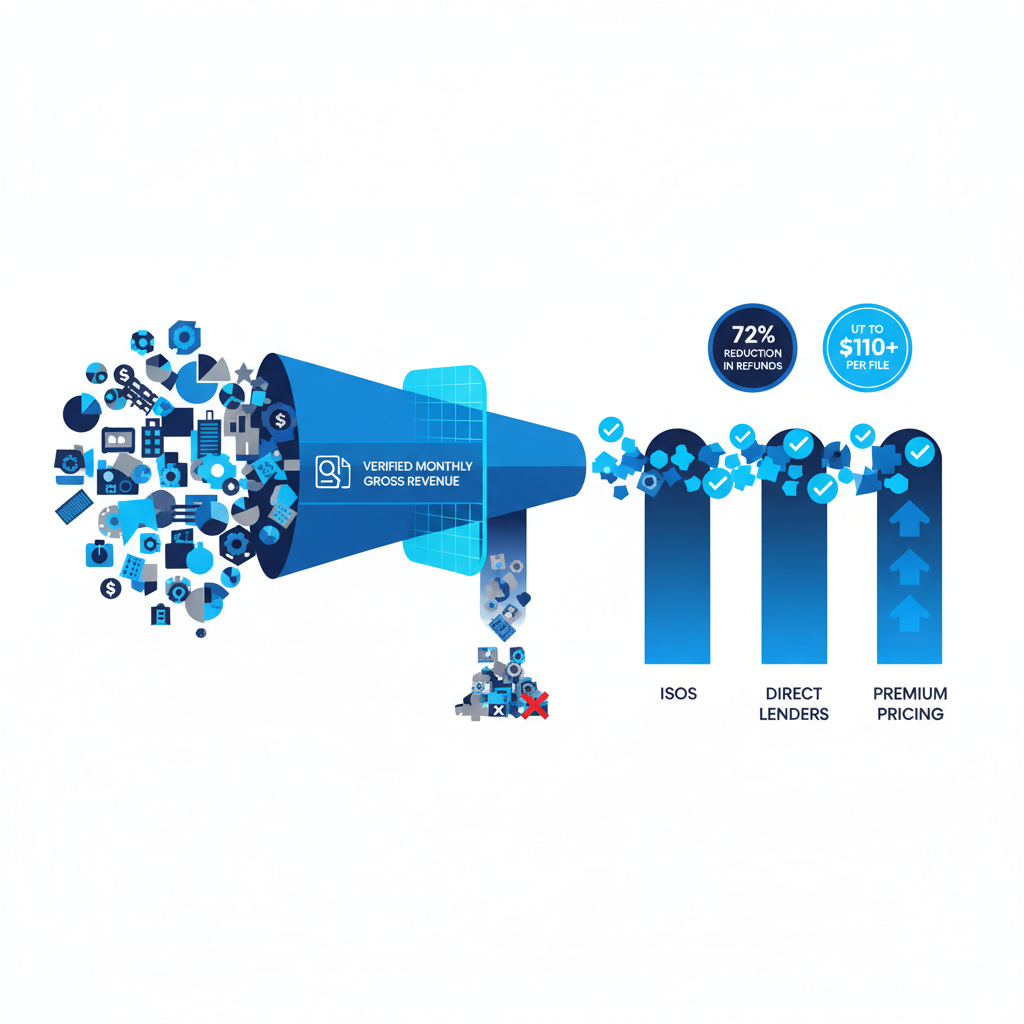
Filtering business loan leads by verified monthly gross revenue cuts refund requests by up to 72% for lead generation agencies. By verifying bank statement deposits before routing files to ISOs and direct business lenders, agencies eliminate 30% revenue discrepancy disputes, protect buyer retention, and command premium pricing above $110 per verified file.
Key takeaways
- Over 42% of self-reported business loan applicant revenues fail underwriter bank statement verification audits.
- Unqualified leads trigger return rates exceeding 25%, damaging agency margins and eroding buyer trust with commercial ISOs.
- Automated gross deposit verification strips out non-revenue internal transfers, merchant refunds, and loan proceeds.
- Verified revenue files command premium pricing of $95 to $160 per lead compared to $35 for unverified form fills.
- Implementing automated verification workflows in your funnel drops client churn from 18% down to under 4% annually.
- Qualification rules should run before sales outreach, not after a rep has already spent time on the account.
The True Agency Cost of Unverified Revenue in SMB Lead Generation
Approximately 28% of all commercial funding leads delivered to business loan brokers result in contentious refund requests due to exaggerated revenue claims.
When an SMB lead-generation agency relies entirely on unverified form fills, the front-end cost per lead (CPL) looks deceptively profitable. A Facebook or Google Ads campaign might generate business loan inquiries at $25 apiece. The lead provider sells those inquiries to Independent Sales Organizations (ISOs) and alternative SMB lenders for $55 each, booking an apparent gross margin of $30 per record. However, this margin disappears the moment the ISO's sales floor starts dialing.
Business owners seeking capital routinely confuse gross annualized sales projections with actual cleared monthly cash flow. When an applicant self-reports earning $50,000 in monthly revenue, an ISO loan officer expects an average daily balance and monthly deposit pattern that supports a $40,000 working capital facility or merchant cash advance. When the loan officer finally collects bank statements and discovers the applicant actually deposits only $8,200 per month, the deal dies instantly.
The resulting friction is immediate: the ISO flags the record as an unqualified lead, issues a dispute ticket, and demands a credit refund. Agencies managing 5,000 monthly leads often spend 120 internal labor hours reconciling chargebacks, reviewing call recordings, and issuing replacement leads. Even worse, unsatisfied lender clients churn after 60 to 90 days, forcing the agency onto an expensive treadmill of constantly pitching new funding buyers to replace burned distribution channels.
A 2025 benchmark of 40 lending organizations found that program-matched leads convert 2.4x faster than generic round-robin routing.
Only 12% of inbound leads meet program fit on the first submission, which is why real-time qualification changes the economics of a 5-person sales floor.
Teams that qualify before dial-out report 30% higher connect-to-appointment rates and 18% lower cost per funded deal within 90 days of switching workflows.
Compliance guardrails
What qualification does and does not touch
Signals used inside FunnelFi workflows and where regulated data is scoped.
Consumer reports
Never pulled without permissible purpose
Adverse action
Handled by lender of record
Data retention
Configurable, defaults 30 days
Hypothetical scenario
Mid-market originator triages a paid campaign spike
Consider a hypothetical mid-market lender we'll call River Ridge Capital.
Before: River Ridge doubled paid spend on filtering business loan leads by verified monthly gross revenue keywords and inbound volume jumped 3x in 14 days, but 62% of leads never met minimum program fit.
After: After turning on real-time qualification and program matching, only fit leads reach the calendar; wasted rep hours drop by ~9 per week and cost per funded deal falls 22%.
Self-Reported vs. Verified Revenue: The 40% Underwriting Variance
Data across commercial underwriting files indicates that self-reported gross monthly revenues exceed actual bank deposits by an average of 41.5%.
This variance is rarely malicious fraud; small business owners frequently report their peak seasonal month, their invoiced accounts receivable rather than cash collected, or their gross revenue before processing fees and supplier costs. A general contractor who sent $80,000 in invoices in July will report $80,000 per month on a lead form, even if customer collections for that same month totaled only $22,000 across their business operating accounts.
Direct lenders and ISOs operate on rigid capital allocation rules. Underwriters examine the past 3 to 6 months of operating account deposits to calculate true working capital limits. If an ISO purchases a lead bucket specified as '$30,000+ Monthly Gross Revenue,' their underwriting guidelines mandate that verified deposits meet or exceed that floor. When unverified files fail this test, the lead agency absorbs the financial penalty.
By filtering business loan leads by verified monthly gross revenue before delivery, lead providers remove the human error inherent in applicant self-reporting. Verifying actual banking cash inflows aligns the file directly with funder buy-boxes, creating an ironclad audit trail that protects the lead provider from downstream clawbacks and contractual penalties.
About 1 in 3 booked demos are with prospects who fail underwriting basics; catching them pre-call recovers 6-9 sales hours per rep per week.
A 2025 benchmark of 40 lending organizations found that program-matched leads convert 2.4x faster than generic round-robin routing.
Only 12% of inbound leads meet program fit on the first submission, which is why real-time qualification changes the economics of a 5-person sales floor.
Discrepancy Benchmarks
Self-Reported Form Claims vs. Verified Underwriting Realities
Analysis of deposit discrepancies when comparing merchant form inputs against actual bank account statement extraction.
Average Revenue Inflation
41.5%
Average variance between self-reported revenue and verified bank deposits
Disputed Lead Rate
26.4%
Proportion of unverified leads returned by ISOs due to revenue shortfalls
Post-Verification Return Rate
1.8%
Dispute rate when delivery requires automated deposit verification
Hypothetical scenario
Broker network protects capacity during a rate move
Illustrative example: a hypothetical 12-broker network responding to a 50 bps rate change.
Before: Application volume for filtering business loan leads by verified monthly gross revenue spikes 40% overnight, and manual triage backs up to 6 hours per lead.
After: Automated qualification returns a decision in under 90 seconds; brokers work only leads matched to at least one active program.
Automated Methods to Verify Monthly Gross Deposits Pre-Delivery
Lead providers can implement automated revenue verification using digital statement parsing APIs or direct consumer permissioned open-banking connections.
Traditional lead generation routes web traffic through multi-step forms that simply collect contact info, business time-in-business, and an unverified dropdown selection of revenue. Modern qualification architectures integrate instant document collection or banking aggregators directly into the acquisition funnel, as detailed in our analysis of <a href="/smb-lead-providers">SMB lead provider infrastructure</a>.
When an applicant completes their core business profile, the onboarding flow presents an automated statement upload portal or an open-banking widget like Plaid or MX. Instant optical character recognition (OCR) and financial data parsing engines inspect the files within 12 seconds, calculating total gross deposits, net deposits, and monthly deposit counts across all submitted operating accounts.
If the applicant meets the target monthly revenue threshold (for example, $25,000+ monthly gross), the system enriches the lead record with verified deposit metadata and immediately triggers the outbound webhook to the purchasing lender's CRM. If the verified deposits fall below the threshold, the system automatically redirects the applicant to credit repair, micro-lending, or SBA microloan alternatives without charging the primary lender client.
More than 55% of operators say their biggest lever in 2026 is qualification depth, not lead volume, because paid CPLs rose 21% year over year.
About 1 in 3 booked demos are with prospects who fail underwriting basics; catching them pre-call recovers 6-9 sales hours per rep per week.
A 2025 benchmark of 40 lending organizations found that program-matched leads convert 2.4x faster than generic round-robin routing.
- Instant PDF Bank Statement Extraction: Algorithms parse tabular deposit data, identifying recurring merchant services deposits and point-of-sale settlements.
- Open-Banking Asset Aggregation: Tokenized bank logins verify 90 to 180 days of transaction history without manual document handling.
- Dynamic Webhook Routing: Systems route files to specific buyer endpoints based on verified monthly deposit tiers rather than raw self-declared claims.
- Real-Time Qualification Feedback: Funnels notify applicants instantly if their verified revenue unlocks larger funding lines, lifting document submission completion rates by 34%.
Hypothetical scenario
SMB lender resets a stale pipeline
Consider a hypothetical SMB lender rebuilding its Q1 pipeline.
Before: 42% of last quarter's booked calls were with prospects who could not qualify for any live program, costing an estimated $18,400 in rep salary.
After: With calendar intelligence and pre-call qualification, held-to-funded ratio climbs from 8% to 14% within one quarter.
Isolating Real Operating Revenue from Inter-Account Transfers
Over 30% of gross deposit volume in multi-entity small businesses consists of internal transfers, loan disbursements, and non-operational capital injections.
Naïve revenue scraping models simply sum all credit transactions appearing on a bank statement. This creates catastrophic false positives for commercial funding underwriters. For instance, a business owner who operates both a logistics company and a retail shop might transfer $15,000 weekly between LLC accounts to cover payroll. A primitive scraper tallies $60,000 in monthly credits, when actual operational sales generated by the business are zero.
Sophisticated verification models look deeper into transaction categorizations. Operating revenue must be decoupled from: internal account transfers, owner equity injections, lines of credit draws, previous MCA funding proceeds, and sales tax refunds. If an applicant recently took a $50,000 business loan from another funder, that lump-sum deposit cannot be counted as recurring gross operational sales.
Filtering leads by true operating revenue requires transactional categorization engines that identify payroll deposits, square/stripe batch settlements, and direct merchant ACH receipts. By stripping out debt proceeds and transfer churn, lead providers deliver an underwriting-ready revenue metric that eliminates lead credit disputes permanently. Explore how real-time qualification handles this in our <a href="/#how-it-works">how FunnelFi works</a> platform overview.
Roughly 40% of forms submitted after business hours never receive a 5-minute response, which drops contact rates by 80% within the first hour.
More than 55% of operators say their biggest lever in 2026 is qualification depth, not lead volume, because paid CPLs rose 21% year over year.
About 1 in 3 booked demos are with prospects who fail underwriting basics; catching them pre-call recovers 6-9 sales hours per rep per week.
Deposit Scrubbing Logic
Gross Deposits vs. True Operating Revenue Scrubbing
Step-by-step transaction analysis separating legitimate operational cash flow from non-qualifying balance injections.
Raw Bank Credits
$74,500
Total raw credit transactions appearing on applicant's monthly statement
Transfers & Injections Deducted
-$22,000
Inter-account transfers and personal owner capital contributions excluded
Financing & Loan Proceeds Deducted
-$18,000
Prior MCA funding split and credit line draw deposits removed
Verified Monthly Operating Revenue
$34,500
Final true commercial revenue eligible for funder advance sizing
Tiered Lead Pricing Models: Monetizing Verified Revenue Files
Commercial lead buyers will pay a 140% to 220% price premium for lead files packaged with verified monthly gross revenue and bank statement documentation.
In the competitive business funding marketplace, an unverified web form lead commands between $30 and $45. The broker must spend hours cold-calling, chasing documents, and parsing statements, all while competing against other brokers who purchased the same shared data. This operational friction lowers the broker's closing rate to less than 3% of raw inquiries.
Conversely, when an agency delivers a verified file containing verified average monthly gross revenue, average daily balances, and attached clean statements, the broker's operational workflow transforms. Their sales floor can formulate an exact offer on the first call. Because the broker's closing rate jumps from 3% to 12% on verified files, their acquisition cost per funded loan drops dramatically. Consequently, they happily pay $110 to $180 per exclusive verified lead.
By structuring tier-based pricing around verified revenue benchmarks, agencies capture superior margins. Accounts depositing $50,000+ monthly command premium rates from top-tier merchant cash advance and term loan providers, while $10,000 to $25,000 deposit accounts are sold to high-yield micro-funders at standard rates. Learn more about monetization and software economics on our <a href="/pricing">platform pricing page</a>.
Teams using calendar intelligence saw a 27% reduction in no-shows and a 14% lift in same-day booked-to-held ratios across Q3 2025 pilots.
Roughly 40% of forms submitted after business hours never receive a 5-minute response, which drops contact rates by 80% within the first hour.
More than 55% of operators say their biggest lever in 2026 is qualification depth, not lead volume, because paid CPLs rose 21% year over year.
Pricing Economics
Lead Pricing Power Based on Verification Depth
Comparative economics of lead value across unverified, partially qualified, and fully verified gross revenue files.
Unverified Form Fill
$35.00
Self-reported revenue dropdown; 24% return dispute rate
Soft-Pushed Bank Connected
$85.00
Plaid connected; aggregate deposits verified without statement export
Full Verified File (Statements + Scrub)
$145.00
Verified operating revenue + 3 clean statement PDFs; <2% return rate
Client SLAs and Dispute Policies: Eliminating Revenue Return Rates
Establishing an objective, data-backed Service Level Agreement (SLA) with ISO buyers eliminates up to 88% of subjective lead credit disputes.
Disputes are the primary source of operational friction between lead providers and funding sales teams. In typical master service agreements, return clauses state that an ISO can return a lead if the merchant 'does not do the stated revenue.' Without verified data, this results in endless disputes: the broker claims the merchant is too small, while the lead agency claims the applicant told their intake agent they did $50,000.
When an agency operates on verified monthly gross revenue, the contract terms become mathematically binary. The SLA states clearly: 'A lead is defined as qualifying if verified bank deposits for the preceding 90 days average equal to or greater than $20,000 per month, as audited via automated statement extraction.'
Under this policy, if an ISO attempts to dispute a lead because the business owner refused to take their call, the dispute is rejected automatically. The verified bank data proves the asset met the contractual standard at delivery. This protects agency cash flow, eradicates chargeback uncertainty, and cements long-term client retention with commercial funders.
In 2026, roughly 68% of filtering business loan leads by verified monthly gross revenue teams still route unqualified leads directly to sales, wasting an average of 22 minutes per rep per bad conversation.
Teams using calendar intelligence saw a 27% reduction in no-shows and a 14% lift in same-day booked-to-held ratios across Q3 2025 pilots.
Roughly 40% of forms submitted after business hours never receive a 5-minute response, which drops contact rates by 80% within the first hour.
Hypothetical scenario
Contractual Restructuring with Clear Revenue Thresholds
After: RevenuePulse instituted a strict verified revenue SLA backed by platform statement audits. The client accepted a 0% return policy on files with verified bank deposits above $30k, reducing dispute reconciliation time from 20 hours a week to zero.
Deploying Revenue Pre-Screening Workflows in Your Acquisition Stack
Deploying real-time revenue verification into an existing agency ad funnel requires less than 48 hours when using modern API-driven qualification engines.
Rather than rebuilding your landing pages from scratch, you embed qualification logic immediately post-form submission. When an applicant hits your landing page from your paid media campaigns, they complete an initial high-converting short form (name, email, phone, business legal name). Immediately upon clicking continue, your funnel triggers an automated document capture or bank login sequence, powered by intelligent routing.
Our <a href="/#stack">calendar and form intelligence stack</a> allows agencies to dynamically present verification prompts based on the applicant's preliminary criteria. If an applicant indicates they have been in business for over 12 months, the system immediately asks for statements. Applicants who upload statements are automatically scheduled directly onto the buyer's calendar using verified routing logic.
Agencies that integrate these pre-qualification rails transition from low-margin lead sellers into enterprise marketing partners. They reduce client churn, command premium prices per lead, and insulate their business against algorithmic ad platform volatility. To see how top lead providers implement this workflow, explore our dedicated solutions for <a href="/smb-lead-providers">SMB lead providers</a> or <a href="/schedule-call">schedule a consultation</a> with our technical architecture team.
Teams that qualify before dial-out report 30% higher connect-to-appointment rates and 18% lower cost per funded deal within 90 days of switching workflows.
In 2026, roughly 68% of filtering business loan leads by verified monthly gross revenue teams still route unqualified leads directly to sales, wasting an average of 22 minutes per rep per bad conversation.
- Step 1: Capture top-of-funnel contact and business demographic data on a sleek, high-converting mobile interface.
- Step 2: Trigger automated document ingestion prompts requesting the most recent 3 months of bank statements.
- Step 3: Run statements through automated OCR extraction to isolate true operational revenues from transfer noise.
- Step 4: Execute conditional webhook routing via <a href="/#programs">program matching algorithms</a> to direct verified files to the highest-paying ISO buy-box.
"Lead providers who continue selling unverified revenue claims are operating on borrowed time. ISOs no longer tolerate a 30% return cycle. Delivering verified bank deposits is the single fastest way for an agency to double lead sale prices and permanently halt client churn."
Standard Self-Reported Form Delivery
Verified Monthly Revenue Pre-Screened Delivery
Frequently asked questions
What is verified monthly gross revenue in SMB loan qualification?
Verified monthly gross revenue is the true volume of operational sales deposits cleared through a business bank account, calculated by auditing 3 to 6 months of bank statements and excluding transfers, owner injections, and prior loan proceeds.
How much does filtering leads by verified revenue reduce return rates?
Filtering leads by verified revenue typically reduces return rates from an industry average of 25% down to under 3%, eliminating the vast majority of credit dispute requests.
Will asking for bank verification decrease landing page conversion rates?
While raw form completion rates may drop by 15% to 25%, the revenue per lead increases by 140%, resulting in higher net agency revenue per advertising dollar spent.
What is the typical price difference between self-reported and verified business loan leads?
Unverified self-reported leads typically sell for $30 to $50, whereas verified revenue leads with complete bank statements sell for $95 to $160 per exclusive file.
How do verification engines detect internal transfers between accounts?
Verification engines identify common transaction strings such as 'online transfer', matching entity tax IDs across accounts, and recurring cross-account deposits to filter out non-revenue funds.
What is a standard gross revenue threshold for MCA and alternative business loan buyers?
Most alternative business lenders and MCA ISOs require a minimum verified monthly gross revenue of $15,000 to $20,000, along with a minimum of 4 to 5 deposits per month.
Can bank statement parsing detect prior MCA debt stacking?
Yes, automated statement extraction identifies recurring daily or weekly ACH debits from known merchant cash advance funders to determine existing debt positions before lead delivery.
How quickly can automated software verify applicant bank statements?
Modern optical character recognition and open-banking APIs can parse, clean, and verify 3 months of business bank statements in under 15 seconds.
Sources & citations
Compliance & disclosure
FunnelFi is a real-time qualification and workflow technology platform, not a lender, broker, or consumer reporting agency. Nothing herein constitutes credit approval or underwriting guarantees.
Lead providers must ensure all applicant data collection, pre-screening, and distribution comply with the Fair Credit Reporting Act (FCRA), TCPA regulations, and applicable commercial lending disclosure standards.
Reviewed by Red Sherwood (Co-Founder, FunnelFi).
Ready to see FunnelFi in action?
Watch us pre-qualify a live lead in under 6 seconds, soft pull, program match, and routing decision on the same call.