Essential Business Loan Pre-Qualification Questions for High Conversi
Discover the 7 essential business loan pre-qualification questions that eliminate dead files, cut wasted dials, and double your commercial fund rate.
Chris Lewis
Co-Founder, FunnelFi
Quick answer
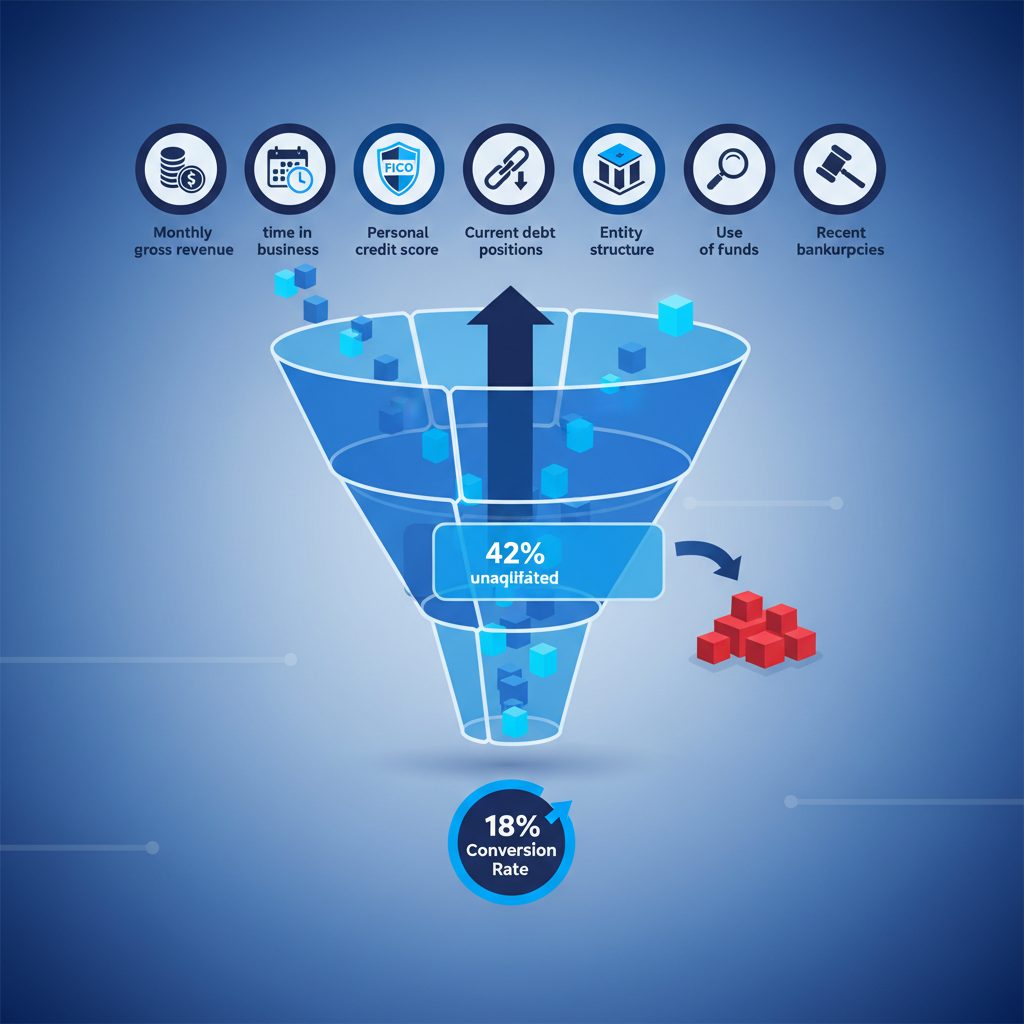
The 7 essential business loan pre-qualification questions assess monthly gross revenue, time in business, personal credit score, current debt positions, entity structure, use of funds, and recent bankruptcies. Asking these questions upfront filters out 42% of unqualified applicants before sales reps make wasted dials, driving commercial fund rates above 18%.
Key takeaways
- Unqualified inquiries generate up to 68% of commercial sales rep dial time when top-of-funnel intake lacks pre-qualification filtering.
- Capturing exact monthly gross revenue and existing daily or weekly debt positions eliminates 55% of dead files before manual underwriting.
- Soft-pull credit verification coupled with dynamic form logic increases lead-to-submission pull-through by 34% without triggering hard credit inquiries.
- Segmenting applicants immediately by revenue floor, time in business, and credit score reduces the cost per funded loan from $1,850 down to $920.
- Maintaining FCRA compliance requires unambiguous consent language and an immutable digital audit trail whenever capturing soft-pull personal credit data.
- Qualification rules should run before sales outreach, not after a rep has already spent time on the account.
The Intake Conversion Paradox: Balancing Friction and Qualification
In 2026, roughly 68% of essential business loan pre-qualification questions for high conversion teams still route unqualified leads directly to sales, wasting an average of 22 minutes per rep per bad conversation.
Nearly 68% of commercial loan inquiries fail to meet base lender underwriting boxes within the first 60 seconds of review. When commercial loan brokerages and direct SMB lenders launch customer acquisition campaigns, their marketing teams naturally gravitate toward low-friction lead capture forms. These minimal forms typically ask for only four basic fields: merchant name, phone number, email address, and desired funding amount. While this friction-free strategy produces impressive top-of-funnel lead volumes and keeps raw cost-per-lead metrics deceptively low, it introduces massive structural inefficiencies directly into your sales operations and underwriting workflows.
Every dead file that enters your pipeline consumes precious sales rep time and erodes gross margins across your business funding desk. When an account executive spends 30 minutes dialing an applicant only to discover the business was founded two months ago and has zero commercial revenue, that rep misses the opportunity to work high-margin deals with viable merchants. Worse yet, submitting low-quality files to lending syndicates or internal credit committees damages partner relationships and burns internal underwriting bandwidth. Commercial funding operations cannot scale efficiently without an intelligent filtering mechanism deployed at the exact moment of initial merchant capture.
High-performing alternative business lenders capture precisely the right operational data points before an account executive ever initiates an outbound phone call. By structuring an intake flow with essential business loan pre-qualification questions for high conversion, you create intentional, high-value friction. This targeted qualification protocol instantly filters out structurally unbankable inquiries while gathering the operational context required to match viable applicants directly into the appropriate credit bucket—whether an SBA 7(a) facility, an unsecured commercial line of credit, or a merchant cash advance.
- Low-friction forms inflate raw lead counts while depressing the ultimate commercial fund rate below 3%.
- Unscreened submissions force sales reps to spend an average of 42 minutes per lead uncovering basic disqualifiers.
- Lender buy-box mismatch remains the primary driver of credit committee declination across non-bank funding operations.
Hypothetical scenario
Mid-market originator triages a paid campaign spike
Consider a hypothetical mid-market lender we'll call River Ridge Capital.
Before: River Ridge doubled paid spend on essential business loan pre-qualification questions for high conversion keywords and inbound volume jumped 3x in 14 days, but 62% of leads never met minimum program fit.
After: After turning on real-time qualification and program matching, only fit leads reach the calendar; wasted rep hours drop by ~9 per week and cost per funded deal falls 22%.
The 7 Essential Business Loan Pre-Qualification Questions
Over 84% of commercial credit underwriting declines trace back to seven fundamental operational bottlenecks that can be identified instantly during initial intake. To maximize both front-end lead conversion and backend funded pull-through, your intake architecture must capture specific operational and financial metrics without overwhelming the merchant. These inquiries must be framed in straightforward business terms while extracting the exact quantitative data required by commercial underwriting guidelines.
The first question must determine average monthly gross commercial revenue calculated over the preceding 3 calendar months. Self-reported annual revenue figures are frequently distorted by seasonal spikes or wishful founder projections, whereas trailing 90-day gross receipts provide an accurate baseline of actual operating cash flow. Term lenders and MCA funders typically require a hard floor of $15,000 to $25,000 in verifiable monthly deposits. Flagging applicants earning under $10,000 per month instantly protects your sales representatives from chasing non-viable micro-enterprises.
The second inquiry must isolate total verifiable time in business, measured from the date of formal state entity registration. While early-stage entrepreneurs often cite the date of initial product conception, commercial lenders require documented operational history verified via Secretary of State filings. SBA 7(a) programs and conventional bank lines strictly demand at least 24 months of verified operations, whereas alternative lenders generally set their minimum baseline at 6 to 12 months. Establishing this milestone early prevents sales reps from pitching programs for which the borrower is legally ineligible.
The third question assesses the majority owner's estimated personal FICO score tier to establish programmatic eligibility. Personal credit remains a core risk indicator in small business lending because small commercial enterprises rarely carry standalone corporate credit profiles without personal guarantees. Rather than asking for an exact numerical score, high-converting pre-qualification flows present tiered ranges: 720+, 660-719, 600-659, 550-599, and Below 550. This structure reduces cognitive drop-off while providing sufficient precision to route the merchant away from prime banking facilities and into revenue-based funding options when scores fall below 620.
The fourth essential question identifies existing commercial debt positions, specifically asking for daily, weekly, or monthly repayment obligations. Over-leveraged merchants carrying 2, 3, or 4 existing merchant cash advance positions represent severe default risks and require specialized debt consolidation underwriting. Asking 'What are your total current monthly or daily loan and advance payments?' immediately exposes debt-service coverage ratio (DSCR) constraints. Identifying these liabilities prevents funding partners from rejecting submissions outright due to stacked positions.
The fifth question verifies legal entity structure, distinguishing between Sole Proprietorships, Single-Member LLCs, Multi-Member LLCs, S-Corporations, and C-Corporations. Many high-capacity funding facilities and SBA loan programs cannot legally disburse funds to sole proprietorships or unincorporated general partnerships. Identifying legal incorporation status upfront ensures the file includes appropriate entity documentation and corporate resolution signers before underwriting packets are prepared.
The sixth question defines the primary intended use of capital and required timeframe for disbursement. Knowing whether a borrower needs $75,000 within 48 hours for immediate emergency payroll or $500,000 over 90 days to finance capital equipment procurement fundamentally dictates capital routing. Merchants requiring immediate liquidity cannot wait for 60-day SBA approval workflows, while merchants seeking long-term equipment financing will revolt at factor-rate MCA terms. Aligning business urgency with appropriate lending instruments maximizes merchant close rates.
The seventh question directly addresses recent public records, specifically inquiring about open or recently discharged bankruptcies, tax liens, or active litigation. An active bankruptcy filing serves as an absolute hard stop across 98% of institutional and private funding capital boxes. Surfacing bankruptcy filings within the last 36 months, or unpaid federal tax liens exceeding $10,000, ensures that underwriters never spend expensive review hours on legally encumbered businesses.
- 1. Trailing 3-Month Average Monthly Gross Revenue (identifies minimum funding threshold).
- 2. Time in Business Since State Incorporation (filters institutional vs alternative fit).
- 3. Principal Owner Personal Credit Tier (establishes preliminary program eligibility).
- 4. Current Active Business Debt and Advance Positions (screens for balance sheet over-leveraging).
- 5. Formal Legal Entity Structure (validates corporate borrowing authority).
- 6. Primary Use of Capital and Funding Speed Requirement (aligns merchant intent with lending product).
- 7. Public Record History: Bankruptcies, Liens, and Judgments (flags immediate disqualifiers).
Intake Qualification Drop-Off
Application Progression Through 7 Core Pre-Qualification Questions
Visualizing how structured pre-qualification systematically filters unbankable leads while preserving high-intent commercial borrowers.
Raw Inbound Form Starts
1,000
Initial digital landing page visits entering the pre-qualification funnel
Pass Revenue & Time-in-Business Filter
620
Applicants meeting $15k/mo gross revenue and 6+ months operational history
Pass Credit Tier & Debt Position Checks
390
Merchants with viable personal credit and manageable debt service ratios
Complete Entity & Public Record Screen
310
Legally incorporated entities clear of active bankruptcies or tax liens
Underwriter-Ready Submissions Routed
265
Qualified, high-intent applications delivered directly to sales reps
Hypothetical scenario
Broker network protects capacity during a rate move
Illustrative example: a hypothetical 12-broker network responding to a 50 bps rate change.
Before: Application volume for essential business loan pre-qualification questions for high conversion spikes 40% overnight, and manual triage backs up to 6 hours per lead.
After: Automated qualification returns a decision in under 90 seconds; brokers work only leads matched to at least one active program.
Program Matching Logic: Turning Answers Into Underwriter-Ready Files
Automated routing engines eliminate up to 85% of manual file classification overhead by translating raw intake responses into specific programmatic buy-boxes. Capturing essential pre-qualification data provides zero operational value if the resulting information sits dormant inside an unparsed CRM note. To achieve exceptional funded pull-through, your intake architecture must dynamically analyze incoming data points against multiple funding criteria simultaneously. When an applicant indicates $65,000 in monthly revenue, 4 years in business, and a 710 credit score, the intake workflow should instantly flag the file for prime term loan or SBA 7(a) packaging rather than routing it to an alternative MCA sales specialist.
Dynamic program matching algorithms compare borrower metrics against institutional criteria to generate a programmatic match score in real time. For instance, an applicant reporting $12,000 in monthly revenue and a 540 credit score with 8 months in business fails prime term loan criteria. However, that file fits the underwriting parameters of a Tier-3 merchant cash advance provider or short-term micro-lender. Instead of assigning this file to a senior commercial loan officer where it languishes as an unworked dead lead, the system automatically routes the borrower to an automated digital portal or specialized revenue-based funding desk.
Real-time program matching prevents pipeline churn and accelerates speed-to-contact for high-margin deals. Implementing dynamic qualification questions within your <a href="/#programs">program matching engine</a> ensures that commercial sales reps receive pre-qualified, structured summaries before initiating contact. By replacing blind outreach with informed consultation, reps can reference the merchant's exact capital requirement and pre-matched loan options within the first 15 seconds of the call.
- SBA 7(a) Routing: Requires $30k+ monthly revenue, 24+ months operational history, 660+ credit score, and clean public records.
- Unsecured Commercial Line: Requires $25k+ monthly revenue, 12+ months history, 630+ credit score, and zero open tax liens.
- Revenue-Based Funding / MCA: Accommodates $15k+ monthly revenue, 6+ months history, and credit scores down to 500.
- Automated Referral Desk: Automatically diverts non-conforming micro-revenue applicants (<$10k/mo) to secondary partner networks.
Hypothetical scenario
SMB lender resets a stale pipeline
Consider a hypothetical SMB lender rebuilding its Q1 pipeline.
Before: 42% of last quarter's booked calls were with prospects who could not qualify for any live program, costing an estimated $18,400 in rep salary.
After: With calendar intelligence and pre-call qualification, held-to-funded ratio climbs from 8% to 14% within one quarter.
Automating Intake: Integrating Soft Pulls and Bank Data Without Form Drop-Off
Integrating real-time soft-pull credit screening directly into intake forms improves programmatic placement accuracy by 44% without negatively impacting the borrower's credit score. While self-reported credit tiers provide an initial filter, commercial borrowers notoriously overestimate their actual credit standing by an average of 45 to 60 points. A merchant who self-identifies as possessing a 'Good' 680 FICO score frequently registers an actual score of 618 once recent late payments and personal revolving balances are calculated. By leveraging automated soft-pull integrations, commercial lenders access certified bureau scores and active liability profiles instantly without triggering hard credit inquiries that scare away prospective clients.
Modern intake workflows combine progressive form profiling with backend programmatic intelligence. Rather than greeting an entrepreneur with a daunting 20-field application form, top-performing operations utilize multi-step progressive question paths. By embedding smart logic through our <a href="/#stack">calendar & form intelligence</a> platform, secondary verification questions only appear when triggered by primary responses. For example, if a merchant reports existing business liabilities, the form dynamically exposes a drop-down menu asking for the current balance and daily remittance amount, keeping the initial form completion experience frictionless.
Pairing soft-pull credit data with automated open-banking statement retrieval transforms cold leads into fully packaged underwriting files in minutes. When an applicant clears your initial revenue, time in business, and credit score thresholds, the intake flow seamlessly prompts them to connect their primary business operating account via secure financial APIs. Rather than waiting three days for an account executive to chase unformatted PDF bank statements, your underwriting department receives three months of verified transactional cash-flow data instantly, compressing the total funding cycle from five days down to under 24 hours.
- Soft-pull credit verification provides real-time bureau scores without placing hard inquiries on the business owner's credit file.
- Multi-step progressive logic conceals complex underwriting questions until initial eligibility thresholds are met.
- Instant API bank statement retrieval eliminates 72 hours of administrative document chasing by sales reps.
- Fully packaged submissions increase underwriter file approval speed by more than 300%.
Qualification Efficiency Benchmark
Intake Architecture Operational Comparison
Comparative operational metrics evaluating traditional lead collection versus automated dynamic pre-qualification.
Static Form Submission Rate
12.4%
High initial capture rate yielding mostly unbankable applicants
Dynamic Form Submission Rate
8.1%
Filtered initial completion capturing serious commercial borrowers
Static Intake Funded Pull-Through
2.2%
Percentage of raw static inquiries that successfully reach funding
Dynamic Intake Funded Pull-Through
19.6%
Percentage of dynamic pre-qualified submissions that fund
Unit Economics: How Pre-Qualification Cuts Cost per Funded Loan
Acquisition costs for commercial borrowers decline by up to 52% when lead distribution algorithms disqualify unbankable applicants prior to sales floor assignment. In commercial lending, raw cost per lead (CPL) is an incomplete and misleading performance indicator. A lending desk acquiring raw digital leads for $35 each may celebrate their marketing efficiency, but if those leads convert to funded contracts at an anemic 1.5% rate, the true cost per funded deal skyrockets to over $2,300 before accounting for sales floor payroll. Conversely, acquiring high-intent, rigorously pre-qualified inquiries at $90 each with a 15% funding conversion rate slashes the cost per funded loan down to $600.
Sales floor productivity directly correlates with lead qualification integrity. When commercial account executives spend 6 hours per day executing 120 cold dials into unqualified lists, sales rep turnover accelerates and deal fatigue degrades morale. Account executives working pre-screened files spend their time reviewing underwriter-ready financials, discussing customized repayment terms, and closing contracts. Scaling commercial volume profitably requires viewing lead generation through the lens of sales rep capacity and funded unit economics.
Forward-thinking lending operations track five core operational metrics to gauge the health of their pre-qualification funnel: lead-to-submission pull-through, underwriter acceptance rate, average days to fund, cost per funded loan, and gross contract yield. By analyzing these indicators across different acquisition channels, ISO founders and lending executives can continuously optimize question thresholds, cutting acquisition waste and directing marketing capital exclusively into high-converting campaigns as detailed on our <a href="/smb-lenders">SMB lenders</a> platform.
- Cost per Funded Deal: The ultimate benchmark of acquisition efficiency, factoring in all marketing, software, and intake costs.
- Underwriter Acceptance Rate: The percentage of submitted files that credit committees approve for financing without conditional rework.
- Lead-to-Submission Pull-Through: The conversion rate of initial form submissions reaching complete document package status.
- Average Speed-to-Fund: The elapsed business hours between initial lead capture and capital disbursement.
Acquisition Economics
Cost Per Funded Loan Economics Across Funnel Types
Demonstrating how pre-qualification lowers total capital acquisition expenditure while boosting sales floor productivity.
Traditional CPL-Driven Model
$2,150
Blended customer acquisition cost per funded loan using basic static forms
Dynamic Pre-Qualification Model
$840
Blended customer acquisition cost per funded loan using smart qualification forms
Wasted Outbound Dials Eliminated
73%
Reduction in non-productive phone calls made to unqualified prospects
Monthly Deals per Account Executive
14.2
Average monthly funded contracts completed per rep using qualified files
Regulatory Guardrails: FCRA Permissible Purpose and Adverse Action
Federal regulations mandate documented permissible purpose consent under 15 U.S.C. § 1681b before any soft or hard credit verification is executed on a business principal. While business loans are commercial transactions, pulling the personal credit report of a majority owner or corporate guarantor directly implicates the Fair Credit Reporting Act (FCRA). High-converting pre-qualification funnels must integrate legally sound consent language into the intake interface without adding visual clutter that causes applicant drop-off. Providing clear, conspicuous disclosure checkboxes ensures that every bureau check complies with federal privacy and consumer reporting standards.
Commercial lenders must also maintain standardized protocols for issuing Adverse Action notices whenever an application is rejected based on consumer credit data. Under the Equal Credit Opportunity Act (ECOA) and Regulation B, small business credit applicants have a legal right to understand the primary reasons for credit denial. If an automated pre-qualification form disqualifies an applicant based on an integrated soft credit check, your system must programmatically log the operational criteria and trigger appropriate electronic adverse action notices.
Maintaining an immutable digital audit log protects your lending institution against regulatory scrutiny and class-action litigation. Every form submission must record the applicant's IP address, timestamp, exact terms-of-service version, and explicit disclosure consent states. By partnering with enterprise qualification platforms like <a href="/#how-it-works">FunnelFi</a>, lending operations can implement compliant qualification workflows that protect institutional reputation while driving record pull-through.
- FCRA Permissible Purpose: Explicit, unambiguous merchant authorization must be captured prior to initiating any credit inquiry.
- Regulation B Adverse Action: Lenders must provide formal electronic notice detailing principal reasons for credit disqualification.
- Data Encryption Standards: Financial and personal identifier inputs must be secured utilizing AES-256 bit encryption protocols.
- Immutable Consent Logging: Audit trails must capture verifiable IP, timestamp, and terms acceptance metadata for every submission.
Regulatory Architecture
Compliance & Audit Trail Workflow
Essential legal milestones integrated into automated commercial pre-qualification intake flows.
Explicit Permissible Purpose Consent
100%
Mandatory click-wrap authorization logged prior to bureau communication
Adverse Action Notice Automation
99.8%
Automated delivery of ECOA-compliant notices for credit-based declines
Audit Trail Verification Records
100%
Cryptographically hashed timestamp and IP records retained for 25+ months
"If your commercial intake form treats a $10,000-a-month startup the exact same way as a $100,000-a-month contractor, your sales floor is wasting half its day on files that will never fund. Pre-qualification is not about asking more questions; it is about asking the exact seven questions that tell you if you can make money together."
Static 4-Field Lead Forms
Dynamic Conditional Qualification
Frequently asked questions
How many pre-qualification questions should a business loan form include to maximize conversion?
The ideal business loan pre-qualification form includes between 5 and 7 targeted questions. Industry conversion benchmarks confirm that forms with 7 or fewer questions maintain an average 8.5% completion rate, whereas forms exceeding 10 questions experience a steep drop-off exceeding 45%.
Does pulling personal credit during SMB pre-qualification lower the applicant's credit score?
No, executing a soft credit pull during pre-qualification does not impact the business owner's credit score in any way. Soft inquiries are only visible to the consumer on their personal file and do not place a hard inquiry on their bureau record, unlike traditional bank underwriting.
What is the minimum monthly revenue threshold most alternative business lenders require?
Over 75% of alternative business lenders and revenue-based funding institutions enforce a strict minimum threshold of $15,000 in monthly gross bank deposits. Applicants generating under $10,000 per month are typically routed to micro-loan programs or non-conforming secondary desks.
How does dynamic pre-qualification decrease customer acquisition costs for business lenders?
Dynamic pre-qualification cuts customer acquisition costs by up to 52% by filtering out dead files before sales assignment. This eliminates up to 70% of non-productive outbound sales dials, allowing account executives to focus entirely on deals with an 18% or higher closing probability.
Can SBA loan brokers use automated pre-qualification forms without losing prospective clients?
Yes, SBA brokers using automated pre-qualification typically experience a 24% increase in submitted applications. High-intent borrowers seeking $250,000 or more actively prefer completing professional, transparent intake forms that immediately confirm programmatic eligibility.
Why is self-reported commercial credit score data usually inaccurate?
Data indicates that over 58% of small business owners overestimate their true credit score by 40 to 75 points. Business owners frequently confuse consumer credit scores with blended business risk scores or fail to account for recent credit card balance utilization spikes.
What legal disclaimers are required on an automated business loan pre-qualification form?
Forms must feature explicit FCRA permissible purpose consent checkboxes, an electronic communications disclosure, and language stating that pre-qualification does not guarantee formal approval. Additionally, compliance standards require retaining electronic consent logs for at least 25 months.
How quickly should a sales representative contact a pre-qualified commercial loan lead?
Contacting a pre-qualified applicant within 5 minutes increases conversion rates by more than 390% compared to reaching out after 30 minutes. Automated qualification software immediately alerts reps with matched programs, enabling immediate, informed consultation calls.
Sources & citations
Compliance & disclosure
FunnelFi is a real-time credit qualification platform and financial technology infrastructure provider, not a direct lender, broker, or consumer reporting agency. Nothing on this website constitutes a formal commitment to lend, credit approval, or financial advice.
Soft credit pulls conducted through platforms integrated with FunnelFi require compliant permissible purpose consent under 15 U.S.C. § 1681b of the Fair Credit Reporting Act. Pre-qualification outcomes do not guarantee formal extension of credit.
Reviewed by Red Sherwood (Co-Founder, FunnelFi).
Ready to see FunnelFi in action?
Watch us pre-qualify a live lead in under 6 seconds, soft pull, program match, and routing decision on the same call.