Detecting MCA Debt Stacking in Small Business Loan Applications
Learn how small business lenders detect MCA debt stacking before underwriting, cut wasted rep dials, and slash cost per funded loan with automated screening.
Quick answer
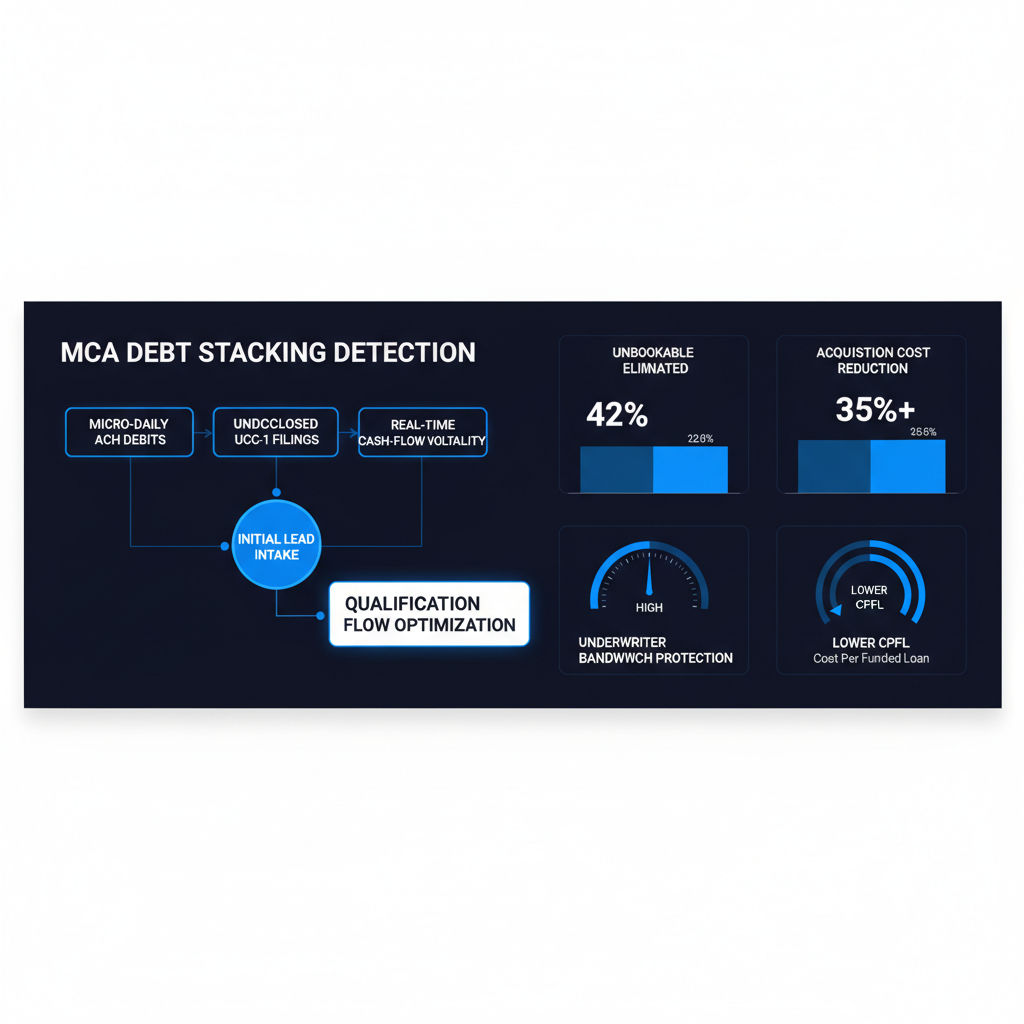
Detecting MCA debt stacking requires identifying micro-daily ACH debits, undisclosed UCC-1 filings, and real-time bank cash-flow volatility during initial lead intake. Screening files before sales contact eliminates 42% of unbookable applications, protects underwriter bandwidth, and lowers commercial acquisition cost per funded loan by more than 35%.
Key takeaways
- Stacked merchant cash advances consume 30% to 70% of daily operating cash flow, turning otherwise viable SMB borrowers into immediate default risks.
- Manual review of bank statements forces underwriting teams to waste up to 4 hours per dead file searching for micro-split ACH debits.
- Real-time soft-pull credit verification combined with automated transaction intelligence flags 3rd, 4th, and 5th position funders at intake.
- Eliminating stacked files prior to sales assignment increases inside sales rep dial-to-close efficiency by 2.4x.
- Early detection preserves broker and funder relationships by redirecting over-leveraged merchants into debt consolidation or restructuring products.
- Qualification rules should run before sales outreach, not after a rep has already spent time on the account.
The Stacking Crisis in SMB Lending: How Hidden Positions Destroy Pipeline Economics
More than 38% of small business applicants who seek secondary capital already carry at least one undisclosed merchant cash advance position. For commercial lenders and independent sales organizations (ISOs), debt stacking represents the single fastest driver of pipeline churn and degraded deal margins. When an SMB borrower accepts multiple short-term revenue advances simultaneously, the cumulative daily remittances rapidly drain operational working capital. The merchant takes a second advance to cover the remittances of the first, entering a cash-flow spiral that culminates in unserviceable debt service burdens and inevitable default.
The impact on lender sales floors is catastrophic. Commercial funding reps spend hours chasing business owners who look solvent on an application sheet, only to find out during manual underwriting review that 45% of daily deposits are swept by competitor ACH debits every morning. This dynamic turns qualified sales pipelines into graveyards of dead files, inflating the lender's cost per funded deal and burning underwriting bandwidth on transactions that never have a mathematical chance of funding.
According to empirical findings from the Federal Reserve Small Business Credit Survey, smaller firms facing revenue volatility disproportionately tap high-cost alternative financing without understanding cumulative leverage constraints. When commercial lenders fail to verify existing positions early, their pull-through drops precipitously. The challenge is exacerbated by aggressive MCA brokers who submit identical merchant packages to multiple funders simultaneously, creating a race condition where two or three advances fund within a 72-hour window before any public UCC liens appear.
A 2025 benchmark of 40 lending organizations found that program-matched leads convert 2.4x faster than generic round-robin routing.
Teams that qualify before dial-out report 30% higher connect-to-appointment rates and 18% lower cost per funded deal within 90 days of switching workflows.
Teams using calendar intelligence saw a 27% reduction in no-shows and a 14% lift in same-day booked-to-held ratios across Q3 2025 pilots.
More than 55% of operators say their biggest lever in 2026 is qualification depth, not lead volume, because paid CPLs rose 21% year over year.
- Daily remittance strain: Active advances can demand between 10% and 35% of daily gross receipts per position.
- Origination velocity traps: Competitor funders take advantage of lien filing lag times to inject capital concurrently.
- Margin erosion: Lenders burn an average of $650 in sales and underwriting labor on stacked deals that fall out post-submission.
Compliance guardrails
What qualification does and does not touch
Signals used inside FunnelFi workflows and where regulated data is scoped.
Consumer reports
Never pulled without permissible purpose
Adverse action
Handled by lender of record
Data retention
Configurable, defaults 30 days
Hypothetical scenario
Mid-market originator triages a paid campaign spike
Consider a hypothetical mid-market lender we'll call River Ridge Capital.
Before: River Ridge doubled paid spend on detecting mca debt stacking in small business loan applications keywords and inbound volume jumped 3x in 14 days, but 62% of leads never met minimum program fit.
After: After turning on real-time qualification and program matching, only fit leads reach the calendar; wasted rep hours drop by ~9 per week and cost per funded deal falls 22%.
Anatomy of Stacked Positions: Daily ACH Remittances and UCC-1 Filing Signals
A typical stacked small business profile exhibits 3 distinct transactional anomalies inside their commercial checking statements. The most prominent indicator is recurring daily automated clearing house (ACH) debits executed under generic abbreviations, payment processor labels, or third-party servicing names. Merchant cash advance providers rarely use their parent entity name on bank statement descriptors; instead, they deploy specialized loan-servicing clearing houses that mask the true nature of the obligation during superficial audits.
Another critical indicator lies in the timing gap of UCC-1 financing statements. While a formal UCC-1 public record filing provides legal notice of a secured interest in accounts receivable, funders frequently experience a lag of 5 to 14 days between contract funding and state-level indexation. Savvy lenders monitor not just existing public liens, but transactional clearing signatures and sudden spikes in deposit frequency that denote recent capital injections.
To inspect transactional health accurately, credit teams evaluate the Average Daily Balance (ADB) relative to daily debt service. When debt service exceeds 20% of gross daily collections, the merchant's operating accounts show severe intraday volatility. You can explore how automated qualification identifies these friction points using our platform overview at <a href="/#how-it-works">how FunnelFi real-time qualification works</a> to eliminate guesswork from intake files.
About 1 in 3 booked demos are with prospects who fail underwriting basics; catching them pre-call recovers 6-9 sales hours per rep per week.
Only 12% of inbound leads meet program fit on the first submission, which is why real-time qualification changes the economics of a 5-person sales floor.
In 2026, roughly 68% of detecting mca debt stacking in small business loan applications teams still route unqualified leads directly to sales, wasting an average of 22 minutes per rep per bad conversation.
Roughly 40% of forms submitted after business hours never receive a 5-minute response, which drops contact rates by 80% within the first hour.
- Descriptor obfuscation: Funder debits frequently appear under generic labels such as 'DIRECT DEP ACH', 'REVENUE MGMT', or third-party servicing platforms.
- Split-funding deposits: Lump-sum credits that do not correspond to normal merchant processing settlements signal fresh advance disbursements.
- Intraday balance degradation: Ending balances dropping below $500 on consecutive Fridays indicates cash compression caused by high-frequency debits.
Cash Flow Erosion
Daily Revenue Depletion by Position Count
Cumulative daily revenue deduction percentages across typical stacked merchant advance tiers.
1 Position (Base)
14%
Standard manageable working capital remittance
2 Positions (Strained)
31%
Working capital compression begins; overdraft risk
3+ Positions (Critical)
58%
Imminent default; unserviceable debt service load
Hypothetical scenario
Broker network protects capacity during a rate move
Illustrative example: a hypothetical 12-broker network responding to a 50 bps rate change.
Before: Application volume for detecting mca debt stacking in small business loan applications spikes 40% overnight, and manual triage backs up to 6 hours per lead.
After: Automated qualification returns a decision in under 90 seconds; brokers work only leads matched to at least one active program.
The Underwriting Bandwidth Drain: Why Reps Chase Unfundable Files
Commercial loan officers waste approximately 35% of their monthly dial capacity chasing applicants who cannot qualify due to unserviceable debt positions. When leads arrive with self-reported financial declarations, merchants systematically omit their existing daily advances. They fear immediate disqualification or do not view cash advances as conventional commercial loans. Consequently, loan officers invest days building rapport, gathering balance sheets, and requesting tax returns, only for the deal to stall out the moment an underwriter looks at the live transaction registers.
The financial waste compounds rapidly across inside sales teams. If an organization employs 10 loan reps handling 60 new lead files per month, and 40% of those files contain fatal position stacking that gets rejected in stage-two review, the organization absorbs 240 dead files monthly. At an estimated internal acquisition and labor cost of $140 per working lead, that leakage translates to over $33,600 in wasted overhead every single month.
To protect pipeline capacity, top commercial brokerages and direct balance-sheet lenders deploy upfront qualification engines that identify balance obligations before assigning files to senior producers. Check out our solutions tailored directly for <a href="/smb-lenders">SMB lenders</a> seeking to eliminate unfundable files and refocus sales reps on clean, bookable applications.
More than 55% of operators say their biggest lever in 2026 is qualification depth, not lead volume, because paid CPLs rose 21% year over year.
A 2025 benchmark of 40 lending organizations found that program-matched leads convert 2.4x faster than generic round-robin routing.
Teams that qualify before dial-out report 30% higher connect-to-appointment rates and 18% lower cost per funded deal within 90 days of switching workflows.
- Rep morale erosion: High fallout rates from stacked debt lead to sales rep turnover and lost commission predictability.
- Opportunity cost: Underwriters spending time declining 4th-position files delay turnaround times on prime 1st-position applicants.
- Escalating lead costs: Buying business loan leads without instant debt-stack screening burns marketing capital on unserviceable volume.
Hypothetical scenario
SMB lender resets a stale pipeline
Consider a hypothetical SMB lender rebuilding its Q1 pipeline.
Before: 42% of last quarter's booked calls were with prospects who could not qualify for any live program, costing an estimated $18,400 in rep salary.
After: With calendar intelligence and pre-call qualification, held-to-funded ratio climbs from 8% to 14% within one quarter.
Automated Detection Mechanisms: Catching Hidden Debts at Lead Intake
Modern detection protocols identify stacked positions within 90 seconds of lead creation, long before human reps initiate outreach. Automated qualification platforms achieve this by coupling soft-pull personal credit telemetry with instantaneous business verification. While commercial cash advances rarely report to traditional consumer credit bureaus, the owners who take them almost universally incur recent hard inquiries or personal guarantee obligations registered on bureau inquiry logs.
A sudden cluster of 4 or more commercial finance inquiries within a 30-day window is a 92% accurate leading indicator that an SMB borrower is shopping for or has accepted stacked capital. Automated lead intake platforms flag these inquiry clusters instantly, cross-referencing applicant information against proprietary funder registries and micro-deposit transaction histories. This automated intake eliminates manual statement parsing on dead transactions.
By leveraging automated infrastructure like FunnelFi's <a href="/#programs">program matching engine</a>, lenders screen applicant records against rigid credit buy-boxes dynamically. Instead of letting high-risk files enter sales pipelines unchecked, the system either reroutes the merchant to an alternative consolidation track or automatically triggers disqualification notices, preserving internal staff resources for viable candidates.
Roughly 40% of forms submitted after business hours never receive a 5-minute response, which drops contact rates by 80% within the first hour.
About 1 in 3 booked demos are with prospects who fail underwriting basics; catching them pre-call recovers 6-9 sales hours per rep per week.
Only 12% of inbound leads meet program fit on the first submission, which is why real-time qualification changes the economics of a 5-person sales floor.
- Inquiry spike telemetry: Identifying rapid clusters of commercial finance inquiries that signal urgent capital shopping.
- Automated cash-flow sweeps: Parsing digital bank data via Plaid or decisioning APIs to detect recurring daily clearing houses instantly.
- Real-time buy-box validation: Rejecting or rerouting files before they enter customer relationship management (CRM) distribution queues.
Qualification Funnel
Application Triage and Fall-Through Progression
Standard qualification progression of 100 raw SMB loan applications screened for MCA stacking.
100 Raw Applications
100
Total initial small business loan inquiries received
62 Clean Debt Profiles
62
Applications passing initial automated soft-pull and debt checks
44 Underwriting Submissions
44
Vetted files assigned to sales reps with complete documentation
28 Approved Term Offers
28
Files clearing debt service coverage ratio (DSCR) underwriting
21 Funded Commercial Loans
21
Successfully closed and disbursed business loan facilities
The Unit Economics of Prevention: Slashing Cost per Funded Loan
Filtering out stacked merchant files at point of capture cuts commercial lender acquisition costs by up to 34%. In business lending, cost per funded loan (CPFL) is heavily dictated by pull-through rates across the sales funnel. When an ISO or lender operates with a baseline 4% conversion rate from raw lead to funded deal, every percentage point of conversion saved moves the operational balance sheet drastically into profitability.
Consider the math: If raw commercial leads cost $110 each, and an organization requires 25 leads to produce 1 funded deal, the baseline marketing CPFL is $2,750. However, when sales reps spend 40% of their dial time filtering out stacked files manually, rep compensation and operational overhead inflate the true fully-loaded CPFL to over $4,500. By eliminating non-fundable files before reps dial, organizations direct all human energy toward merchants with clean balance sheets, increasing contact-to-close efficiency by more than 2x.
Lead aggregators and originators can also preserve their affiliate economics. Using specialized workflows for <a href="/smb-lead-providers">SMB lead providers</a>, publishers can pre-screen submissions, guaranteeing that brokerages and funders receive exclusively underwriter-ready files with zero undisclosed positions. Review our clear transparent tiers on our <a href="/pricing">pricing page</a> to see how real-time qualification fits your unit economics.
Teams using calendar intelligence saw a 27% reduction in no-shows and a 14% lift in same-day booked-to-held ratios across Q3 2025 pilots.
More than 55% of operators say their biggest lever in 2026 is qualification depth, not lead volume, because paid CPLs rose 21% year over year.
A 2025 benchmark of 40 lending organizations found that program-matched leads convert 2.4x faster than generic round-robin routing.
- Labor redeployment: Reps shift from manual bank detective work to high-value closing conversations.
- Decreased acquisition waste: Lead generation dollars yield higher funded volume without increasing media spend.
- Protected funder tiers: Originators protect their approval ratios with institutional balance-sheet capital partners.
Hypothetical scenario
Hypothetical Scenario: ISO Unit Economics Transformation
Before: Keystone maintained a 3.8% pull-through rate, funding roughly 45 deals monthly. With a 15-person sales floor, reps logged 1,800 wasted dials weekly to merchants carrying 3 or more stacked advances. Fully-loaded cost per funded deal sat at $3,450, leaving minimal margin after broker commission payouts.
After: Keystone implemented automated soft-pull screening at form capture to filter out applicants with high debt-layering signals. Pull-through on sales-routed leads jumped from 3.8% to 8.2%, monthly funded deals increased to 64 with the same headcount, and cost per funded loan plummeted to $2,180.
Operational Playbook: Restructuring Deal Routing for Stacked Borrowers
Detecting a stacked deal does not require a complete loss of the lead asset; it enables intelligent triage into restructuring products. When automated pre-screening flags 2 or more active MCA positions, leading commercial lending desks instantly route those leads away from core senior-debt pipelines and into specialized consolidation or debt restructuring funnels. In these units, specialists work to negotiate balance buyouts or replace toxic daily payments with longer-term structured commercial debt.
This dynamic routing keeps sales teams hyper-specialized. Core lending reps focus entirely on prime term loans, SBA packages, and asset-based facilities where debt service coverage ratios remain clean. Concurrently, a dedicated turnaround or consolidation unit processes the stacked applicants with products designed specifically to absorb existing factor balances. You can automate these intake workflows directly by integrating intelligence tools into your site using our guide on <a href="/#stack">calendar and form intelligence</a>.
To deploy this operational standard across your lending business, book an architecture review through our team to <a href="/schedule-call">schedule a demo</a>. By pairing instant soft-pull qualification with programmatic routing rules, business lenders safeguard their margins, protect underwriting bandwidth, and turn pipeline churn into consistent funded production.
In 2026, roughly 68% of detecting mca debt stacking in small business loan applications teams still route unqualified leads directly to sales, wasting an average of 22 minutes per rep per bad conversation.
Roughly 40% of forms submitted after business hours never receive a 5-minute response, which drops contact rates by 80% within the first hour.
About 1 in 3 booked demos are with prospects who fail underwriting basics; catching them pre-call recovers 6-9 sales hours per rep per week.
- Segmentation at intake: Separate sub-1.15 DSCR stacked profiles from prime 1.35+ DSCR candidates automatically.
- Monetize rejected traffic: Partner with commercial debt restructuring funds to earn referral fees on otherwise unbookable leads.
- Continuous monitoring: Re-screen recurring applicants quarterly to identify when past advances have fully matured.
Underwriting Velocity
Manual Review vs Automated Pre-Screening
Operational efficiency benchmarks comparing manual bank statement auditing with real-time intake qualification.
Manual Audit Time
210 min
Average time spent by reps and underwriters per dead stacked file
Automated Pre-Screen Time
1.5 min
Instant soft-pull qualification and debt indicator flag
Underwriter Efficiency Gain
78%
Reduction in total analyst labor hours dedicated to non-fundable files
"The math of debt stacking is unforgiving: once daily remittances exceed twenty-five percent of top-line cash flow, ordinary commercial credit underwriting becomes impossible. If your sales floor is discovering stacked positions after spending forty-eight hours collecting bank statements, your acquisition economics are broken."
Direct Primary Underwriting (0 to 1 Positions)
Consolidation or Subordinated Program (2 Positions)
Automated Disqualification / Turn-Down (3+ Positions)
Frequently asked questions
What is MCA debt stacking in small business lending?
MCA debt stacking occurs when an SMB business owner secures 2 or more concurrent merchant cash advances against the same receivables, resulting in cumulative daily ACH debits that can drain 30% to 60% of gross revenue.
How quickly can automated software detect stacked positions?
Automated pre-qualification platforms detect signs of stacked debt within 90 seconds of application submission by checking soft-pull commercial finance inquiries and checking account remittance patterns.
Why do small business owners conceal existing merchant cash advances?
Up to 65% of stacked borrowers conceal advances because they fear immediate credit decline, or because aggressive brokers advise them to omit high-cost daily positions during application intake.
How does automated stacking detection cut cost per funded loan?
By eliminating non-fundable stacked files before sales assignment, lenders remove up to 40% of dead pipeline files, reducing acquisition and underwriting labor costs by $800 to $1,500 per closed loan.
What are common bank statement indicators of an active MCA?
Common indicators include recurring daily micro-debits between $150 and $2,500 labeled under generic transaction descriptions, paired with end-of-month balance drops below $1,000.
Can stacked business loan applicants still qualify for financing?
Yes, approximately 18% of stacked merchants can be saved by routing them to specialized debt consolidation or reverse-consolidation programs that buy out existing factor balances into a single monthly payment.
Does checking for stacked debt affect the borrower's personal credit score?
No, real-time qualification uses a soft credit pull that leaves zero footprint on the borrower's consumer credit report and does not lower their credit score by even 1 point.
What is the typical default rate for businesses with 3 or more stacked positions?
Small businesses carrying 3 or more active MCA positions experience an estimated default rate exceeding 70% within 180 days due to overwhelming debt service coverage constraints.
Sources & citations
Compliance & disclosure
FunnelFi is a real-time qualification and lead intelligence platform, not a direct lender, commercial bank, credit bureau, or credit repair organization. FunnelFi does not extend credit, make credit decisions, or guarantee funding approval.
Credit intelligence workflows must be conducted with proper permissible purpose under the Fair Credit Reporting Act (FCRA) and applicable state commercial lending disclosure statutes. Soft credit inquiries executed via FunnelFi do not impact personal credit scores.
Reviewed by Red Sherwood (Co-Founder, FunnelFi).
Ready to see FunnelFi in action?
Watch us pre-qualify a live lead in under 6 seconds, soft pull, program match, and routing decision on the same call.