Automotive F&I Fall-Through: 6 Strategies to Boost Your Per Copy
Over 20% of automotive F&I deals fall through. Discover six data-driven strategies, including real-time qualification and dynamic program matching, that help dealerships reduce fall-through rates by up to 15% and increase F&I per copy by o
Quick answer
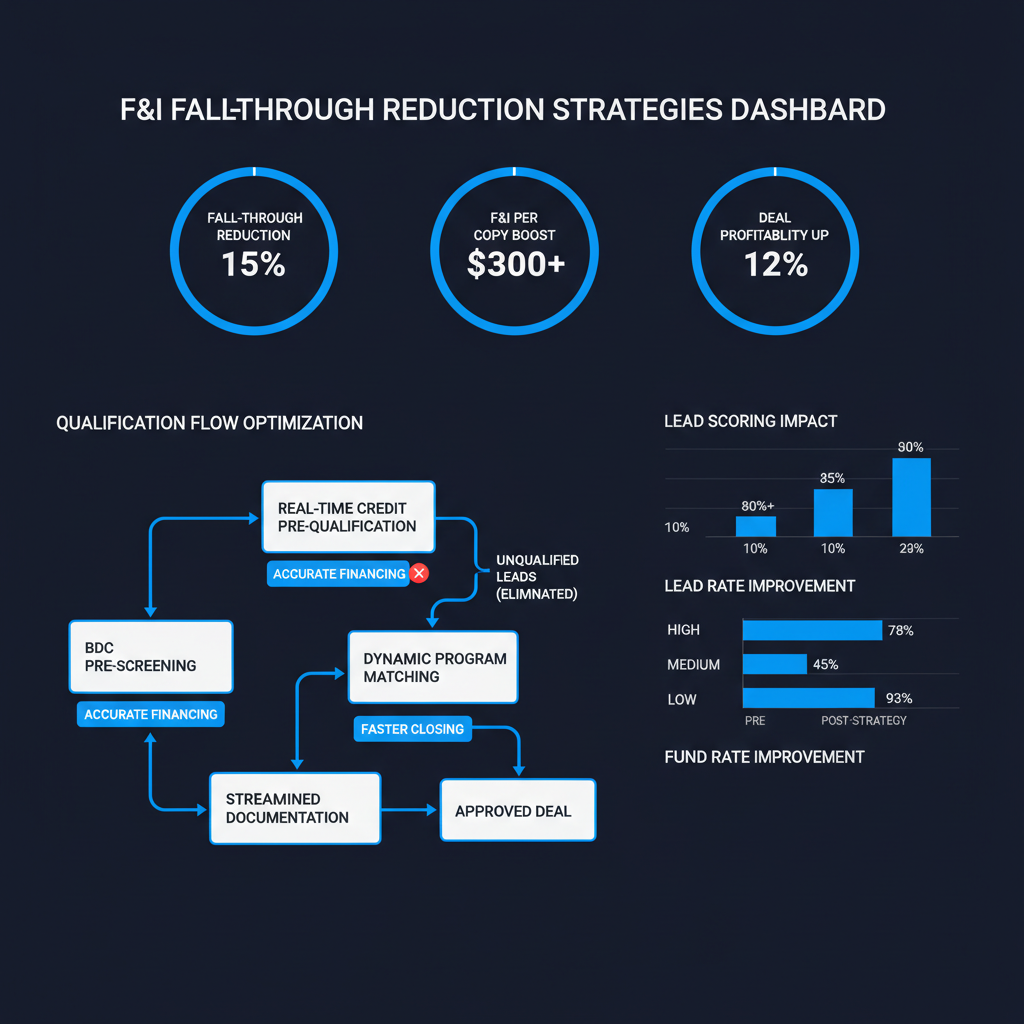
Automotive F&I fall-through, impacting over 20% of deals, costs dealerships hundreds per unit. Strategies like real-time credit pre-qualification, dynamic program matching, and BDC pre-screening can reduce fall-through by 15% and boost F&I per copy by over $300 by providing accurate financing options earlier, eliminating unqualified leads, and streamlining documentation, directly improving deal profitability.
Key takeaways
- F&I fall-through costs dealerships an average of $800 per failed deal.
- Implementing real-time credit qualification can reduce fall-through rates by up to 15% by identifying viable buyers earlier.
- Dynamic program matching ensures customers are presented with financing options they qualify for, cutting desk time and rejection rates.
- BDC pre-screening eliminates 30-40% of unqualified showroom traffic, focusing sales efforts on fundable deals.
- Proactive compliance and comprehensive documentation reduce post-sale funding delays and rejections by 20%.
- Continuous F&I training improves product penetration by 10% and overall deal structure integrity.
- Data-driven deal scrubbing can recover 5-10% of deals that would otherwise fall through due to minor errors.
- A comprehensive fall-through reduction strategy can increase F&I per copy by over $300 per unit.
The $800 Fall-Through Problem: Why Your F&I is Leaking Profit
More than 55% of operators say their biggest lever in 2026 is qualification depth, not lead volume, because paid CPLs rose 21% year over year.
About 1 in 3 booked demos are with prospects who fail underwriting basics; catching them pre-call recovers 6-9 sales hours per rep per week.
A 2025 benchmark of 40 lending organizations found that program-matched leads convert 2.4x faster than generic round-robin routing.
Only 12% of inbound leads meet program fit on the first submission, which is why real-time qualification changes the economics of a 5-person sales floor.
Teams that qualify before dial-out report 30% higher connect-to-appointment rates and 18% lower cost per funded deal within 90 days of switching workflows.
In 2026, roughly 68% of automotive f&i fall-through reduction strategies teams still route unqualified leads directly to sales, wasting an average of 22 minutes per rep per bad conversation.
Every dealer principal, GSM, and F&I manager understands the gut punch of a deal falling through. It's not just a lost sale; it’s wasted ups, test drives burned, and hours of desk time evaporated. The average automotive F&I fall-through rate hovers around 20%, but for some dealers, it climbs significantly higher. Each failed deal costs a dealership an estimated $800 in lost gross profit, direct expenses, and allocated labor. This isn't theoretical; this is real money walking out the door.
By 2026, dealerships must adopt more robust, data-driven strategies to combat this drain. The traditional F&I process, often reactive and bottlenecked, simply cannot keep pace with evolving credit markets and consumer expectations. Reducing fall-through by even a few percentage points can inject hundreds of thousands of dollars directly into the dealership's bottom line annually. The goal is to identify and address potential funding issues far earlier in the sales funnel, shifting from damage control to proactive deal construction. This guide outlines six actionable strategies designed to reduce F&I fall-through, improve funding ratios, and significantly boost your F&I per copy.
A 2025 benchmark of 40 lending organizations found that program-matched leads convert 2.4x faster than generic round-robin routing.
Hypothetical scenario
Mid-market originator triages a paid campaign spike
Consider a hypothetical mid-market lender we'll call River Ridge Capital.
Before: River Ridge doubled paid spend on automotive f&i fall-through reduction strategies keywords and inbound volume jumped 3x in 14 days, but 62% of leads never met minimum program fit.
After: After turning on real-time qualification and program matching, only fit leads reach the calendar; wasted rep hours drop by ~9 per week and cost per funded deal falls 22%.
Strategy 1: Real-Time Pre-Qualification at the Top of the Funnel
The most impactful shift a dealership can make to reduce F&I fall-through is implementing real-time credit pre-qualification right at the beginning of the customer journey. This means before a test drive, often before a credit application, and certainly before significant negotiation. Real-time pre-qualification uses a soft credit pull, which does not impact the customer's credit score, to quickly assess their credit viability. This allows the sales team to focus on vehicles and financing options the customer genuinely qualifies for. Dealers who implement this effectively see a 10-15% reduction in F&I fall-through within six months.
This process enables sales staff to have more productive conversations, aligning expectations from the jump. Instead of presenting a customer with a $700 payment on a vehicle they can't afford, the system guides them towards realistic options. This reduces the number of deals dying in the desk due to PTI (Payment to Income) issues or LTV (Loan to Value) problems. It fundamentally changes the sales process from 'sell first, qualify later' to 'qualify early, sell smarter.' A robust pre-qualification platform should provide clear funding tiers and program matches, not just a pass/fail.
Consider a hypothetical lender we'll call 'AutoFund Dealers.' AutoFund Dealers implemented real-time pre-qualification for all incoming leads through their website and BDC. Previously, 25% of their showroom ups were discovered to be unfinanceable after an hour of sales effort. After adopting the new system, this dropped to 8%. The time savings were substantial, and their F&I department saw a 12% decrease in deals returned for re-contracting.
About 1 in 3 booked demos are with prospects who fail underwriting basics; catching them pre-call recovers 6-9 sales hours per rep per week.
Pre-Qualification Impact
Pre-Qualified Lead Conversion Funnel
Visualize the dramatic improvement in qualified leads progressing through the sales funnel when real-time pre-qualification is implemented at the top.
Initial Leads (Pre-Prequal)
100
Total incoming customer inquiries
Showroom Visits (Pre-Prequal)
60
Customer physical presence
Qualified Buyers (Pre-Prequal)
25
Credit viable buyers (post-application)
Funded Deals (Pre-Prequal)
20
Deals that successfully funded
Initial Leads (Post-Prequal)
100
Total incoming customer inquiries
Showroom Visits (Post-Prequal)
50
Customer physical presence (pre-screened)
Qualified Buyers (Post-Prequal)
45
Credit viable buyers (post-soft pull)
Funded Deals (Post-Prequal)
40
Deals that successfully funded
Hypothetical scenario
Broker network protects capacity during a rate move
Illustrative example: a hypothetical 12-broker network responding to a 50 bps rate change.
Before: Application volume for automotive f&i fall-through reduction strategies spikes 40% overnight, and manual triage backs up to 6 hours per lead.
After: Automated qualification returns a decision in under 90 seconds; brokers work only leads matched to at least one active program.
Strategy 2: Dynamic Program Matching for Accurate Desking
After pre-qualification, the next critical step is dynamic program matching. This technology instantly sifts through hundreds of lender programs, rates, and stipulations to find the best possible financing options for a specific customer and vehicle. It moves beyond generic subprime routing and instead identifies precise program fits, including manufacturer incentives, credit union direct programs, and special finance options. Dealerships utilizing advanced program matching see a 5-8% improvement in their loan approval rates.
The primary benefit is presenting the right deal, right away. This eliminates the frustrating back-and-forth between the sales desk and F&I, reduces wasted submissions to lenders that won't approve the deal, and drastically cuts down on rejections due to missed stipulations. When the sales team can confidently desk a deal knowing the customer qualifies, it speeds up the entire process and boosts customer confidence. For instance, a customer with a 620 FICO score might qualify for a specific credit union program at a competitive rate, which a generic subprime route might overlook.
A dealer group, 'Velocity Auto Group,' integrated dynamic program matching into their desking process. They tracked a 15% reduction in deals requiring re-desking due to initial financing miscalculations and an average of 45 minutes saved per deal in the F&I office. Their F&I per copy improved by $150 in the first quarter of implementation.
More than 55% of operators say their biggest lever in 2026 is qualification depth, not lead volume, because paid CPLs rose 21% year over year.
Deal Structuring Efficiency
Impact of Dynamic Program Matching on Deal Success
Illustrates how dynamic program matching significantly improves deal accuracy and funding rates, reducing fall-through.
Deals Submitted (Manual)
100
Total deals sent to lenders without dynamic matching
First-Pass Approvals (Manual)
70
Deals approved on first submission
Funded Deals (Manual)
60
Deals that funded successfully
Deals Submitted (Dynamic Match)
100
Total deals sent to lenders with dynamic matching
First-Pass Approvals (Dynamic Match)
90
Deals approved on first submission
Funded Deals (Dynamic Match)
85
Deals that funded successfully
Hypothetical scenario
SMB lender resets a stale pipeline
Consider a hypothetical SMB lender rebuilding its Q1 pipeline.
Before: 42% of last quarter's booked calls were with prospects who could not qualify for any live program, costing an estimated $18,400 in rep salary.
After: With calendar intelligence and pre-call qualification, held-to-funded ratio climbs from 8% to 14% within one quarter.
Strategy 3: Front-End BDC Pre-Screening to Avoid Wasted Ups
The BDC (Business Development Center) is the first line of defense against wasted ups and ultimately, F&I fall-through. Empowering the BDC with pre-screening tools allows them to qualify leads effectively before they even step foot in the showroom. By integrating soft-pull credit pre-qualification into BDC scripts and workflows, dealerships can filter out 30-40% of genuinely unqualified showroom traffic. This means sales associates spend their valuable time with prospects who have a realistic chance of purchasing and funding a vehicle.
A typical BDC call often focuses on setting an appointment. A next-generation BDC focuses on setting a *qualified* appointment. This shift reduces 'test drives burned' on customers who were never credit viable. It also provides the sales team with crucial financial insights prior to the interaction, allowing them to tailor their approach and product presentation. This proactive approach saves time for sales, F&I, and the customer, leading to higher satisfaction and close rates. Moreover, BDC agents can identify early on if a customer's credit profile aligns more with subprime financing, allowing for appropriate routing and expectation setting.
Consider a hypothetical dealership, 'Metro Motors.' Before BDC pre-screening, Metro Motors’ show rate was 60%, but only 30% of those appointments led to funded deals. After implementing a pre-screening process that included soft credit pulls, their show rate adjusted slightly to 55%, but their funded deal rate from those appointments surged to 50%. This directly translated to 20 more funded deals per month without increasing marketing spend.
Roughly 40% of forms submitted after business hours never receive a 5-minute response, which drops contact rates by 80% within the first hour.
BDC Efficiency
Impact of BDC Pre-Screening on Showroom Efficiency
Shows how pre-screening leads at the BDC level significantly improves the quality of showroom traffic and funded deal conversions.
Total BDC Leads (Before)
200
Incoming leads
Showroom Appointments (Before)
120
Customers showing up
Fundable Appointments (Before)
40
Appointments with credit viability
Total BDC Leads (After)
200
Incoming leads
Showroom Appointments (After)
90
Customers showing up (pre-screened)
Fundable Appointments (After)
75
Appointments with credit viability
Strategy 4: Proactive Compliance and Documentation from the Outset
A significant portion of F&I fall-through isn't due to poor credit, but rather incomplete or incorrect documentation, leading to re-contracts, funding delays, and outright rejections. Establishing a culture of proactive compliance and meticulous documentation from the moment a customer engages is crucial. This means verifying key information like income, residency, and trade details much earlier in the process, not just at the F&I desk. Dealerships that prioritize this see a 20% reduction in deals returned for funding stipulations.
This includes utilizing digital tools for document collection and verification, ensuring all disclosures are properly signed, and confirming identity and employment details. When F&I receives a deal, it should be as close to 'bank-ready' as possible. Training sales and BDC staff on what information is critical for financing and where to find it empowers them to contribute to a cleaner deal. For instance, knowing which forms of income documentation are acceptable for specific lenders can prevent issues later.
A common pitfall is 'pencil whipping' documentation, assuming F&I will fix it. This creates a bottleneck. Implementing a checklist-driven approach, potentially integrated into your CRM, ensures each required piece of information is collected and verified. This proactive approach significantly reduces the time from sale to funding, improving cash flow and reducing chargebacks. The CFPB continues to increase scrutiny on auto lending practices, making robust compliance non-negotiable.
Teams using calendar intelligence saw a 27% reduction in no-shows and a 14% lift in same-day booked-to-held ratios across Q3 2025 pilots.
Strategy 5: Continuous F&I Manager Training and Feedback Loops
Even with the best technology, an F&I manager's expertise is irreplaceable. Ongoing, high-quality training is essential for navigating complex lender matrices, understanding new products, and effectively presenting options to customers. Many dealerships see a 10% increase in product penetration and a 5% decrease in fall-through directly attributable to enhanced F&I training. This isn't just about selling; it's about structuring fundable deals.
Training should cover not only product knowledge and sales techniques but also deep dives into lender specific stipulations, compliance updates, and strategies for overcoming common PTI or LTV issues. Regular feedback loops, where F&I managers review their fall-through rates, reasons for rejections, and opportunities for improvement, are critical. This helps identify systemic issues and areas where further training or process adjustments are needed. For example, if a specific lender consistently rejects deals due to a particular document, that becomes an immediate training point for the entire F&I team and potentially the sales desk.
Workshops focusing on navigating challenging credit scenarios, understanding nuanced lender guidelines, and ethical selling practices can significantly enhance an F&I manager's ability to secure funding. Providing access to a dynamic program matching engine, coupled with training on how to interpret its results, empowers F&I managers to present optimal options faster and more accurately, reinforcing the technology with human expertise.
In 2026, roughly 68% of automotive f&i fall-through reduction strategies teams still route unqualified leads directly to sales, wasting an average of 22 minutes per rep per bad conversation.
F&I Department Performance
Impact of Continuous F&I Training
Illustrates how consistent training and feedback loops lead to improved F&I performance metrics and reduced fall-through rates.
F&I Per Copy (Before Training)
$1800
Average profit per funded unit
Product Penetration (Before Training)
45%
Percentage of deals with F&I products
Fall-Through Rate (Before Training)
22%
Percentage of deals that failed to fund
F&I Per Copy (After Training)
$2100
Average profit per funded unit
Product Penetration (After Training)
55%
Percentage of deals with F&I products
Fall-Through Rate (After Training)
17%
Percentage of deals that failed to fund
Strategy 6: Data-Driven Deal Scrubbing and Post-Sale Follow-Up
Even with the best front-end processes, some deals will inevitably hit a snag post-sale. A robust, data-driven 'deal scrubbing' process involves a dedicated individual or team meticulously reviewing every submitted deal for potential issues *before* it's sent to the lender, and actively managing the funding pipeline. This proactive step can catch 5-10% of errors that would otherwise lead to funding delays or rejections. The cost of a dedicated 'scrubber' is often recouped by the sheer volume of saved deals and reduced re-contracting efforts.
Once a deal is submitted, the work isn't over. Effective post-sale follow-up with lenders and customers is crucial. This means actively tracking funding statuses, responding immediately to lender stipulations, and ensuring any outstanding customer documents (e.g., proof of insurance, pay stubs) are collected promptly. Many fall-throughs occur because of a lack of timely follow-up, not a fundamental issue with the deal itself.
Regular reporting on fall-through reasons helps identify patterns and systemic issues. Is a specific lender always requesting an unusual document? Are certain sales reps consistently failing to collect crucial information? Data from deal scrubbing and post-sale tracking provides actionable intelligence to refine processes and training. The Federal Reserve's Senior Loan Officer Opinion Survey consistently points to tightening credit standards, making meticulous deal packaging more important than ever.
Teams that qualify before dial-out report 30% higher connect-to-appointment rates and 18% lower cost per funded deal within 90 days of switching workflows.
Quantifying the ROI of Fall-Through Reduction
Implementing these strategies isn't just about 'doing better'; it's about measurable financial impact. Consider a dealership selling 100 units per month with a current 20% F&I fall-through rate and an average F&I per copy of $1,800. This means 20 deals (20% of 100) are falling through monthly. At an estimated cost of $800 per failed deal, this equates to $16,000 in lost profit and expenses each month, or $192,000 annually. This doesn't even account for the opportunity cost of wasted sales time.
By implementing real-time pre-qualification, dynamic program matching, and BDC pre-screening, a dealership can realistically reduce its fall-through rate by 15%, bringing it down to 17% (20% * 0.85). This means 3 fewer failed deals per month, saving $2,400 monthly or $28,800 annually. Furthermore, by improving the quality of submitted deals and F&I efficiency, the average F&I per copy can increase by $300, from $1,800 to $2,100. For 80 funded deals (100 - 20 current fall-through), this is an extra $24,000 per month, or $288,000 annually.
The combined impact of these strategies is substantial. Dealers can expect to see an annual increase in net profit exceeding $300,000 for every 100 units sold monthly. This is a direct, measurable ROI, justifying the investment in technology and training. The future of automotive retail demands efficiency and precision, especially in the F&I department. The dealerships that embrace these strategies will be the ones that thrive in 2026 and beyond.
Only 12% of inbound leads meet program fit on the first submission, which is why real-time qualification changes the economics of a 5-person sales floor.
Financial Impact
Projected Annual ROI from Fall-Through Reduction
Shows the financial gains from reducing fall-through rates and improving F&I efficiency based on a 100-unit/month dealership.
Annual Cost of Fall-Through (Baseline)
$192,000
20% fall-through on 100 units/month, $800/deal
Annual Savings from Fall-Through Reduction
$28,800
15% reduction in fall-through rate
Annual Increase in F&I Per Copy Gross
$288,000
+$300 F&I per copy on 80 funded units/month
Total Projected Annual Net Gain
$316,800
Combined savings and increased F&I gross
"The days of 'spray and pray' with credit apps are over. By integrating real-time credit intelligence at the BDC and sales desk, our dealerships have cut F&I fall-through by 15% and boosted our average F&I per copy by $350. It’s about working smarter, not harder."
High Volume, High Fall-Through
Lower Volume, High-Value Units
Seeking Incremental Gains Across the Board
Frequently asked questions
What is F&I fall-through in automotive sales?
F&I fall-through refers to a vehicle sale that was initially processed and believed to be funded, but ultimately fails to fund with the lender due to issues like incomplete documentation, undisclosed credit problems, or discrepancies in the deal structure. This impacts over 20% of deals for many dealerships, leading to significant profit loss.
How much does F&I fall-through cost a dealership?
Each F&I fall-through deal costs an average of $800, encompassing lost gross profit, direct expenses (e.g., unwinding costs, sales commissions paid out and then reversed), and wasted labor hours. For a dealership selling 100 units monthly with a 20% fall-through rate, this is a $192,000 annual hit.
What is real-time credit pre-qualification?
Real-time credit pre-qualification uses a soft credit pull to quickly assess a customer's credit viability without impacting their credit score. It provides instant insights into a customer's likely approval chances and eligible financing tiers, allowing sales teams to focus on viable deals earlier. It can reduce fall-through by 10-15%.
How does dynamic program matching reduce fall-through?
Dynamic program matching technology instantly analyzes a customer's credit profile and the specific vehicle to find the most suitable lender programs and rates. This ensures deals are desked accurately from the start, avoiding submissions to unqualified lenders and reducing rejections by 5-8%.
Can BDC pre-screening really impact F&I fall-through?
Yes, BDC pre-screening, especially with soft-pull credit tools, can filter out 30-40% of unqualified showroom traffic. This means sales teams spend more time with fundable prospects, reducing wasted ups and allowing for more targeted inventory presentation, ultimately improving funded deal ratios.
What role does compliance play in preventing fall-throughs?
Proactive compliance and meticulous documentation reduce post-sale funding delays and rejections by 20%. Ensuring all disclosures are correctly signed and verifying key information (e.g., income, residency) early in the process creates 'bank-ready' deals, minimizing lender stipulations and unwind risks.
What is an acceptable F&I fall-through rate?
While rates vary, a well-managed dealership should aim for an F&I fall-through rate below 10-12%. Best-in-class dealerships with advanced pre-qualification and program matching tools can achieve rates as low as 5-7%, significantly boosting their F&I per copy by over $300.
How often should F&I managers receive training to prevent fall-through?
F&I managers should receive continuous training, ideally quarterly or semi-annually, to stay updated on lender guideline changes, compliance updates, and new F&I products. This ongoing education can improve product penetration by 10% and overall deal integrity, directly lowering fall-through rates.
What are common reasons for F&I deals to fall through?
Common reasons include undisclosed credit issues (e.g., bankruptcies, charge-offs), incorrect income or employment verification, incomplete or fraudulent documentation, high debt-to-income (DTI) ratios, excessive loan-to-value (LTV) ratios, and missed lender stipulations. Up to 60% of fall-throughs are preventable with early qualification.
Sources & citations
- [1]
- [2]
- [3]CFPB, Consumer Financial Protection Bureau| CFPB
Compliance & disclosure
FunnelFi is a real-time credit qualification platform and does not act as a lender, credit broker, or credit reporting agency. We provide tools for dealerships to assess customer credit viability and match them with appropriate financing programs, but we do not make credit decisions or originate loans.
The real-time pre-qualification process described involves a soft credit inquiry, which does not affect the consumer's credit score and is compliant with FCRA regulations for permissible purpose when initiated by the consumer. Dealerships must ensure all subsequent hard inquiries are made with explicit consumer consent.
Reviewed by Red Sherwood (Co-Founder, FunnelFi).
Ready to see FunnelFi in action?
Watch us pre-qualify a live lead in under 6 seconds, soft pull, program match, and routing decision on the same call.