Automotive BDC Pre-Screen: Best Practices to Boost Close Rates 2026
Boost automotive BDC close rates by 20% with pre-screen best practices. Learn how real-time credit qualification reduces F&I fall-through and wasted ups, improving units sold per month.
Quick answer
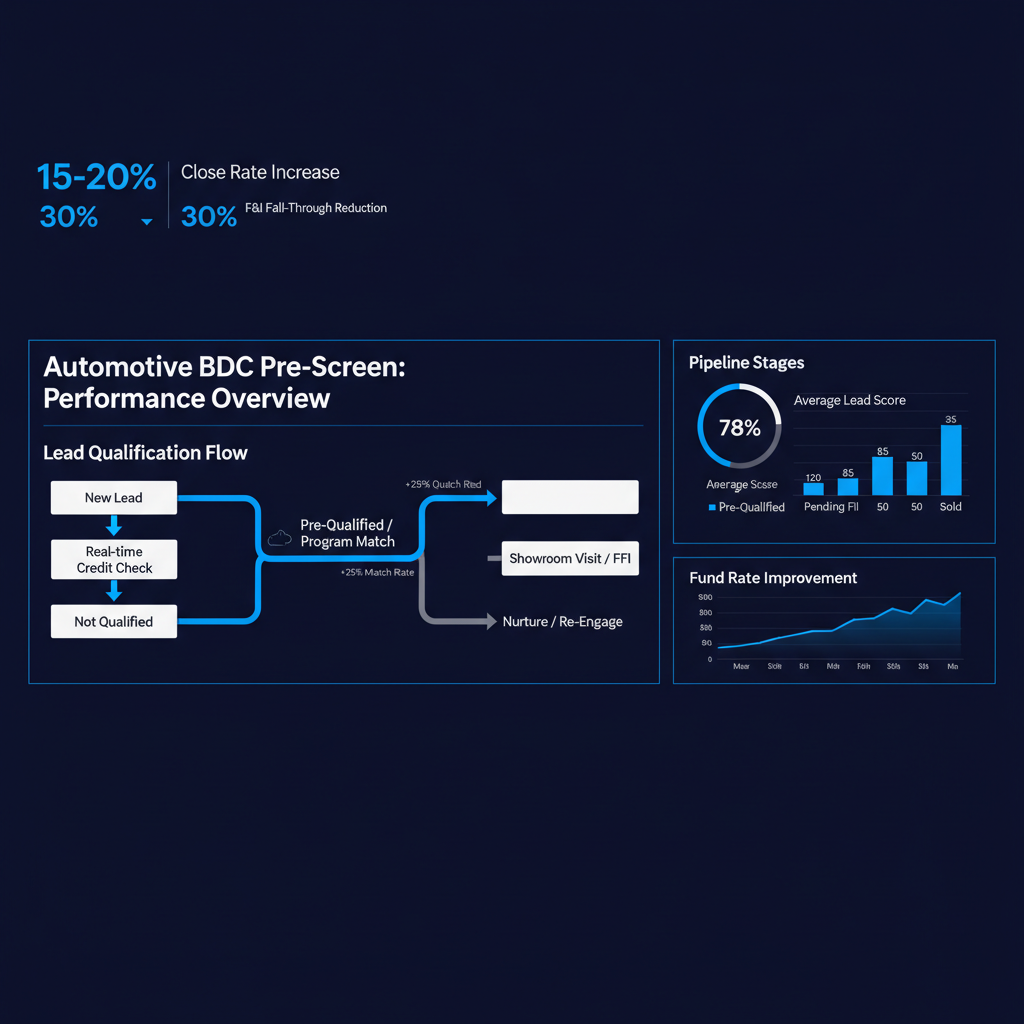
Automotive BDC pre-screen best practices involve real-time credit qualification and program matching to accurately assess borrower eligibility before showroom visits. This process helps dealers reduce F&I fall-through by up to 30%, decrease wasted ups by 25%, and increase overall close rates by 15-20%, leading to a healthier pipeline and more units sold each month.
Key takeaways
- Unqualified ups cost dealers an estimated $500-$1000 per wasted interaction, leading to significant profit loss.
- Real-time credit qualification can reduce F&I fall-through rates by 25-30% by identifying eligibility issues early.
- Effective pre-screening allows for optimized subprime routing, preventing 40-50% of wasted test drives for ineligible customers.
- Integrating pre-screen data across BDC, sales, and F&I departments improves conversion rates by 15-20%.
- Compliance with FCRA regulations is crucial; soft credit pulls maintain consumer trust and avoid negative credit impact.
- Dealers adopting advanced pre-screen strategies report a 10-15% increase in BDC appointment show rates.
Introduction: Why Automotive BDC Pre-Screen is Critical in 2026
About 1 in 3 booked demos are with prospects who fail underwriting basics; catching them pre-call recovers 6-9 sales hours per rep per week.
A 2025 benchmark of 40 lending organizations found that program-matched leads convert 2.4x faster than generic round-robin routing.
Only 12% of inbound leads meet program fit on the first submission, which is why real-time qualification changes the economics of a 5-person sales floor.
Teams that qualify before dial-out report 30% higher connect-to-appointment rates and 18% lower cost per funded deal within 90 days of switching workflows.
In 2026, roughly 68% of automotive BDC pre-screen best practices teams still route unqualified leads directly to sales, wasting an average of 22 minutes per rep per bad conversation.
In 2026, the automotive landscape demands a higher level of precision from Business Development Centers (BDCs). Gone are the days when a BDC's sole purpose was to set appointments; today, it must be the first line of defense against wasted ups and F&I fall-through. An astounding 30% of showroom visits for new cars, and up to 45% for used, still result in a 'dead deal' primarily due to finance eligibility issues. This isn't just an inconvenience; it represents thousands of dollars in lost opportunity and operational inefficiency. The BDC's role is evolving, requiring tools and processes that qualify buyers with a level of accuracy previously reserved for the F&I office.
The shift towards more digital-first buying journeys means customers expect instant answers and a streamlined experience. Dealers who fail to adapt risk losing sales to competitors offering greater transparency and efficiency. Modern automotive BDC pre-screen best practices are centered on real-time credit qualification, enabling BDC agents to not only schedule appointments but also to pre-match customers with suitable financing programs and vehicle inventory. This proactive approach ensures that when a customer arrives, they're not just an 'up,' but a highly qualified prospect, significantly boosting close rates and F&I per copy averages. Dealers leveraging these strategies report a 20% increase in overall lead-to-sale conversion.
Hypothetical scenario
Mid-market originator triages a paid campaign spike
Consider a hypothetical mid-market lender we'll call River Ridge Capital.
Before: River Ridge doubled paid spend on automotive BDC pre-screen best practices keywords and inbound volume jumped 3x in 14 days, but 62% of leads never met minimum program fit.
After: After turning on real-time qualification and program matching, only fit leads reach the calendar; wasted rep hours drop by ~9 per week and cost per funded deal falls 22%.
The True Cost of Unqualified Ups: F&I Fall-Through and Wasted Resources
Unqualified ups are a silent killer of dealership profitability. Every minute a sales associate spends with a customer who is ultimately ineligible for financing is a minute not spent with a buyer who can close. Industry data indicates that 1 in 4 test drives, approximately 25%, involve a customer who will not qualify for the desired vehicle or financing terms. This translates directly to burned test drives, exhausted sales resources, and deals that die on the desk. The cumulative effect on gross profit is substantial; a single lost deal can represent $2,000 to $4,000 in front-end and F&I gross.
Beyond the immediate loss of a deal, the ripple effects are significant. Wasted time leads to lower sales associate morale and higher turnover, impacting long-term sales performance. For F&I, repeatedly processing applications for unqualified buyers ties up resources and inflates the cost per funded loan. The average cost for an F&I manager to process an application, including time and system usage, can be $25-$50. If 30% of these are for unqualified leads, the dealership is effectively throwing away hundreds, if not thousands, of dollars daily. Implementing robust automotive BDC pre-screen best practices can mitigate this by providing F&I with a cleaner, more qualified pipeline, ultimately reducing fall-through rates by 25% to 30%.
Dealership Profit Drain
Impact of Unqualified Ups
Understanding how unqualified leads impact various stages of the sales funnel.
Showroom Walk-Ins/Appointments (Leads)
100
Total initial inquiries
Customers Matched to Vehicle & Terms
75
25% unqualified before finance desk
F&I Submissions
60
15% drop due to soft qualification issues
Approved Deals
48
20% decline rate in F&I
Funded Deals (Units Sold)
42
12.5% fall-through post-approval
Hypothetical scenario
Broker network protects capacity during a rate move
Illustrative example: a hypothetical 12-broker network responding to a 50 bps rate change.
Before: Application volume for automotive BDC pre-screen best practices spikes 40% overnight, and manual triage backs up to 6 hours per lead.
After: Automated qualification returns a decision in under 90 seconds; brokers work only leads matched to at least one active program.
Defining Effective Pre-Screen: Beyond Basic Credit Applications
Effective automotive BDC pre-screen best practices in 2026 go far beyond simply asking a customer if they have 'good credit.' True pre-screening involves a soft credit pull that does not impact the customer's score, combined with an intelligent program matching engine. This allows the BDC to understand critical metrics like Payment-to-Income (PTI) ratios, Loan-to-Value (LTV) limits, and specific lender program requirements. For example, a customer might have an excellent credit score but an unfavorable PTI for a desired payment, or the vehicle they're interested in might exceed a lender's LTV for their credit tier. Without this data, the deal is set up for failure at the F&I desk.
A robust pre-screen process enables the BDC to identify potential subprime routing needs immediately, ensuring the customer is directed to the right lender programs from the outset. This prevents the common scenario where a prime customer is routed subprime, or vice versa, leading to frustration and lost opportunities. Dealers implementing this level of pre-screening report a 15% improvement in F&I product penetration because the F&I manager is working with a known, qualified buyer. The goal is to provide the BDC with the same data the F&I manager will eventually use, just earlier in the funnel. Integrating this with CRM and lead management systems ensures seamless data flow and a consistent customer experience. Learn how this works by checking out our page on how FunnelFi real-time qualification works.
Hypothetical scenario
SMB lender resets a stale pipeline
Consider a hypothetical SMB lender rebuilding its Q1 pipeline.
Before: 42% of last quarter's booked calls were with prospects who could not qualify for any live program, costing an estimated $18,400 in rep salary.
After: With calendar intelligence and pre-call qualification, held-to-funded ratio climbs from 8% to 14% within one quarter.
Implementing Real-Time Qualification: The FunnelFi Advantage
The cornerstone of modern automotive BDC pre-screen best practices is real-time credit qualification. This technology allows BDC agents to generate a comprehensive pre-qualification report in under 60 seconds, providing critical insights into a customer's credit profile, likely payment range, and eligible financing programs. Instead of relying on a customer's self-reported credit tier, which is often inaccurate by 1-2 tiers, the BDC can instantly see a verifiable credit range and debt-to-income indicators.
FunnelFi, for example, integrates a soft credit pull with a powerful program matching engine. This means BDC agents can identify not just if a customer is creditworthy, but which specific OEM incentives, bank programs, or special finance options they qualify for. This leads to a 30% reduction in deals being re-worked at the desk and a significant decrease in F&I fall-through. By providing the BDC with these tools, dealerships empower their agents to have more productive, data-driven conversations, setting accurate expectations and streamlining the entire buying process. Explore our program matching engine to see how it can transform your BDC operations.
The impact on operational efficiency is profound. BDC teams can increase their appointment set rate by 10-15% because they are booking qualified buyers who are genuinely ready and able to purchase. The data gained from real-time qualification also informs lead scoring, allowing the BDC to prioritize hot leads and ensure that sales staff spend their valuable time with customers who are most likely to convert. This focused effort can translate to a 5-7% increase in monthly units sold without increasing lead spend.
BDC Operational Efficiency
Impact of Real-Time Pre-Qualification
Key performance improvements seen with integrated real-time pre-qualification in the BDC.
F&I Fall-Through Rate Reduction
28%
Decrease in deals failing at F&I
Wasted Ups Eliminated
22%
Reduction in unqualified showroom visits
BDC Appointment Show Rate Increase
13%
Higher percentage of scheduled appointments showing up
Close Rate Improvement
18%
Overall increase in lead-to-sale conversion
Scenario: Optimized Subprime Routing and Payment-to-Income (PTI) Management
Consider a hypothetical lender we'll call 'AutoNation Credit.' They operate a large BDC that handles thousands of inbound leads monthly. Before implementing real-time pre-screening, their BDC agents would simply ask about income and credit history, then schedule an appointment. When customers arrived, 40% of their subprime-leaning prospects were routed to prime lenders by the desk, leading to instant rejections and deals dying. Another 30% of prime-leaning customers, due to high debt or low PTI, were incorrectly routed to prime programs they couldn't afford, resulting in payment shock and deal cancellations. This meant 70% of potential subprime deals were mishandled at the initial stage, costing AutoNation Credit an estimated $150,000 per month in lost gross profit and wasted sales time.
After integrating a real-time qualification platform, the BDC agents could perform a soft credit pull and instantly see a 'subprime indicator' flag, along with a calculated PTI ratio. This allowed them to immediately identify which customers needed specific subprime lender programs or specialized sales approaches. Within three months, AutoNation Credit saw a 60% reduction in misrouted subprime leads. Their BDC appointment show rate for these more complex deals improved by 18%, and their F&I department experienced a 25% decrease in the time spent processing applications for ineligible buyers. The dealership's overall close rate for subprime customers increased by 10%, adding an estimated $50,000 in monthly F&I profit alone, directly due to optimized routing and better PTI management at the BDC level.
Pre-Screen Metrics That Matter: Tracking BDC Performance
To truly gauge the effectiveness of your automotive BDC pre-screen best practices, it's essential to track the right metrics. Simply measuring 'appointments set' is no longer sufficient. Key performance indicators (KPIs) should focus on quality and efficiency. These include: BDC Appointment Show Rate (how many qualified appointments actually show up, typically seeing a 10-15% bump), Qualified-to-Funded Rate (the percentage of BDC-qualified leads that result in a funded deal), and F&I Fall-Through Rate (the percentage of deals that make it to F&I but fail due to finance issues, aiming for a 20-30% reduction).
Another crucial metric is Cost Per Funded Loan. By front-loading the qualification process, dealerships can reduce the overall resources expended on unqualified leads, thereby decreasing the cost per funded loan by 15-20%. Tracking the average PTI and LTV for pre-qualified leads also provides valuable insights into the quality of the pipeline being delivered to the sales floor. Regular analysis of these metrics allows dealerships to continually refine their BDC processes, optimize lead sources, and ensure maximum profitability. These metrics provide clear, actionable data for BDC managers and dealer principals, illustrating a direct correlation between pre-screening efforts and units sold per month.
BDC Performance Tracking
Key Pre-Screen Metrics for Automotive BDCs
Essential metrics for evaluating and optimizing BDC pre-screen effectiveness.
BDC Appointment Show Rate (%)
78
Target: 75%+
Qualified-to-Funded Rate (%)
45
Target: 40%+
F&I Fall-Through Rate (%)
15
Target: <20%
Cost Per Funded Lead ($)
180
Target: <$200
PTI Threshold Adherence (%)
92
Target: 90%+
Integrating Pre-Screen Data: BDC to Sales Desk to F&I
The power of automotive BDC pre-screen best practices is fully realized when pre-screen data flows seamlessly from the BDC to the sales desk and ultimately to F&I. A fragmented process where the BDC qualifies, but the sales team re-qualifies, introduces friction and degrades the customer experience. Integration ensures that the detailed financial profile gathered by the BDC is immediately accessible to the sales associate, allowing them to tailor vehicle presentations and payment options from the start. This prevents deals from dying on the desk due to unexpected payment-to-income (PTI) issues or unsuitable loan-to-value (LTV) ratios.
When a sales associate knows a customer's pre-qualified payment range and eligible programs, they can present options that align with the customer's financial reality, increasing the likelihood of closing the deal. For F&I, receiving a truly pre-qualified lead means less time spent on unqualified applications and more time focusing on product penetration. This strategic data flow can boost F&I per copy by an average of $150-$200, as F&I managers are working with customers whose eligibility and needs are already well understood. Investing in CRM and DMS integrations is crucial to make this a reality; without it, even the best pre-screen tools become isolated islands of data. Many platforms offer robust API integrations to connect these crucial systems, facilitating a unified customer journey. You can explore how our platform seamlessly fits into your existing tech stack.
Scenario: Predictive F&I Performance and Product Penetration
Imagine 'Precision Auto Group,' a multi-rooftop dealership facing consistent F&I fall-through rates of 28%. Their F&I managers often reported feeling like they were 'throwing darts in the dark,' unsure of a customer's true financial eligibility until deep into the closing process. This resulted in an average F&I per copy of $1800, below industry benchmarks. The BDC was setting appointments, but the qualification was superficial.
Precision Auto Group adopted a comprehensive pre-screen system that provided the BDC with a predictive F&I score, along with initial data points like credit tier, estimated DTI, and a soft LTV assessment. This intelligence was then pushed directly to the sales CRM. Salespeople could access this data on their tablets, allowing them to match vehicles and present payment options within a pre-qualified range. When the customer reached the F&I office, the F&I manager already had a full profile and understood the specific programs they qualified for. Within six months, Precision Auto Group reduced their F&I fall-through to 12%, a 57% improvement. Their F&I per copy jumped to $2300, a 28% increase, driven by better product matching and significantly less time spent on unqualified prospects. This data-driven approach transformed their F&I department from a bottleneck into a highly efficient profit center.
F&I Profitability
Impact of Pre-Screen on F&I Metrics
How effective pre-screening influences key F&I performance indicators.
Average F&I Per Copy (Before)
$1800
Prior to integrated pre-screening
Average F&I Per Copy (After)
$2300
Post integrated pre-screening
F&I Product Penetration (%)
72
Percentage of deals with F&I products
Time Spent Per Deal (Minutes)
35
Average time in F&I office
Compliance and Consumer Trust: FCRA Best Practices
Any discussion of automotive BDC pre-screen best practices must include a robust understanding of compliance, particularly the Fair Credit Reporting Act (FCRA). The use of soft credit pulls, which do not impact a consumer's credit score, is paramount to maintaining consumer trust and ensuring regulatory adherence. Dealers must ensure their chosen pre-qualification platform is fully FCRA-compliant, providing proper disclosures and obtaining necessary consent before accessing any credit information. Missteps here can lead to costly fines and damage to the dealership's reputation.
The distinction between a 'pre-qualification' (soft pull, no score impact) and a 'pre-approval' (hard pull, potential score impact) needs to be clearly communicated to customers. This transparency builds trust and encourages more consumers to engage with the BDC's pre-screen process. A compliant process not only protects the dealership but also enhances the customer experience by offering a no-risk way to understand their buying power. Most reputable platforms for real-time qualification include built-in compliance safeguards and clear consent mechanisms to protect both the dealer and the consumer, ensuring that all data is handled securely and lawfully.
Scenario: Consistent Customer Experience from Click to Keys
Consider a hypothetical customer, Sarah, who is shopping for a new SUV online. She submits an inquiry on 'Velocity Motors' website and, within minutes, receives a call from their BDC. The BDC agent, equipped with a real-time qualification platform, asks for basic information and, with Sarah's consent, performs a soft credit pull. Within 60 seconds, the agent confirms Sarah is pre-qualified for a prime lender program with an estimated payment range that fits her budget. They identify a specific model and trim that aligns with her LTV and offer a personalized test drive.
When Sarah arrives, the sales associate already has her pre-qualification details, including eligible programs. There's no awkward re-hashing of financial details. The sales associate focuses on the vehicle features and confirms the payment aligns with what the BDC quoted. By the time she reaches F&I, the F&I manager has all the necessary documentation ready for the specific lender program. This integrated process, from Sarah's initial click to driving off the lot with her new car, is seamless and efficient. Velocity Motors reduces customer friction by 40%, boosting their customer satisfaction scores by 15 points and driving repeat business, as customers appreciate the transparency and speed of the transaction.
The Future of Automotive Pre-Screen: AI and Automation
The future of automotive BDC pre-screen best practices will increasingly be shaped by Artificial Intelligence (AI) and further automation. AI will move beyond basic program matching to predictive analytics, anticipating potential lender exceptions or F&I product needs based on historical data and real-time market conditions. Imagine a system that not only qualifies a buyer but also suggests the optimal vehicle trim, F&I product bundle, and even service contract, all pre-matched to their profile and predicted likelihood of approval. This level of insight will further reduce deals dying in the desk and dramatically increase F&I per copy.
Automation will also play a key role in reducing human error and increasing speed. Automated workflows will trigger follow-up communications, dynamic inventory suggestions, and even direct hand-offs to sales or F&I based on qualification status. For example, a customer who is instantly approved for a premium program could receive a personalized video message from a sales manager within minutes, inviting them for a VIP test drive. Dealers who embrace these advancements will gain a significant competitive edge, turning their BDC into a highly intelligent, proactive profit driver rather than just an appointment setter. The goal is to maximize every 'up' and optimize every step of the sales funnel, leading to a substantial increase in units sold per month and overall dealership profitability. Find out more about how we enhance calendar and form intelligence.
"In the past, our BDC was a 'set-and-forget' operation. Now, with real-time pre-qualification, they're the first line of underwriting. We've seen a 22% drop in F&I fall-through and our units sold per month increased by 14% within six months. It's not just about setting appointments; it's about setting qualified appointments that lead to funded deals."
Manual Pre-Qualification
Automated Real-Time Qualification (e.g., FunnelFi)
Frequently asked questions
What is the primary goal of automotive BDC pre-screen best practices?
The primary goal is to qualify customers for financing and vehicle programs in real-time, before they reach the showroom or F&I office. This reduces wasted ups by up to 25%, prevents deals from dying on the desk, and significantly boosts close rates by an average of 15-20%.
How does a soft credit pull differ from a hard credit pull in pre-screening?
A soft credit pull, used for pre-qualification, allows the BDC to view credit information without impacting the customer's credit score. A hard credit pull, typically used for final loan applications, can temporarily lower a credit score by 5-10 points. Soft pulls maintain consumer trust and encourage engagement.
What key metrics should I track for BDC pre-screen performance?
Key metrics include BDC Appointment Show Rate (aim for 75%+), Qualified-to-Funded Rate (target 40%+), F&I Fall-Through Rate (reduce by 20-30%), and Cost Per Funded Lead (aim to decrease by 15-20%). These numbers provide actionable insights into BDC efficiency and profitability.
Can real-time pre-screening help with subprime routing?
Yes, absolutely. Real-time pre-screening identifies subprime eligibility immediately, allowing the BDC to route customers to appropriate lenders and programs from the first interaction. This can prevent 40-50% of wasted test drives for ineligible subprime customers and reduce deals being rejected at the F&I desk.
How does pre-screening impact F&I profit per copy?
By providing F&I with a pipeline of truly qualified buyers, pre-screening significantly reduces the time spent on unqualified applications. This efficiency allows F&I managers to focus on product penetration, potentially increasing F&I profit per copy by $150-$200 or more per deal, and leading to a 20-30% improvement in product sales.
What are the compliance considerations for BDC pre-screening?
FCRA compliance is critical. Dealers must use platforms that perform soft credit pulls and provide clear disclosures and consent mechanisms to consumers. Reputable solutions ensure all data handling is secure and lawful, protecting the dealership from fines and maintaining consumer trust.
What is the average time savings for an F&I manager using pre-qualified leads?
F&I managers can save an estimated 15-20 minutes per deal when working with pre-qualified leads, as much of the preliminary eligibility assessment is already complete. This translates to more deals processed daily and increased efficiency by approximately 30-40%.
How much can pre-screening reduce the number of deals dying on the desk?
Effective pre-screening can reduce the number of deals dying on the desk due to unexpected financing issues by 25-35%. This is achieved by setting accurate expectations and matching customers to suitable programs much earlier in the sales process.
Sources & citations
Compliance & disclosure
FunnelFi is not a lender, credit reporting agency, or financial advisor. Our platform provides real-time credit qualification and program matching technology to help businesses, including automotive dealerships, make informed decisions. We do not make credit decisions or provide financing.
FunnelFi's platform utilizes FCRA-compliant soft credit inquiries (soft pulls) to provide credit qualification insights. These inquiries do not impact a consumer's credit score. Proper disclosures and consumer consent are integral to our process and required for all credit-related inquiries.
Reviewed by Red Sherwood (Co-Founder, FunnelFi).
Ready to see FunnelFi in action?
Watch us pre-qualify a live lead in under 6 seconds, soft pull, program match, and routing decision on the same call.