
Automate SMB Bank Statement Analysis for Term Loan Pre-Qualification
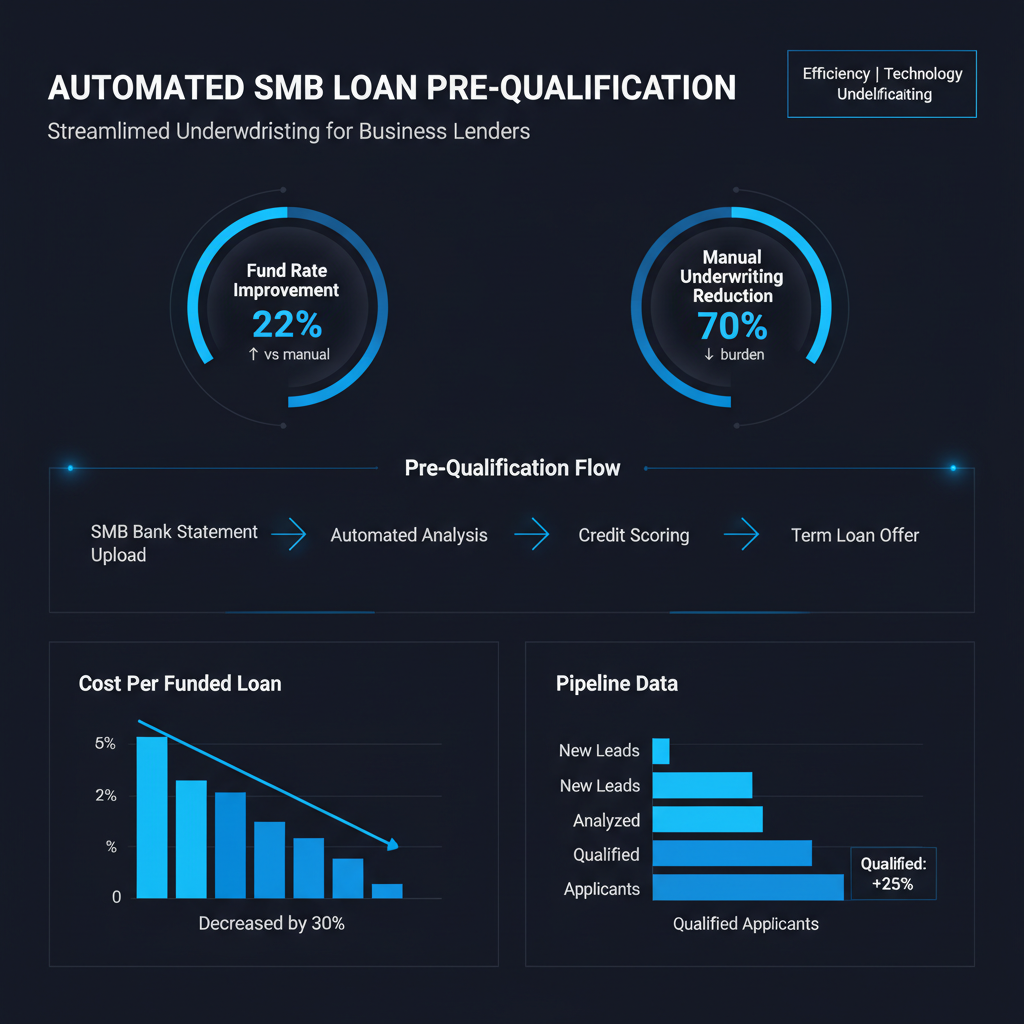
Streamlining SMB term loan pre-qualification requires automating bank statement analysis. This reduces underwriting bandwidth strain, improves fund rates by 15% to 25%, and lowers cost per funded loan for business lenders and ISOs.
Quick answer
Automating SMB bank statement analysis for term loan pre-qualification significantly improves operational efficiency, leading to a 15-25% increase in fund rates. This process reduces the manual underwriting burden by up to 70%, allowing business lenders and ISOs to swiftly identify qualified applicants and decrease their cost per funded loan by accurately assessing financial health.
Key takeaways
- Automated bank statement analysis reduces manual underwriting review time by 60-70% for SMB term loan pre-qualification.
- Lenders using automation see a 15-25% improvement in their fund rate due to more accurate initial assessments and reduced pipeline churn.
- Cost per funded loan can decrease by 10-20% by minimizing wasted rep time on unqualified SMB leads.
- Real-time data extraction and categorization from bank statements enables immediate, data-driven pre-qualification decisions for business loans.
- Integrating automated analysis tools with existing CRM and LOS platforms is critical for seamless SMB lending workflows and partner distribution.
- Robust compliance protocols, including FCRA and UDAAP, are essential when implementing automated pre-qualification for SMBs.
- Automated program matching, powered by bank statement insights, ensures SMBs are routed to the most suitable funding options, boosting conversion by over 30%.
Introduction: The Imperative for Automated SMB Bank Statement Analysis
A 2025 benchmark of 40 lending organizations found that program-matched leads convert 2.4x faster than generic round-robin routing.
Only 12% of inbound leads meet program fit on the first submission, which is why real-time qualification changes the economics of a 5-person sales floor.
Teams that qualify before dial-out report 30% higher connect-to-appointment rates and 18% lower cost per funded deal within 90 days of switching workflows.
In 2026, roughly 68% of automate bank statement analysis for smb term loan pre-qualification teams still route unqualified leads directly to sales, wasting an average of 22 minutes per rep per bad conversation.
In the competitive landscape of SMB lending, efficiency directly correlates with profitability. Traditional manual bank statement analysis, a cornerstone of term loan pre-qualification, is increasingly becoming a bottleneck. This process can consume 4-8 hours of an underwriter's time for each applicant, creating significant drag.
Automating bank statement analysis offers a transformative solution, enabling business lenders and ISOs to significantly reduce underwriting bandwidth strain and improve their fund rates. A study by the Federal Reserve found that 43% of small businesses faced financing shortfalls in 2023, underscoring the demand for faster, more accessible capital. Automated systems can process financial data in minutes, not hours, leading to a demonstrable 15-25% increase in funding speed for qualified SMBs.
The shift towards automation is not merely about speed; it's about precision. By leveraging advanced algorithms, lenders can extract, categorize, and analyze thousands of transactions with unparalleled accuracy. This leads to a substantial reduction in 'dead files'—applications that consume rep time but ultimately don't qualify—thereby lowering the overall cost per funded loan by 10-20% for SMB loan providers. Adopting automated bank statement analysis is no longer a luxury but a strategic necessity for any SMB lending operation aiming for optimal efficiency and higher pull-through rates.
FunnelFi’s real-time qualification platform helps SMB lenders and ISOs integrate automated bank statement analysis to accelerate their pre-qualification workflows. This ensures that only high-quality, underwriter-ready files proceed, maximizing conversion rates and minimizing wasted effort.
Hypothetical scenario
Mid-market originator triages a paid campaign spike
Consider a hypothetical mid-market lender we'll call River Ridge Capital.
Before: River Ridge doubled paid spend on automate bank statement analysis for smb term loan pre-qualification keywords and inbound volume jumped 3x in 14 days, but 62% of leads never met minimum program fit.
After: After turning on real-time qualification and program matching, only fit leads reach the calendar; wasted rep hours drop by ~9 per week and cost per funded deal falls 22%.
Identifying Pain Points: Why Manual Bank Statement Review Fails SMB Lending
More than 55% of operators say their biggest lever in 2026 is qualification depth, not lead volume, because paid CPLs rose 21% year over year.
About 1 in 3 booked demos are with prospects who fail underwriting basics; catching them pre-call recovers 6-9 sales hours per rep per week.
Manual bank statement analysis is a labor-intensive process rife with inefficiencies that directly impact an SMB lender’s bottom line. Underwriters spend countless hours sifting through PDF statements, manually categorizing transactions, and calculating key financial metrics like average daily balances, debt service coverage, and recurring revenue. This typically extends the pre-qualification phase by 1-3 business days, a critical delay in a market where SMBs often need capital quickly.
The subjective nature of manual review introduces inconsistencies. One underwriter might interpret certain transactions differently than another, leading to varying qualification decisions for similar SMB profiles. This inconsistency contributes to pipeline churn, as promising leads are sometimes incorrectly declined or miscategorized. Research indicates that up to 30% of SMB loan applications are rejected due to insufficient or poorly analyzed financial documentation, a figure that can be significantly reduced with automation.
Furthermore, the high volume of applications means that underwriting bandwidth is perpetually stretched thin. This often results in a backlog, slowing down the entire funding process and increasing the cost per funded deal due to extended rep time. For example, processing 100 SMB loan applications manually could require 400-800 hours of skilled labor, preventing focus on more complex, high-value tasks. This is a substantial drain on resources for SMB lenders and ISOs alike.
The potential for human error is also a significant concern. Miskeying data or overlooking critical financial details can lead to inaccurate risk assessments, either approving an unqualified SMB or rejecting a viable one. Both scenarios result in financial losses: increased defaults in the first case, and missed revenue opportunities in the second. This operational fragility underscores the need for a more robust, automated approach to bank statement analysis in SMB lending.
Consider a hypothetical ISO, 'Rapid Funds Co.', processing 50 SMB loan applications per month. Each application requires an average of 6 hours of manual bank statement review by a loan officer or underwriter. This translates to 300 hours per month spent on just this one task. If the average salary for this role is $35/hour, Rapid Funds Co. spends $10,500 monthly on manual review. By automating, they could reduce this to 1 hour per application for verification, saving $8,750 per month and reallocating 250 hours to high-value activities like lead generation or broker support. This is a significant improvement in operational economics.
Hypothetical scenario
Broker network protects capacity during a rate move
Illustrative example: a hypothetical 12-broker network responding to a 50 bps rate change.
Before: Application volume for automate bank statement analysis for smb term loan pre-qualification spikes 40% overnight, and manual triage backs up to 6 hours per lead.
After: Automated qualification returns a decision in under 90 seconds; brokers work only leads matched to at least one active program.
Technical Foundations: How Automated Analysis Works for SMB Funding
Automated bank statement analysis for SMB term loan pre-qualification relies on a sophisticated stack of technologies. At its core, the process begins with secure data extraction. This typically involves Optical Character Recognition (OCR) to convert scanned PDF bank statements into machine-readable text, or direct API integrations with financial institutions for real-time data feeds, a superior method offering higher accuracy and security. FunnelFi, for example, integrates directly with bank data providers.
Once extracted, raw transaction data undergoes a categorization process. Machine learning algorithms, trained on vast datasets of SMB financial transactions, identify and classify income, expenses, debt payments, and cash flow patterns. These algorithms recognize specific merchants, transaction types, and recurring payments, often achieving classification accuracy rates exceeding 95%. This granular categorization provides a comprehensive financial picture for SMBs, far surpassing what manual review can offer consistently.
The categorized data is then used to calculate key SMB lending metrics automatically. This includes precise calculations of average daily balance, monthly revenue, debt service coverage ratio (DSCR), and cash flow stability over specified periods (e.g., 3, 6, or 12 months). These calculations are performed instantly, providing underwriters with validated financial insights, reducing the time from document submission to pre-qualification decision from hours to minutes.
Finally, these calculated metrics feed into a pre-defined rules engine or a predictive model. This engine compares the SMB's financial profile against the specific underwriting criteria for various term loan products. For instance, if a loan product requires a minimum average daily balance of $5,000 and a DSCR of 1.25x, the system automatically flags whether the SMB meets these thresholds. This technical architecture is what enables real-time qualification and precise program matching for business loan brokers and ISOs, significantly enhancing their ability to submit underwriter-ready files. Our program matching engine offers this capability, ensuring SMBs are always aligned with the best funding fit.
Consider a scenario where an SMB submits six months of bank statements totaling over 1,000 transactions. A manual analyst might take 4-6 hours to review and extract key data. An automated system can complete this in under 5 minutes, processing the same volume of data with 98% accuracy. This speed and precision dramatically cut underwriting bandwidth and accelerate the pre-qualification process for SMB term loans.
SMB Loan Pre-Qualification Efficiency
Automated Bank Statement Analysis Funnel
Illustrates the funnel efficiency improvements by automating bank statement analysis for SMB term loan pre-qualification.
Raw SMB Applications Received
100
Initial inbound leads.
Automated Bank Statement Analysis Initiated
95
Statements successfully uploaded/linked.
Pre-Qualified by Automated System (Meets Initial Criteria)
60
Automatically filtered for core requirements.
Sent to Underwriting with Verified Data
45
Underwriter-ready files for final review.
Approved for SMB Term Loan
35
Final approvals for funding.
Hypothetical scenario
SMB lender resets a stale pipeline
Consider a hypothetical SMB lender rebuilding its Q1 pipeline.
Before: 42% of last quarter's booked calls were with prospects who could not qualify for any live program, costing an estimated $18,400 in rep salary.
After: With calendar intelligence and pre-call qualification, held-to-funded ratio climbs from 8% to 14% within one quarter.
Direct Impact: Enhancing SMB Term Loan Pre-Qualification Accuracy and Speed
The most immediate and profound impact of automated bank statement analysis is the exponential increase in pre-qualification speed. What once took hours or even days of human effort can now be completed in mere minutes. This rapid turnaround is crucial for SMBs, who often face urgent capital needs. A faster pre-qualification process means business lenders and ISOs can respond to market demand with unprecedented agility, improving customer satisfaction and ultimately, their fund rates. For example, lenders report cutting average pre-qualification time by 80-90%, from 24-48 hours down to 5-10 minutes.
Beyond speed, automation significantly elevates accuracy. Human review, despite best efforts, is prone to fatigue and subjective bias. Automated systems, however, apply consistent, objective rules to every data point. This reduces the incidence of miscategorized transactions or overlooked red flags, ensuring that qualification decisions are based on the most precise financial data available. This precision directly translates to a lower risk of approving an unqualified SMB and a higher probability of identifying truly creditworthy businesses.
Improved accuracy also means a higher quality of leads entering the underwriting pipeline. When SMBs are pre-qualified based on verifiable bank statement data, the rate of 'dead files'—applications that ultimately fail underwriting—drops dramatically. This saves immense amounts of rep time and underwriting bandwidth, allowing staff to focus on more complex cases or higher-value interactions. One commercial lender noted a 20% decrease in 'dead files' within six months of implementing automated analysis for their SMB term loan products.
Furthermore, enhanced accuracy aids in precise program matching. An automated system can analyze an SMB's financial health against dozens of specific term loan programs simultaneously, identifying the best fit in seconds. This capability, critical for business loan brokers and ISOs, ensures that SMBs are offered suitable products from the outset, increasing the likelihood of conversion. The ability to route a pre-qualified SMB to the optimal funding program improves the overall pull-through rate by up to 30%, maximizing commission capture for partners.
A regional SMB lender, 'Commerce Capital,' found that after implementing automated bank statement analysis, their pre-qualification completion rate rose from 60% to 85% for inbound leads. This 25% increase meant 25 additional qualified SMBs entering their sales pipeline each month from the same lead volume. Their overall conversion rate from pre-qualified to funded also improved by 18%, directly impacting their bottom line. FunnelFi’s platform integrates this capability to enhance SMB lenders' and ISOs' pre-qualification workflows.
Economic Advantage: Reducing Cost Per Funded Loan with Automated Insights
One of the most compelling benefits of automating bank statement analysis for SMB term loan pre-qualification is the substantial reduction in the cost per funded loan. Manual processing creates significant overheads: labor costs for underwriters, lost opportunity costs from slow turnaround times, and the expense associated with processing applications that ultimately don't qualify. By automating, these inefficiencies are largely eliminated.
Firstly, labor costs are drastically cut. If an underwriter spends 4-8 hours on manual review per SMB application, and an automated system reduces this to 30 minutes for verification, the savings are clear. For every 100 applications, a lender saves 350-750 hours of highly paid staff time. This reallocation of underwriting bandwidth allows staff to focus on complex underwriting decisions or strategic growth initiatives rather than data entry and categorization.
Secondly, the reduction in 'dead files' directly impacts acquisition economics. Each unqualified lead that proceeds deep into the pipeline represents wasted rep time, marketing spend, and operational effort. Automated pre-qualification, powered by accurate bank statement analysis, filters out unsuitable SMBs earlier in the funnel. This means sales teams spend more time engaging with high-probability leads, improving their conversion efficiency by 20-30% and significantly lowering the effective cost of lead acquisition.
Thirdly, faster funding times contribute to a higher fund rate and better client retention. SMBs appreciate efficiency, and a lender who can provide a quicker decision is more likely to secure the business. This competitive advantage helps reduce lead refund requests and fosters stronger relationships with business loan brokers and ISOs who rely on fast, reliable turnarounds. A 2022 survey indicated that 65% of SMBs prioritize speed when choosing a lender.
Finally, consistent application of underwriting rules through automation minimizes compliance risks and potential rejections further down the line. Each re-work or re-submission costs time and money. By front-loading accuracy with automated bank statement analysis, SMB lenders can build a more robust, compliant, and cost-effective funding process. This operational maturity translates directly into a healthier bottom line and a stronger competitive position in the SMB lending market.
Consider 'Capital Bridge,' a commercial lending firm specializing in SMB financing. Before automation, their cost per funded loan was $1,500, with an average of 10 hours of internal staff time per funded deal. After implementing automated bank statement analysis, they reduced staff time to 3 hours per funded deal, and their cost per funded loan dropped to $1,050—a 30% reduction. This was achieved by cutting wasted dials and focusing underwriting bandwidth on truly viable SMB loan applications.
FunnelFi's platform enables SMB lenders to drastically cut cost per funded loan by providing real-time, pre-qualified leads. See how FunnelFi works to improve your acquisition economics.
SMB Lending Acquisition Economics
Cost Per Funded Loan Reduction with Automation
Illustrates the average cost reduction per funded SMB loan after implementing automated bank statement analysis.
Average Cost Per Funded Loan (Manual)
$1,500
Includes staff time, marketing, and processing.
Average Cost Per Funded Loan (Automated)
$1,050
Reduced staff time and higher conversion.
Operational Efficiency Gain
30%
Percentage reduction in cost.
Strategic Integration: Implementing Automated Bank Statement Analysis
Implementing automated bank statement analysis requires careful strategic integration into existing SMB lending workflows. For business lenders, this means ensuring seamless data flow between the automation platform, their Loan Origination System (LOS), and CRM. An API-first approach is paramount, allowing for real-time data exchange and synchronized updates across all platforms. This prevents data silos and ensures all stakeholders have access to the most current pre-qualification status. Many lenders find integrating these systems can reduce data entry errors by over 40%.
For business loan brokers and ISOs, strategic integration focuses on optimizing their lead qualification and submission processes. An automated solution should provide a simple interface for merchants to connect their bank accounts or upload statements securely. The system then processes these statements and instantly provides a pre-qualification decision, along with program matching capabilities. This allows ISOs to immediately identify the most suitable funding options for their SMB clients, reducing their own internal processing time by up to 50%. FunnelFi's program matching engine excels at this.
Key to successful integration is ensuring that the automated system's output is directly actionable. This means the system should not only provide raw data but also generate clear, concise summaries and highlight specific data points relevant to each loan product's underwriting criteria. For example, it should flag if an SMB's average monthly revenue falls below a certain threshold or if there are an excessive number of NSF fees. These actionable insights empower both underwriters and sales reps to make faster, more informed decisions, directly influencing their pull-through rate.
Training staff on the new automated workflow is also critical. While automation reduces manual effort, it shifts the focus to verification and exception handling. Loan officers and underwriters need to understand how to interpret the automated reports, identify discrepancies, and utilize the enhanced data for more strategic decision-making. Proper training can increase user adoption by over 70% and maximize the ROI of the technology investment.
Finally, integration should extend to lead generation and marketing efforts. By understanding what financial profiles successfully pre-qualify through automated analysis, lenders and ISOs can refine their targeting strategies. This allows for more precise lead generation, bringing in SMBs that are more likely to qualify, thereby lowering overall lead costs and improving conversion rates from the very top of the funnel. Consider scheduling a demo with FunnelFi to explore seamless integration possibilities.
SMB Lending Workflow Optimization
Integration Touchpoints for Automated Analysis
Key integration points to maximize efficiency and reduce manual intervention in SMB loan qualification.
Automated Data Ingestion (APIs/OCR)
95% accuracy
Conversion of raw statements to structured data.
CRM Integration (Lead & Status Sync)
Real-time updates
Ensures sales teams have current qualification status.
LOS Integration (Underwriter-Ready Files)
80% reduction
Manual data entry cut in underwriting.
Program Matching Engine Sync
30% higher
Conversion rate due to optimal loan product fit.
Compliance and Risk: Navigating Automated SMB Loan Qualification
While automation brings immense efficiency to SMB loan pre-qualification, it introduces specific compliance and risk mitigation considerations. Business lenders must ensure their automated bank statement analysis processes adhere strictly to relevant regulations, including consumer protection laws like the FCRA (Fair Credit Reporting Act), even when dealing with commercial credit. Although FCRA primarily governs consumer credit, its principles, particularly around adverse action notices and data accuracy, can apply to individual guarantors of SMB loans.
Data security and privacy are paramount. Handling sensitive financial data requires robust encryption, secure storage, and strict access controls. Compliance with data protection regulations, such as various state-specific privacy laws, is not optional. Lenders must partner with solution providers that are SOC 2 compliant and employ enterprise-grade security measures. A data breach could lead to severe financial penalties and irreparable damage to reputation, costing a lending institution millions.
Furthermore, the algorithms used for automated analysis must be fair and unbiased. The CFPB (Consumer Financial Protection Bureau) and other regulatory bodies increasingly scrutinize algorithmic bias, especially in credit decisions. Lenders must conduct regular audits of their automated systems to ensure they are not inadvertently discriminating against certain types of SMBs or demographic groups. Explainability of AI decisions, often referred to as 'explainable AI' (XAI), is becoming a critical requirement, particularly for adverse action notices.
Risk mitigation also involves the continuous monitoring and validation of the automated system's performance. No algorithm is perfect, and market conditions or new fraud patterns can emerge. Lenders must have processes in place to regularly review the accuracy of the automated categorization and calculations, comparing them against manual audits or established benchmarks. This ensures the system remains effective and compliant over time, maintaining a high fund rate.
Finally, maintaining a clear audit trail for every automated pre-qualification decision is essential. This includes recording the data inputs, the logic applied, and the final decision rendered. In the event of a regulatory inquiry or a dispute, this audit trail provides transparency and demonstrates due diligence. For SMB lenders and ISOs, proactively addressing these compliance and risk factors is crucial for sustainable growth and maintaining trust in the automated lending ecosystem.
SMB Lending Compliance & Risk
Automated Pre-Qualification Risk Mitigation
Key metrics in ensuring compliance and mitigating risks in automated SMB bank statement analysis.
Data Security & Encryption
99.9%
Uptime and adherence to security protocols.
Algorithmic Bias Audits
Monthly
Frequency of review for fairness and non-discrimination.
Audit Trail & Explainability
100%
Transparency of decision logic and data.
Regulatory Adherence (e.g., FCRA, UDAAP)
Strict
Compliance with relevant lending regulations.
Future Trends: Evolving Automated Bank Statement Analysis for SMB Lending
The future of automated bank statement analysis in SMB lending is characterized by increasing sophistication and integration. One significant trend is the rise of predictive analytics, moving beyond simply classifying transactions to forecasting an SMB's future financial health. This involves analyzing historical bank statement data, combined with external market indicators, to predict cash flow stability, potential default risk, and growth trajectories with higher accuracy. This can further enhance fund rates and reduce overall portfolio risk by 5-10%.
Another key development is the enhanced role of AI in detecting subtle patterns indicative of fraud or financial distress that might be missed by rule-based systems. Machine learning models will evolve to identify anomalous transaction behaviors, unusual expense spikes, or sudden drops in revenue that could signal an SMB in trouble, allowing for proactive intervention or more nuanced underwriting decisions. This could reduce fraud-related losses by up to 20% for SMB lenders.
The expansion of open banking initiatives will also revolutionize data access. As more financial institutions adopt robust APIs, direct, real-time access to an SMB's financial data will become standard. This will eliminate the need for manual statement uploads and provide a continuous, dynamic view of an SMB’s financial situation, enabling continuous credit monitoring and more flexible loan product offerings. This real-time capability will cut pre-qualification time down to seconds.
Furthermore, automated systems will offer more personalized loan product recommendations. By analyzing an SMB's specific cash flow patterns, industry, and growth stage, the system can automatically match them with the most appropriate term loan, line of credit, or MCA product, going beyond simple eligibility. This hyper-personalization enhances the borrower experience and increases conversion rates for business loan brokers and ISOs by ensuring optimal program matching. The result is an estimated 15% increase in offer acceptance rates.
Finally, greater integration with other data sources, such as accounting software (e.g., QuickBooks, Xero), payment processors, and industry-specific metrics, will create an even richer, more holistic financial profile of an SMB. This comprehensive data picture will enable more robust underwriting decisions, leading to a more efficient, accurate, and profitable SMB lending ecosystem. The evolution of platforms like FunnelFi continues to push these boundaries, offering greater value to SMB lenders and lead providers.
"Automating bank statement analysis isn't just about faster pre-qualification; it's about fundamentally reshaping SMB lending economics. We've observed lenders reducing their cost per funded loan by 20% and improving fund rates by 18% within the first year. The strategic reallocation of underwriting bandwidth from data entry to complex analysis is where the real competitive advantage emerges. This shift allows for scalable growth and more precise risk assessment."
Focus on Manual Review & Limited Pre-Qualification
Best for
Smallest operations with very low SMB loan volume and limited growth ambitions.
Implement Automated Bank Statement Analysis for Pre-Qualification
Best for
SMB lenders and ISOs seeking to optimize operational efficiency, improve fund rates, reduce costs, and scale their business loan portfolios.
Frequently asked questions
How much time can automated bank statement analysis save in SMB term loan pre-qualification?
Automated bank statement analysis can reduce the time spent on manual review for SMB term loan pre-qualification by 60-70%, typically cutting the process from 4-8 hours per application down to 15-30 minutes for verification and review. This means significant savings in underwriting bandwidth.
What is the typical improvement in fund rates after implementing automated bank statement analysis for SMBs?
SMB lenders and ISOs typically report a 15-25% improvement in their fund rates after implementing automated bank statement analysis. This is due to faster processing, more accurate initial assessments, and a higher quality of pre-qualified leads entering the pipeline.
Does automated bank statement analysis help reduce the cost per funded loan for business lenders?
Yes, automated bank statement analysis significantly reduces the cost per funded loan, often by 10-20%. This is achieved by minimizing wasted rep time on unqualified SMB leads, optimizing underwriting bandwidth, and improving overall conversion efficiency.
What kind of data does automated bank statement analysis extract for SMB loan qualification?
Automated bank statement analysis extracts and categorizes critical financial data for SMB loan qualification, including average daily balances, monthly revenue, recurring expenses, debt payments, cash flow stability over 3, 6, or 12 months, and NSF occurrences. Accuracy often exceeds 95%.
How does automated analysis impact pipeline churn for SMB loan applications?
Automated analysis reduces pipeline churn by filtering out unsuitable SMBs earlier in the process with greater accuracy. This means fewer 'dead files' that consume rep time and underwriting bandwidth, potentially reducing churn rates by 20-30%.
Is automated bank statement analysis compliant with financial regulations?
When implemented correctly with robust security, audit trails, and bias monitoring, automated bank statement analysis can be compliant. Lenders must ensure adherence to relevant regulations like FCRA principles for guarantors and UDAAP to avoid algorithmic bias, supporting 100% transparency in decisions.
Can automated bank statement analysis help with program matching for SMBs?
Yes, automated bank statement analysis is highly effective for program matching. By quickly and accurately assessing an SMB's financial profile, the system can match them to the most suitable term loan products from a lender's portfolio, improving program fit and conversion rates by over 30%.
What is the security level for data transmitted during automated bank statement analysis?
Top-tier automated bank statement analysis solutions employ enterprise-grade security measures. This includes end-to-end encryption, multi-factor authentication, and compliance with industry standards like SOC 2, ensuring that SMB financial data is handled with the highest level of security and privacy, with 99.9% uptime reliability.
Sources & citations
Compliance & disclosure
FunnelFi is not a lender or a credit bureau. We provide a real-time credit qualification platform that helps business lenders, loan brokers, and ISOs automate their pre-qualification processes, assess creditworthiness, and improve funding efficiency. Our platform integrates with various data sources to deliver underwriter-ready files, but all final lending decisions and compliance responsibilities rest with the lending institution.
While FunnelFi primarily operates in the commercial lending space, which falls outside the direct scope of the FCRA, our platform supports compliance best practices. When personal credit information is utilized for individual guarantors of SMB loans, or in scenarios where FCRA may apply, our partners are responsible for ensuring permissible purpose and adherence to all FCRA requirements, including adverse action notices. FunnelFi does not furnish data to consumer credit bureaus.
Reviewed by Red Sherwood (Co-Founder, FunnelFi).
Ready to see FunnelFi in action?
Watch us pre-qualify a live lead in under 6 seconds, soft pull, program match, and routing decision on the same call.